





Now Reading: Here’s a peek into the cliche yet memorable scenes we see every Filipino Teacher’s Day
-
01
Here’s a peek into the cliche yet memorable scenes we see every Filipino Teacher’s Day
Here’s a peek into the cliche yet memorable scenes we see every Filipino Teacher’s Day

“Ayan na si Ma’am! Magtago na kayo!”
“Nasaan na ’yong cake?”
“Bilisan niyo, baka makita ni ma’am!”
“May tape ba kayo?”
“Guys, ready na ba lahat?“
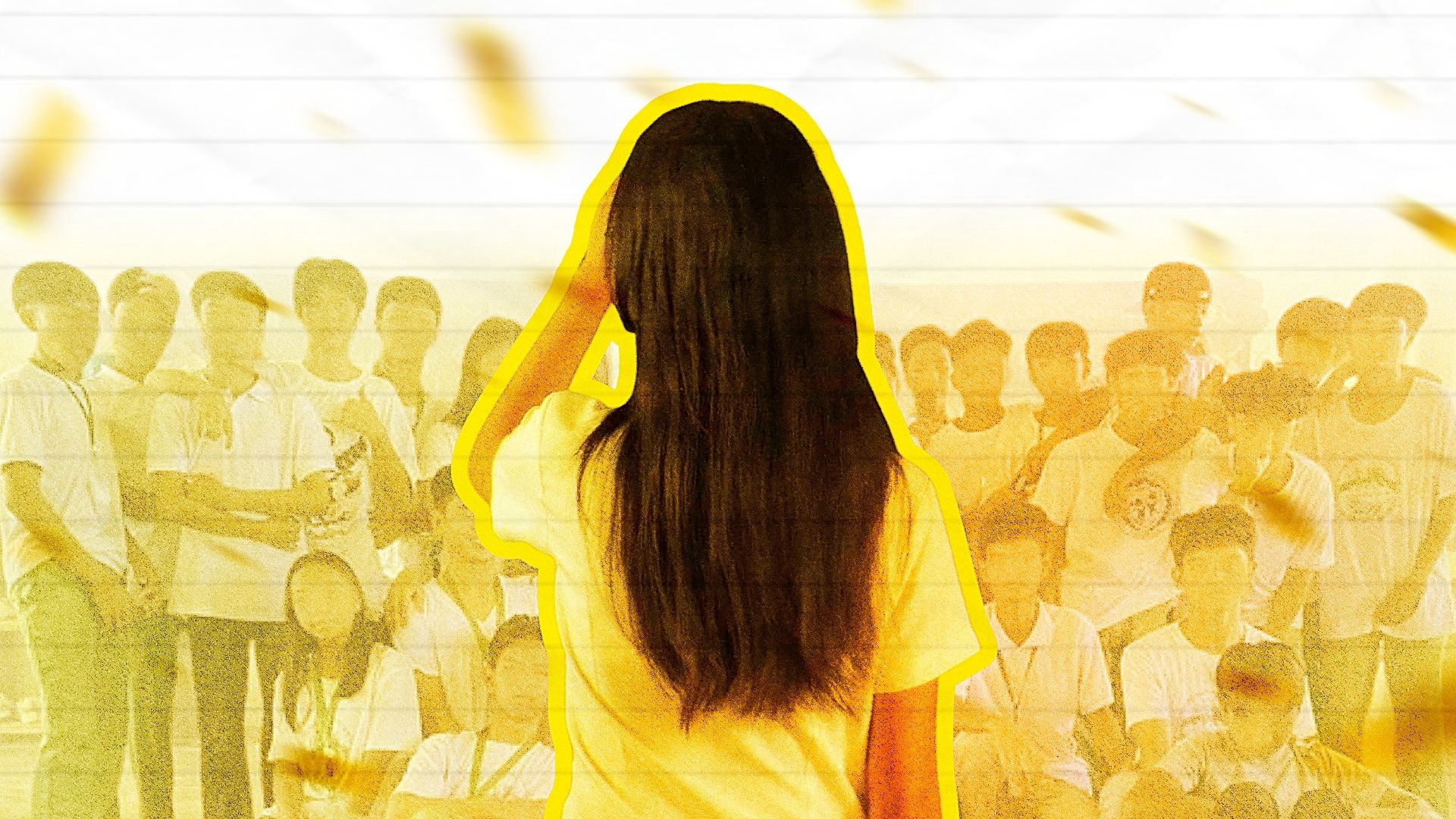
These are the words one might hear echoing from their classmates in their classroom every Teacher’s Day in the Philippines. They are spoken in hurried whispers and nervous laughter as students scramble to hide bouquet flowers, tuck simple yet meaningful gifts underneath tables and armchairs, and finish assembling the red-themed balloons and decorations before the teacher arrives.
The blackboard, which we use to solve mathematical problems, write reminders, and list the noisy students, is suddenly covered in calligraphy. The armchairs are pushed aside to make room for a surprise while someone is always stationed by the door, keeping watch for the one person who must not see what everyone has been preparing.
For a few minutes, an ordinary classroom becomes a carefully guarded secret.
It is a familiar scene, one that seems to return every year with a different section and batch of students but have almost the same set of rituals. As time passes, these little practices become more than simple surprises; they become part of the collective memory of being a student and a highly treasured heart-touching scenario for our mighty teachers.
Teacher’s Day may come only once a year, but it creates a rare moment when the usual rhythm of school pauses. For one day, the classroom is not only a place for lessons, examinations, and deadlines. It becomes a space where students gather to remember the people who have spent the rest of the year making sure they are guided, empowered, and nurtured.
Thus, with a day that is specially made to tell our teachers how we appreciate them and the wisdom they impose upon us, here are the memorable and nostalgic scenarios that we often hear and see amidst the chaos of Filipino classrooms during Teacher’s Day.
When enthusiasm starts with hushed morning plans
“Guys, early tayo bukas ha!”
Long before the teacher arrives, the preparation has already begun. The class group chat becomes a planning room filled with questions about who will logistically bring and buy the cake, who will handle the decorations, who will prepare the thank you letters, and who will make sure that no one accidentally reveals the surprise.
Students who normally arrive just before the bell suddenly agree to meet while the school is still quiet. They are carrying bags filled with balloons, cartolinas, ribbons, flowers, and other things that must remain hidden until the right moment.
Before the teacher arrives, the classroom is already a different place. Chairs are moved, decorations are carefully arranged, and someone inevitably finds themselves standing on a chair to fix a piece of decorative paper that refuses to stay in place on the ceiling.
And with everyone’s heart pumping aggressively loud because of a mix of nervousness and excitement, footsteps are finally heard outside the room. This is followed by the familiar warning to hide everything.
Yet beneath the chaos is a simple intention from the students to give a teacher one morning that feels different from all the others.
The short heart attack that comes with a staged commotion
“Ma’am, may nagsusuntukan po sa classroom!”
Here comes the most familiar acting performance of Teacher’s Day—one worthy of a standing ovation.
Two students suddenly appear to be in conflict—one may deceptively punch or slap another wherein voices are raised, expressions become serious, and the rest of the class tries its hardest not to laugh. A classmate may be asked to come outside and find wherever the teacher or the class adviser is to make them rush to the classroom immediately.
Then, at the right moment, the tension suddenly disappears. The whole staged argument turns into a light set of laughter, the room erupts into almost unending applause, and the teacher is greeted by a chorus of “Happy Teacher’s Day po, ma’am/sir!”
Perhaps it is a predictable move, but its familiarity is exactly what makes it nostalgic. Every batch seems to have its own version of the same little performance, creating a memory that students will eventually recognize when they see another class doing it years later.
A song for the year-long guidance and life-long lessons
“Ang awiting ito’y para sa ‘yo…” With those familiar words from Yeng Constantino’s Salamat, the classroom seems to shift into a different kind of silence.
The laughter settles, the rehearsed surprise finally unfolds, and every student turns toward the teacher who, only moments ago, thought it was just another ordinary school day. The song carries what cannot always be said in the middle of a busy school year. Every line contains the gratitude behind every lesson, every reminder, every correction, and every moment when a teacher chooses to stay patient with every student who is treated like their own child.
The voices may not always be in tune, some students may forget the lyrics, and others may laugh halfway through because the emotion suddenly feels too real, just to hide the tears forming in one’s eyes.
However, when the final words of gratitude are sung, the imperfections no longer matter. What remains is the sound of an entire classroom trying, in its own little way, to say salamat—a single and simple word yet something that would make our dear teachers teary-eyed. This is because at last, after days of sleepless nights to finish their lesson plans, presentations, encoding their students’ grades, and reminding them of their missing outputs, their efforts have been recognized.
It is not because one song could ever repay everything a teacher has given, but because sometimes, the simplest way to remember someone is to let the whole room sing for them.
To the small gifts that means the world to them
“Maliit na bagay lang ito, Ma’am/Sir. Pero sana magustuhan mo…”
The song eventually gives way to another familiar tradition: flowers, stuffed toys, cakes, and handwritten cards carefully placed into a teacher’s hands—all given from the heart.
Some are wrapped with ribbons, while others are handed over with shy smiles and nervous laughter. Behind every given gift is a student who remembered, prepared, and thought of their teacher even before the celebration began.
Because these gestures were never really about their price. A flower matters because someone remembered to bring one; a handwritten card becomes special because someone took the time to write what could not be said aloud; a box of chocolates becomes meaningful because it is a little sweetness offered in return for all the lessons they have shared and taught us.
They may be simple things, but on a day meant to make teachers feel remembered, sometimes, the smallest gestures fill the heart and become the ones worth keeping.
It is not just any other day
Teacher’s Day lasts only a day.
The balloons eventually lose their air, the cake is eaten, the flowers begin to wilt, the gifts are brought home, and the decorations are taken down. The board is erased and prepared for another lesson, returning the classroom to its familiar rhythm as though nothing extraordinary had happened.
Indeed, it was never meant to last forever. The decorations were temporary, the surprise lasted only a few minutes, and the song eventually ended. What remains is the memory of having made someone feel valued, even if only for one day.
Years from now, students may forget the exact design of the board or the flavor of the cake. They may forget who brought the flowers or who was assigned to watch the hallway. But they may remember the whispered warnings, the hurried preparations, the staged argument, the laughter after the surprise, the flowers placed carefully into their teacher’s hands, and the familiar melody of songs filled with gratitude and thanks dominating the classroom.
Perhaps Teacher’s Day is only one day marked on the calendar, but gratitude should never be. We do not have to wait for October to bring flowers, write cards, or give gifts to the people who spend their days shaping us.
Sometimes, appreciation looks simpler: listening intently in class, doing our best, respecting their time, and becoming diligent students who make their lessons worth teaching. Because beyond the classroom, teachers are helping build the minds, values, and dreams that will one day build our nation.
To our teachers, the celebration may be for you today, but you deserve to be seen, thanked, and celebrated in every single day that follows.