




Now Reading: HIDDEN NUMBERS: S&T devt under PBBM admin shows illusive data
-
01
HIDDEN NUMBERS: S&T devt under PBBM admin shows illusive data
HIDDEN NUMBERS: S&T devt under PBBM admin shows illusive data

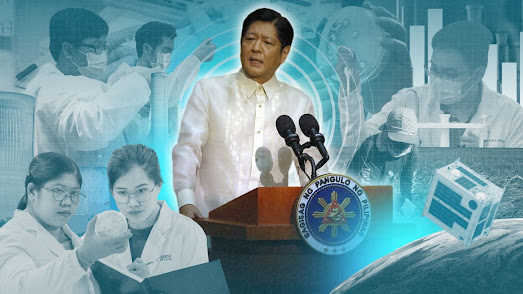
As Marcos Jr. assumed the presidency in 2022, there was a renewed push to harness the power of science and technology as a tool for nation-building—anchored on the initiatives of the Department of Science and Technology (DOST)—amid the shaky foundation of science and technology (S&T) in the country.
During his first State of the Nation Address (SONA), President Ferdinand “Bongbong” Marcos (PBBM) recognized the vitality of a strong Science, Technology, Engineering, and Mathematics (STEM) foundation in producing globally competitive learners, eyeing the expansion of research and development (R&D) in the country.
“I assure you the full support of my administration to research institutions and emphasize the need for the government to provide direction in determining the necessary R&D needed for the country’s economic transformation,” said Marcos Jr.
S&T in Motion
The administration this 2025 has placed greater emphasis on institutional and budgetary support for research and development.
An allocation of Php 8.8 billion for Department of Science and Technology (DOST) Grants-In-Aid (GIA) Program for 2025 is the highest in recent years, which will fund the continuation of its existing programs and accelerated research in agriculture, health, climate science, and industrial innovation.
To make the ambitions possible, DOST continues to offer scholarships and support for smart classrooms. In 2024, the 21st Century Learning Environment Model (CLEM) was launched in CALABARZON, designed to develop 21st-century skills among students, including creativity, collaboration, communication in science, and critical thinking through innovative learning practices and a conducive physical environment.
Programs like the Balik Scientist Program have regained government support. The initiative addresses both the country’s persistent brain drain and its shortage of research personnel by offering incentives to encourage Filipino experts abroad to return and serve.
Relevant to that, PBBM pledged to seek funding for the recent proposal of DOST, which aims to build a research and development institute in the field of virology. It will provide the country with its own Virology and Vaccine Institute of the Philippines (VIP) to build resilience against the possible emergence of novel viruses in the future.
Moreover, the current administration also recognized the vulnerability of the country to various disasters. To scale up disaster risk reduction, the Disaster Response Command Center, which shall serve as the central hub for the government’s disaster response efforts, was launched last 2024.
The country has also launched two additional satellites into space in 2023 that will track weather, predict storms, evaluate soil and water supplies, analyze shifts in population, and be used for traffic management, geo-hazard mapping, and risk assessment.
In addition, the yearly toll of El Niño and drought was also taken into account. During the SONA 2024, numerous solar-powered irrigations were recognized, which are all designed for drought resilience and ensure water security for the people, especially in the underserved areas.
From SONA 2022 to SONA 2024, there is a noticeable emphasis on renewable energy transition. In 2022, PBBM claimed that the use of renewable energy is at the top of his climate agenda.
Every year, the numbers of renewable power plants are growing, varying from hydropower, geothermal power, wind, and primarily, solar. Apart from those, PBBM aims to comply with the International Atomic Energy Agency (IAEA) regulations for the country’s nuclear power plant.
Behind the numbers
While the Philippines continues to be one of the many emerging economies in the world, its advancements in science and the innovation capability remain modest, characterized by a steady increment amid long-standing gaps to be filled in the R&D field.
Ranking 53rd among 133 countries on the 2024 Global Innovation (GI) index, its placement among other countries has been teetering between above and below average global median since 2022, under Marcos Jr’s administration, yet still able to keep up with the pace of its neighboring countries.
“The Philippines has ranked third among 38 lower-middle-income economies, following India and Vietnam, as it maintained its 5th place among ASEAN members, and it is also one of the middle-income economies that have made the most significant ranking improvements since 2013,” reported the World Intellectual Property Organization (WIPO).
Despite the achievement, significant gaps persist as spending for homegrown innovation and development, a crucial innovation sub-pillar, consistently remains far below the global R&D expenditure average of 2.04% and the recommended UNESCO 1% benchmark since 2018, only constituting 0.32% of the gross domestic product, even failing to reach the 0.40% target of Philippine Development Plan for 2024.
This contrasts sharply with the R&D spending of its neighboring southeast Asian countries; 2.2% expenditure average from Singapore, 1.2% from Thailand, and 0.2% from Malaysia.
WIPO has also shown concerning data from 2022 to 2023 of a 7.7% decline in science publication and a sharp 72.7% decline on international patent filing.
It is worth noting that the international patent filing has been worse since 2013 with a staggering decline rate of 12.9%, citing a hurdle left unchecked in weak research commercialization, a gap in research implementation from laboratories, and innovation policy gaps.
“Increasing the number of highly trained professionals in science and technology is crucial for enhancing the country’s global competitiveness,” said the Philippine Council for Agriculture, Aquatic, and Natural Resources Research and Development’s (DOST-PCAARRD) executive director Dr. Reynaldo V. Ebora as a recent statistic on the number of R&D researchers in the country is yet to meet the global benchmark.
Ebora revealed there are 270 researchers, scientists, and engineers (RSEs) per million population in the country, a considerable increase from the reported 174 researchers per million in 2022, yet still failing to meet the UNESCO benchmark of 380 RSEs per million population.
While innovation creation remains shaky, the Philippines ranks as the top global technology exporter as a percentage of total trade particularly in computers, scientific instruments, and electrical machinery, surpassing its competitive neighbors, such as Malaysia and Singapore.
Two truths can exist with the statistics: global partnership in industrial support and dependent foreign innovation being reliant on services and work.
The country is considered a global partner for electronics assembly and export with solid manufacturing infrastructure, skilled labor for precision assembly, and logistics capacities in electronics.
Yet, the country has been dependent on foreign innovation to compensate for its low innovation rate as it is reliant on low-margin human services and assembly work from imported materials.
Ranking the sySTEM
K-12 has led to various possibilities in fostering students’ skills and abilities. It continues to develop young minds in building a foundation for future success and generations. This curricular program—includes kindergarten, grade school, and high school—has become a path to each student’s achievement.
Furthermore, the Manila Bulletin acknowledged that it has been evident over the years, despite deceptive encounters.
Giving emphasis to senior high school strands such as Accountancy, Business, and Management (ABM), Humanities and Social Sciences (HUMSS), General Academic Strand (GAS), and other strands, STEM has gained attention in terms of assessing students’ learning capabilities, as it aligns with major educational subjects.
In the assessment of the 2022 Programme for International Student Assessment (PISA), the Philippines was ranked 77th out of 81 participating countries—below average in the fields of science, math, and reading.
The result indicates the country among the lowest-performing countries, highlighting the need to take significant improvements and develop a call to action.
During the SONA 2022, PBBM concluded a statement regarding the development of the country’s ranking of the senior high school strand STEM.
“These skills and knowledge are necessary for our young people to be able to compete in a highly technological and competitive world. The raw talent is there in our young people,” said President Bongbong Marcos.
Marcos implied that enhancing the STEM program will aid future gain and education allowing the country to stand worldwide.
In spite of the statement concluded by the president, the present state became more alarming than many expected, and what the future holds is vulnerable.
PHorward with S&T
As various research and development initiatives in science and technology continue, this has become living proof that the Philippines has yet to evolve in comparison to other countries.
Statistics could not hide the fact that the country will take long to recover from years of stunted and systematically underdeveloped S&T state—a situation challenged by the prospects of a tech-driven future pushed by the government.
For the latter half of the current administration’s term, there is more to be accomplished from its roadmap—persistent gaps to bridge through sustained and synchronized efforts, community involvement, and a culture that values research and innovation.
This is not the end of an initiative, but rather a condition of advocacy to be evaluated.