





Now Reading: COLUMN | Road to repression
1
-
01
COLUMN | Road to repression

Kirsten Flores
Hand-in-hand, the force of advocacy groups, youth, and marginalized sectors has marched for the attainment and enjoyment of society’s fundamental rights and privileges.

Historically, the EDSA People Power Revolution of 1986 was the catalyst that unfolded the vestiges of democracy that Filipinos live with today. It is proof that when citizens stand united, even the most entrenched dictatorship can be toppled by the power of collective action and civic courage.
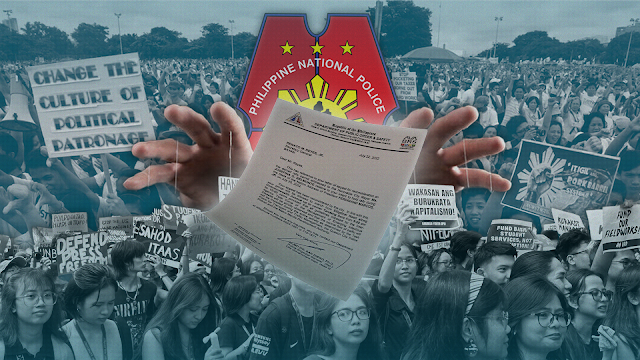
However, the recent ‘No Permit, No Rally Policy‘ advisory of the Philippine National Police (PNP) and the Armed Forces of the Philippines (AFP) red alert status supersedes the ignited demands and outrage of the public in grasping accountability and the rightful government services that taxpayers deserve. By attempting to strictly enforce a permit system for public assemblies and heightening security protocol, the government is not merely maintaining order; it is prematurely stifling dissent, which echoes the very tactics that people rose against nearly four decades ago.
Martial Law silenced many voices through censorship, unjust arrests, and state violence. Today, though we no longer see tanks in the streets or stringent curfews blanketing the nation, policies like this serve as a reminder that the road to repression does not always begin with an intemperate admonition. For sometimes, it starts with a piece of paper, a bureaucratic rule that slowly chips away at our right to speak and assemble.
Maintaining “peace and order,” as the PNP states, dangerously blurs the line between safety regulation and political suppression. It suggests that the state sees public dissent not as a democratic right, but as a threat to its authority. This is deeply troubling when viewed alongside the historical revisionism that has tried to sanitize the legacy of Martial Law, portraying it as a so-called “Golden Era” rather than an era of atrocities.
The timing of this advisory cannot be ignored. As the nation prepares to rekindle our collective memory, the current administration is complicit in efforts to repress one of the darkest chapters of our history and silence those who dare connect the injustices of the past with the unresolved issues of corruption, politics, budgetary restraints, and injustice today.
Corruption and injustice are carried out without permission, so why must the public tend to paperwork to set forth their disappointment? This hypocrisy underscores the danger of a government more concerned with modulating dissent than addressing the grievances that fuel it.
This crackdown on assembly further shakes the already fragile public trust. From the misuse of what amounts to ₱42.3 billion to ₱118.5 billion in infrastructure funds to questionable procurement deals, we bear witness to revelations of not isolated incidents, but systemic failure of governance that continues to drain resources meant for education, health care, and poverty alleviation.
In such a climate, mass mobilizations are not just merely symbolic gestures; they are a necessary form of public accountability. When those in power fail to police themselves, citizens are rightfully vested to take to the streets to demand transparency and justice, uphold the system of checks and balances, and keep the state committed to their duty to act as a bridging mechanism toward a life of dignity.
At its core, this issue is about who truly owns democracy. The people? Or the state?. Democracy cannot thrive in fear and silence. Protests are not acts of chaos to be contained but lifelines of collective autonomy. The EDSA Revolution did not happen because people secured permits; it happened because citizens mobilized even the privileged middle class and reclaimed their sovereignty when those in power had lost all legitimacy.
The right to protest is not a privilege bestowed by the state and therefore cannot be redacted by it. It is enshrined in the Universal Declaration of Human Rights (UDHR) and Article III, Section 4 of the 1987 Philippine Constitution. This global declaration and constitutional guarantee make it clear and codified that such permits should never be wielded as weapons of repression. Additionally, the Public Assembly Act of 1985 (Batas Pambansa Blg. 880) requires permits for rallies primarily to coordinate logistics and maintain public safety, not to serve as a tool for silencing critics. Even under this law, authorities are not allowed to deny permits arbitrarily, nor should they interpret the process as a way to block demonstrations that are critical of the government.
Our past warns us that authoritarianism does not return overnight. It creeps in quietly, through policies and practices that monopolize power, normalize control, and force obedience. Thus, we must remain vigilant. The PNP’s advisory and AFP’s red alert measures may seem procedural or even harmless, on the surface. But in reality, it is a red flag signaling a regression toward a state that denigrates its people instead of serving them.
If our government can freely act without transparency while citizens are forced to navigate bureaucratic hurdles just to protest, then democracy itself is at risk. Genuine peace and order are achieved only by addressing the root causes of public unrest.
The road to repression begins with silence and connivance. The road to freedom, however, begins with courage. As the anniversary of the proclamation of Martial Law nears and as we continue to be wronged by public servants, the Filipino people must choose courage. Let us march, speak, and write not because we were granted permission, but because it is our right and our figh
Related Posts


Previous Post
Next Post

Loading Next Post...
Popular Now


Scroll to Top