









Now Reading: PTI unveils Palawan’s giant-mouthed pitcher plant
-
01
PTI unveils Palawan’s giant-mouthed pitcher plant

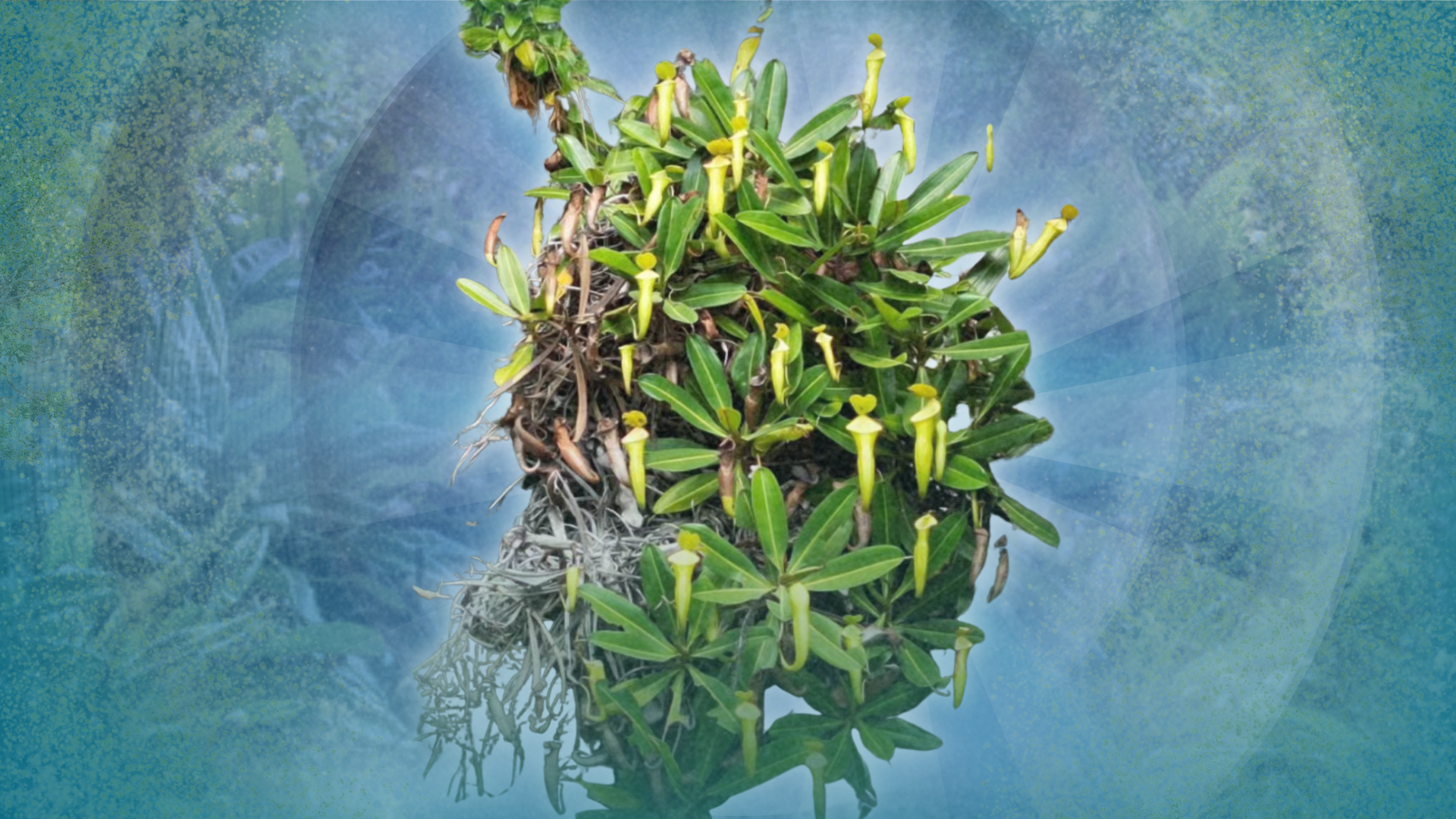
Hidden in the soaring karst walls of the United Nations Educational, Scientific and Cultural Organization (UNESCO) Heritage Site, the Palawan’s Puerto Princesa Subterranean River National Park, a quiet mighty marvel has been waiting—clinging to stone, staring into the sun, and feeding on whatever fate drops into its trap.
After years of delayed climbs and expeditions, an unfamiliar plant seen by scientists peering at their binoculars in 2013 was finally identified. Once mistaken for a known species—Nepenthes campanulata, a bell-shaped pitcher plant native to Borneo and also found in parts of Palawan which is known for its small, compact pitchers—it turned out to be something far rarer, stranger, and entirely new to science.
The Philippine Taxonomic Initiative (PTI) has recently unveiled Nepenthes megastoma, a previously known pitcher plant, or a carnivorous pitfall trap with a prey-trapping mechanism found only in the Puerto Princesa Subterranean River National Park, particularly in the Mount Saint Paul karst formation.
“It is distinguished by its strongly branching growths, bell-shaped (campanulate) pitchers, and peltate tendril (a shield-like structure) attachment,” the researchers wrote.
The new species differs mainly in size and growth habit. True to its name, the species bears a strikingly wide “mouth” or pitcher and strongly branching stems that can reach up to 2.8 m long and 1.2 cm in diameter, making it different from N. campanulata of Borneo—an existing pitcher plant species in Palawan and the tentative assumption of scientists back in 2013.
The further fieldwork of PTI also described the N. megastoma with a unique growth strategy, growing vertically and dangling in formation, looking like a chandelier mounted on the karst limestone formation of the UNESCO Heritage Site, tens to hundreds of meters above ground level.
Researchers also noted unusual biological characteristics, including two distinct forms of upper pitchers—one stout and flaring, the other slender and elongated.
Moreover, its stems and pitchers are coated with a dense mixture of stellate hairs and peltate scales, which are both hair-like outgrowths on plants, which scientists believe may help regulate moisture and improve water retention, allowing the plant to survive intense heat and prolonged drought on exposed rock surfaces. These characteristics are believed to be its mechanism of survival during the extreme dry season that sweeps through central Palawan every year.
However, the field exploration also found the vulnerability of N. megastoma. Typhoon Rai (Odette) in 2021 tore plants from the rock face, leaving behind dark scars where decades-old clumps once hung. Rangers also reported sightings of illegally collected individuals being sold in Manila—indicating that poaching also reached the small population of this big-mouthed pitcher plant.With its extremely small population, amounting to 19 mature clumps and 12 non-flowering likely young (putative juvenile) plants, the research concludes that Nepenthes megastoma satisfies the IUCN (International Union for Conservation of Nature) 3.1 Red List CR (Critically Endangered) criteria.