










Now Reading: At your service, not at your mercy
-
01
At your service, not at your mercy

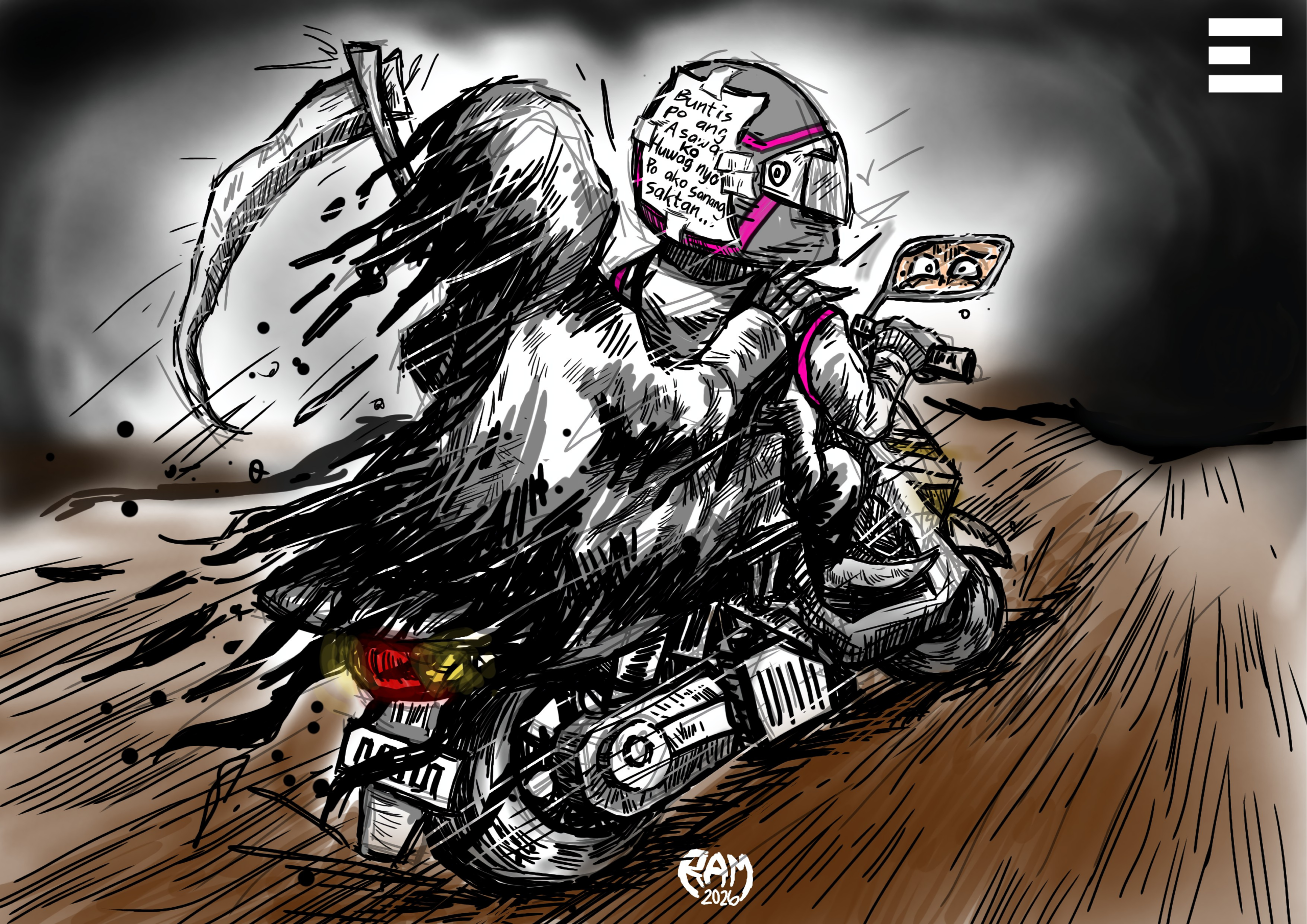
Motorcycle taxi riders wear helmets for the same reason every motorist does: to protect themselves on the road. But one rider recently carried another form of protection on his helmet — a handwritten message addressed not to traffic, but to people.
“Buntis po ang asawa ko. Huwag n’yo po akong saktan.”
The message quickly circulated online after a motorcycle taxi rider wrote those words on the back of his helmet, days after another rider was fatally stabbed by a passenger in Caloocan City on July 14. Fear alone explains why someone would write those words. What deserves equal attention, however, is why the rider believed those particular words might protect him.
Why did he feel the need to explain why his life matters?
The message reflects an expectation that compassion is more likely to come when people know who depends on us. Rather than asking to be spared as another human being, the rider presented himself through someone waiting for him at home; his unborn child became part of his appeal for mercy.
Every worker carries a life beyond the service they provide. Motorcycle taxi riders spend their days transporting passengers from one destination to another, but every completed booking is also a step toward responsibilities invisible to those they serve — some return to children, others support aging parents, save for tuition, or shoulder household expenses that begin even before the engine starts and continue long after it is turned off. These realities exist whether strangers know them or not.
Yet the helmet suggests that humanity alone no longer feels persuasive enough.
The same pattern appears beyond one rider or one profession. Many forms of work place people in positions where they are seen primarily through the service they provide. Customers remember waiting times, fares, deliveries, and transactions more easily than the individuals behind them. In everyday interactions, this mindset sometimes develops into a troubling belief that paying for a service also grants authority over the person providing it.
Payment settles a transaction and does not diminish another person’s dignity.
A motorcycle ride may be booked, a parcel delivered, or a meal served, but none of these exchanges suspend the respect owed to the individual performing the work. Behind every completed booking is a rider navigating congested roads, unpredictable weather, and the constant pressure to maximize every hour on the road to earn enough for a day.
For many motorcycle taxi drivers, declining a trip is not always a practical choice when each booking helps pay for fuel, vehicle maintenance, and the needs oft he family waiting at home. Their work already demands that they accept the everyday risks of traffic. It should never require them to fear becoming victims of violence simply for showing up to work.
The vulnerabilities they face reach beyond the road itself. As gig workers, many motorcycle taxi riders shoulder most operating costs while working without the compromise labour protections available in traditional employment. A study by the University of the Philippines National Center for Transportation Studies pointed to the need for stronger policies that address not only road safety but also the occupational hazards and legal uncertainties surrounding the industry. The recent attacks against riders expose another danger that no amount of skill, discipline, or experience can prepare them for: the possibility that the next passenger may not simply be a customer, but a threat.
Workers are often spoken to with impatience, blamed for circumstances beyond their control, or treated as though courtesy becomes optional the moment money changes hands. When respect is viewed as part of the service rather than as a basic obligation between people, it becomes easier to forget that every worker is living a life as complete and complex as our own. And that is why the rider chose to reveal something deeply personal — because he believed it would make his humanity more visible.
A person’s dignity should not depend on whether they are someone’s spouse, parent, or provider. Those relationships remind us that a life is connected to others, but they do not create its worth. Human life deserves protection before its story is told.
The questions raised by this incident deserve to remain long after the public attention fades. Crimes that dominate headlines often disappear from conversation within days, replaced by newer stories competing for the same space. Psychological research has found that repeated exposure to violent news can contribute to desensitization, gradually reducing emotional responsiveness and the sense of urgency people attach to similar events. Each time violence becomes easier to scroll past, it also becomes easier to accept as another unfortunate reality rather than a problem demanding sustained attention.
The incident also draws attention to the place motorcycle taxi riders now occupy in everyday life. They transport students rushing to class, employees trying to reach work on time, patients seeking medical care, and families sending essentials across the city. Their work has become woven into the country’s urban mobility, yet discussions surrounding the industry remain largely focused on efficiency, affordability, and expansion. The welfare of the people who make those services possible rarely receives the same level of attention. As reliance on motorcycle taxis continues to grow, protecting the workers behind the service should be regarded as a public concern rather than an individual burden.
The words written across that helmet belong to a society where ordinary workers increasingly feel compelled to explain why they deserve to return home at the end of the day.
The arrest of the suspect offers the victim’s family a measure of accountability, and the legal process must run its course. Even so, the responsibility to respond to this tragedy does not rest with the courts alone. Every incident of violence invites a broader reckoning with the conditions that allowed fear to become so ordinary that a rider believed a handwritten plea might offer more protection than silence.
Justice carries a responsibility that reaches farther than the verdict. It should ask whether workers can leave for work without feeling compelled to justify their own humanity, whether public attention remains long enough to demand meaningful change, and whether the lessons of one tragedy become the safeguards that prevent another.
If humanity must first be accompanied by a personal story before it is recognized, the tragedy leaves us in a deeper question: Have we begun to see compassion as something earned rather than something every person deserves? Until that question no longer needs asking, the words written across that helmet will remain an indictment rather than a plea.