







Now Reading: COLUMN | Building tomorrow on shaky foundations
-
01
COLUMN | Building tomorrow on shaky foundations


Aaron Inciong
“We are not building only for today; we are building also for tomorrow[…]”
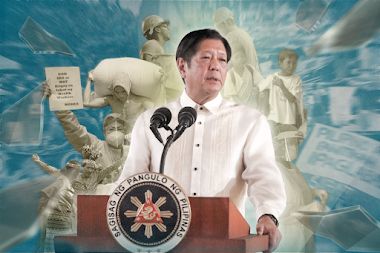
This was one of the quotable lines from President Marcos Jr.’s fourth State of the Nation Address—a polished, future-facing declaration that tries to promise continuity, stability, and vision.
But in the context of this year’s SONA, it is a line meant to stir hope, the words ring hollow, revealing that the foundation of the future remains weak, performative, and exclusionary.
Because if we are truly building for tomorrow, why is education—the most powerful tool for shaping the future—still being treated like an afterthought?
President Marcos mentioned the ARAL Program, early childhood development, and even increased funding for students’ education. These are welcome, long-overdue measures—but they are not enough.
He also highlighted digital enhancements: plans to connect 12,000 schools by 2025, distribute laptops to all public school teachers, and provide over a million SIM cards with free data. Wi-Fi locations increased from 4,000 in 2022 to nearly 19,000.
These are steps, not strides—and rarely solutions.
In order to free teachers from bureaucracy, he also promised to pay them overtime, digitise more bureaucratic forms, and eliminate about 100 pointless paper documents.
He set a goal to construct 40,000 more classrooms by 2028, loosened regulations, and created 60,000 new teaching positions.
But even these, impressive on paper, miss the heart of the crisis: are students actually learning? While infrastructure and digital tools matter, they do not guarantee learning.
What about the educators who serve as each child’s educational scaffold? Chronic burnout, excessive class sizes, and a lack of professional assistance cannot be made up for by overtime compensation.
We hand them outdated modules, broken chalk, and overflowing classrooms while expecting them to do miracles. Treated like footnotes in our national plan, our teachers are country builders, not only policy implementers.
Even with Wi-Fi, if a student struggles with reading comprehension, you will still lose the opportunity to use it to teach them something worthwhile. Even if teachers are given laptops, the resources are wasted if there is inadequate training or if lessons aren’t aligned with what’s actually being taught.
Education in the Philippines is in crisis, and the statistics are stark. A startling 91% of Filipino children, aged 10, cannot read and understand basic texts, a condition the World Bank calls ‘learning poverty.’
According to EDCOMM II’s year two report, most grade 3 students are already one to two years behind expected reading and math levels. 24,000 public schools lack principals; 62% of high school teachers teach outside their field, and basic education receives one of the lowest budget shares despite its foundational role.
What’s the point of rising enrollment if learning remains abysmal? This is especially glaring in the 2022 PISA results, where the Philippines ranked 77th out of 81 countries in reading, math, and science. In creative thinking, we ranked second to last, scoring 14 compared to the OECD average of 33.
These numbers aren’t abstract—they reflect classrooms with students staring at textbooks but not comprehending them, students counting on fingers long past grade school, graduates who can pass exams but struggle with real-world problems.
We are not failing to build the future—we are failing to build the builders of the future.
We are producing graduates, yes—but we are not necessarily producing learners. The diploma has become a finish line, not a proof of mastery.
Year after year, we’re told reforms are coming. But good intentions don’t lift reading scores. Action does.
There comes a point when speeches no longer suffice. We don’t need more declarations of intent. We need urgency. We need implementation.
To be clear, no one expects education to crowd out other pressing concerns. Our nation faces urgent problems across sectors—food, public health gaps, infrastructure, disaster preparedness, and even transportation.
But education intersects with all of them. It shapes the minds that will govern, heal, invent, farm, and lead. To neglect it is to compromise progress on every other front. To underfund it is to abandon the very future we claim to be building.
If the administration is serious about building the future, it must confront the full truth about today’s education crisis—not just with numbers, but with depth, urgency, and follow-through. Tomorrow cannot be built on promises alone.
It must be built on comprehension, competence, and commitment—starting in every classroom, today.
Classrooms are the frontlines of the future. Until we fix what’s broken inside them—until learning is no longer a privilege but a guarantee—no vision of tomorrow will stand. We cannot keep constructing promises on crumbling comprehension. The blueprint must change. The foundation must be learning.