





Now Reading: Making way
-
01
Making way

Every road begins by asking something to move aside.
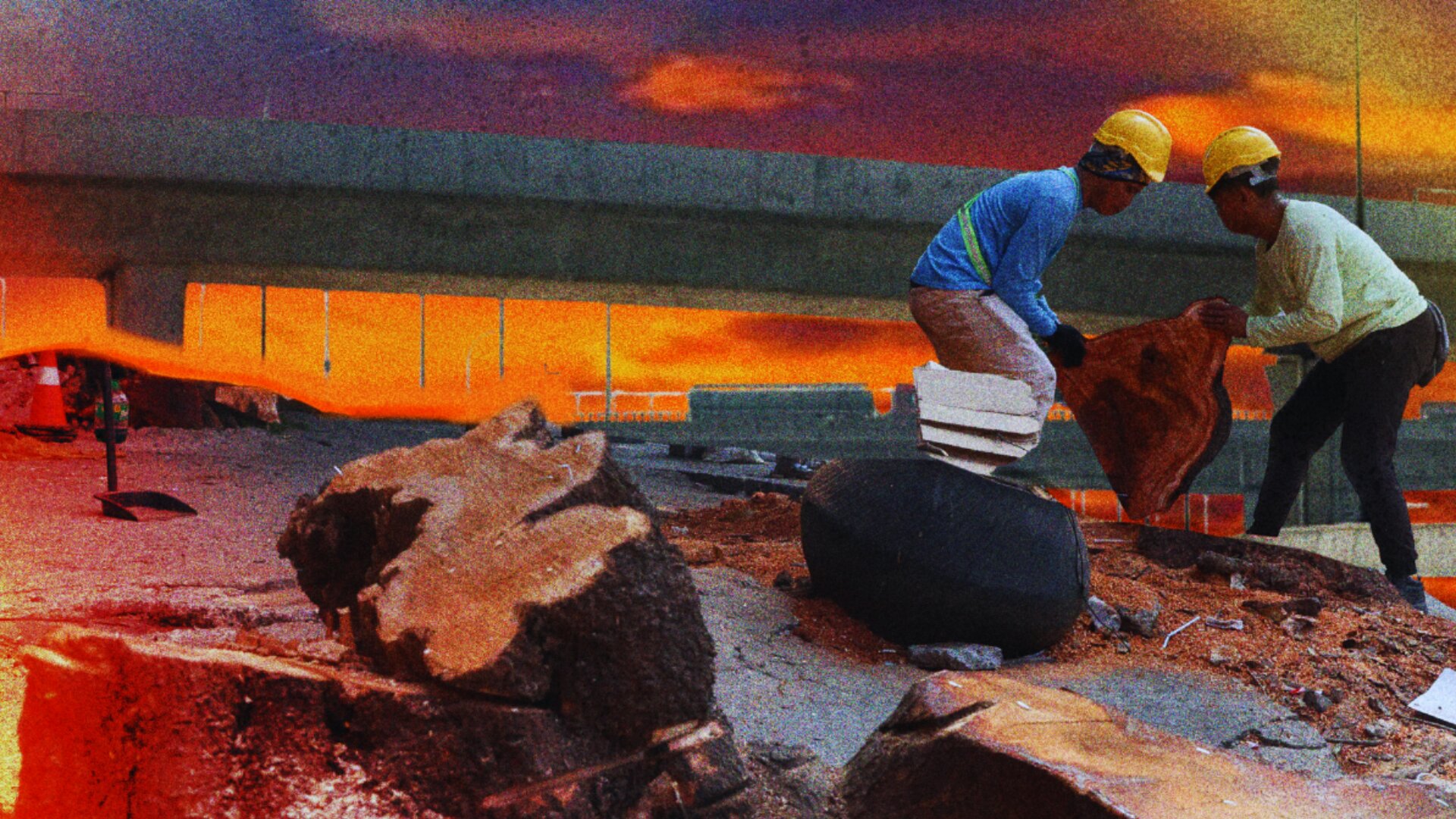
Sometimes, it is a fence. Sometimes, a building. This time, it is hundreds of mature trees that have stood along Quirino Avenue for decades.
To make way for the Southern Access Link Expressway (SALEx), hundreds of trees have been marked for removal. The project promises faster travel, better connectivity, and easier access to the New Manila International Airport. On paper, it is another step toward development.
But standing before rows of freshly cut stumps, one cannot help but ask:
What exactly are we making way for?
Infrastructure is necessary. Few would argue against improving the country’s transportation network. Metro Manila’s traffic congestion has long demanded better solutions, and projects like SALEx aim to shorten travel time and support economic growth. San Miguel Corporation has said the approved alignment was selected after studying several alternatives, while the Department of Environment and Natural Resources (DENR) explained that the clearing activities were covered by permits issued after technical evaluations. According to the company, some trees are being relocated through earth-balling where feasible, while permit conditions require the planting of more than 50,000 replacement seedlings.
The controversy was never simply about trees. It is about what those trees have quietly done for generations.
Metro Manila is already enduring increasingly dangerous temperatures. Heat indices have climbed to levels considered dangerous, making shade more than a comfort; it has become a necessity. Mature trees cool surrounding communities, absorb carbon dioxide, reduce flooding by soaking up stormwater, filter pollutants from the air, and provide habitats for urban wildlife. According to environmental experts, a single 50-year-old tree delivers environmental benefits that hundreds of newly planted saplings cannot immediately replace.
Trees grow back. Time does not. Perhaps the most striking irony is that while many global cities are restoring nature, we continue removing it.
Moreover, Seoul demolished an elevated highway to revive the Cheonggyecheon Stream, transforming concrete into a thriving public green space that cools the city. Utrecht reversed an earlier decision by removing a multi-lane expressway and restoring its historic canal lined with trees. Paris is replacing asphalt with urban forests, recognizing tree canopies as essential public infrastructure against extreme heat.
Meanwhile, Manila is making way by cutting down the very trees that help make urban life bearable.
Furthermore, the law itself recognizes the value of these silent protectors. Republic Act No. 3571 safeguards trees and ornamental plants in public spaces, while Presidential Decree No. 953 penalizes the unauthorized destruction of trees and encourages tree planting to address environmental degradation. These laws do not absolutely prohibit tree removal, and permits may authorize it under specific circumstances. But they reflect a principle that should never be forgotten: trees are public assets, not disposable obstacles.
In spite of that, supporters argue that the project followed legal procedures, secured the necessary permits, and included measures such as tree transplantation and replacement planting to lessen its environmental impact. They also point out that the DENR assessed many of the affected trees as unhealthy, damaged, or structurally unstable, and that the expressway serves an important public purpose.
Still, following legal requirements should only be the starting point. Good development should aim for more than just meeting the minimum standards. The issue is not simply whether the necessary permits were secured, but whether enough was done to protect mature trees whose environmental value cannot be replaced for decades. San Miguel Corporation itself has temporarily paused further tree cutting to reassess the affected trees, showing that there is still room to lessen environmental damage without stopping the project altogether.
Progress should challenge us to build smarter — not simply cut faster.
In addition, development and environmental protection should never be treated as opposing choices. The world’s leading cities increasingly demonstrate that infrastructure can coexist with nature through thoughtful planning, innovative design, and long-term vision. Manila deserves that same ambition.
Because the measure of progress is not only the number of kilometers of expressway we build. It is also the quality of the environment we leave behind for the people who will inherit it.
We should continue making way for development. But development should also make way for clean air, cooler streets, safer communities, and the trees that have protected them long before the first blueprint was ever drawn.
Otherwise, we may succeed in making way for the future — only to realize we cleared away one of the very things that made that future worth living in.