








Now Reading: Not every threat sounds like one
-
01
Not every threat sounds like one

Gweneth Pablo
Ever since the impeachment trial began, there has almost always been a spectacle that shifts attention away from the articles under scrutiny and toward matters seemingly unrelated to the proceedings.
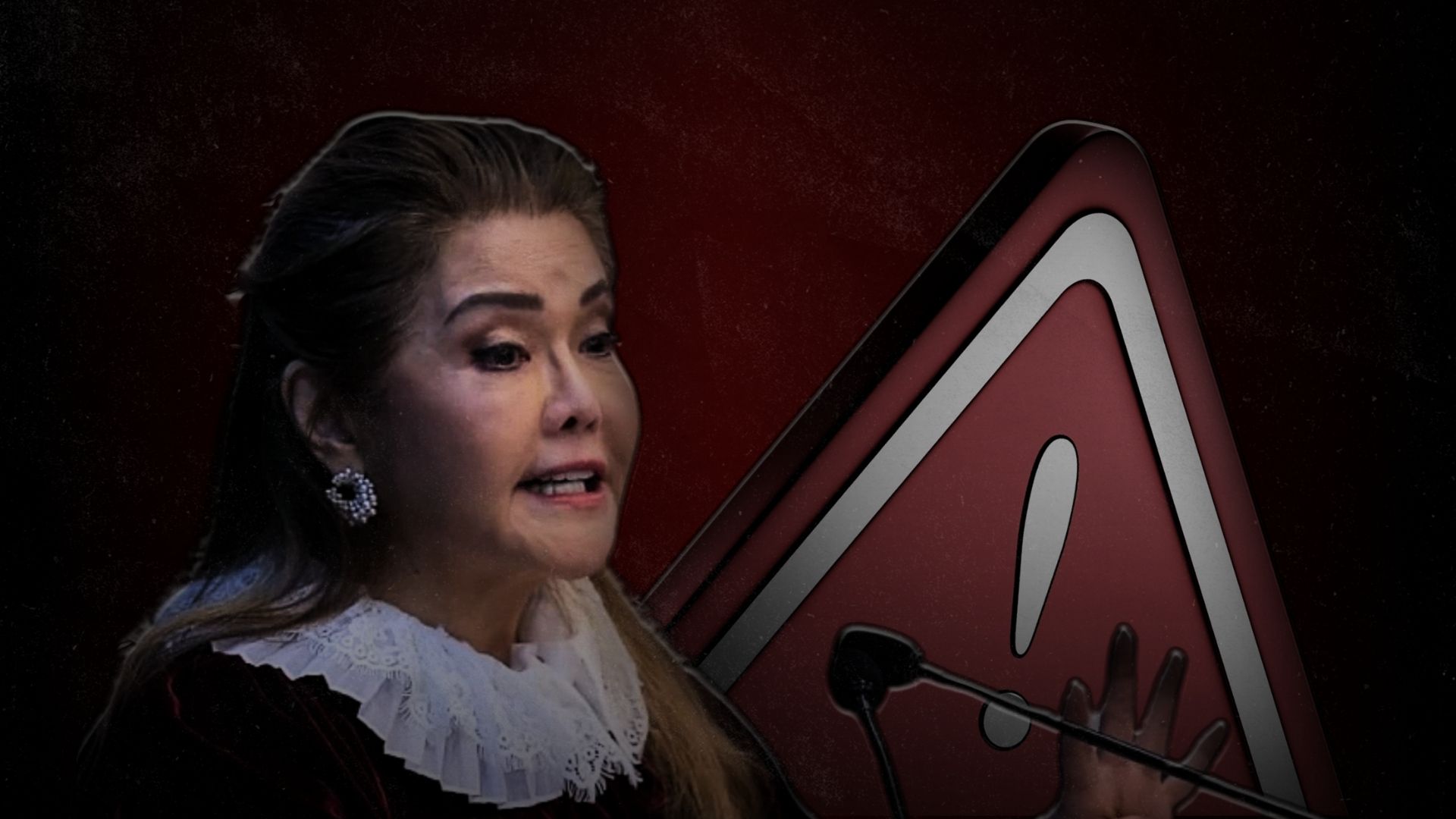
One such moment came when Senator-Judge Imee Marcos asked Gina Acosta–Vice President Sara Duterte’s former special disbursing officer (SDO)–about the health condition of her husband undergoing treatment in Davao on the 17th day of the impeachment trial. Marcos’ final line of questioning during the probe in relation to Article 1, which centers on the alleged misuse of confidential funds, drove the witness into tears before spurting a bunch of apologies–causing the trial to pause momentarily.
On its own, the question can be easily dismissed as an expression of concern. After all, Acosta mentioned during the redirect examination that she went home to Davao City two weeks prior to visit her husband. Its timing–and what preceded it–however, makes it difficult to dismiss the exchange as mere small talk.
Before asking about Acosta’s husband, Marcos had spent much of her two-minute interjection seemingly trying to clear the Vice President on the case of confidential funds. After roughly five questions, Marcos appeared to be building her argument around the fact that Duterte had never physically handled her funds–not even a single centavo, as Acosta confirmed. This odd direction was also flagged by the palace. During a briefing, Palace Press Officer Claire Castro acknowledged the senator’s right to question Acosta but also noted that the questions appeared tailored to get the Vice President “off the hook.”
Taken together, the sequence is difficult to ignore. Marcos had just spent her interjection establishing what Acosta could–and could not–say about Duterte’s handling of the funds. Then came the question about the witness’ husband. While it can be something asked out of genuine concern or acknowledgment, a question need not be malicious to unsettle the person answering it.
It is one thing to consider that the final line of questioning was not–in any shape or form–connected to what was previously being discussed. It did not contribute anything substantial to the trial, nor did it provide clarity to the ensuing line of questioning. If anything, the question sounded more like a threat–at least to netizens who watched the proceedings. Yet, to characterize it as such would be to stretch the exchange beyond what was actually said. While its timing and manner may have been unsettling, the question itself contained neither an explicit threat of harm nor a demand for a particular act that would readably constitute a threat under Article 283 (Light Threats) of the Revised Penal Code.
The absence of a legally actionable threat, however, does not necessarily mean that the exchange was incapable of unsettling the witness. What made the exchange disturbing was the unmistakable power dynamics at play when a sitting senator invokes a subordinate witness’ personal vulnerabilities in a public forum.
Their power imbalance is hard not to notice. A sitting Senator-Judge capable of influencing the impeachment proceedings of a Vice President who happens to be her political ally stands in stark contrast to a witness now facing immense legal and political pressure for testifying in one of the cases filed against Duterte. Whether intended or not, a person wielding a significant political power invoking a vulnerable family member may serve as a source of psychological pressure–particularly when the relative is in Davao, Duterte’s political stronghold, where her family has long exercised considerable political influence.
Despite the lack of concrete evidence to establish that what transpired was a legally recognized threat, its impact remains worth considering. We don’t know what went through her mind at the moment, but Acosta did not break down in tears before repeatedly apologizing for nothing. The possibility remains that the remark reminded her of what exists beyond the courtroom–and of what she might stand to lose if her testimony displeased those with power.
More than how it affected Acosta, the exchange accomplished a familiar political feat: it transformed a high-stakes trial into a spectacle, pushing matters that deserve scrutiny to the sidelines.
Instead of focusing on the additional suspicious and unusual names linked to the substantial sums released from the confidential funds, or on the repeated mention of Col. Raymund Dante Lachica, who may yet prove to be a crucial figure in tracing the distribution of the funds, public attention became fixated on Imee’s question–its implications, whether it was meant to unsettle witness, and whether it could even be considered a threat or merely a gesture of concern.
None of this makes the question unworthy of scrutiny. It does, however, raise concern about how easily a single provocative exchange eclipses the very question a proceeding is supposed to answer.
Since the trial began, this has been a recurring pattern in the proceedings–so much so, that spectacle has begun to resemble a detour, arriving in different forms each time. Today, it may come as a seemingly empathetic question. Tomorrow, it could be a controversial remark that will dominate public discourse for days.
Whether Marcos’ interjection was born out of genuine concern, defense strategy, or political instinct, its significance ultimately extends beyond what she intended. It created a moment worth talking about–and in doing so, it drew attention away from questions the proceedings are meant to answer. In trials where accountability is already difficult to pursue, spectacle should not be allowed to become a substitute for substance.