








Now Reading: Philippine Sports Under Martial Law
-
01
Philippine Sports Under Martial Law


The so-called “golden era of Philippine sports” during the Marcos years shines less like gold and more like well-polished brass.
For decades, the dictatorship’s supporters have pointed to the 1981 Southeast Asian (SEA) Games in Manila and the celebrated Gintong Alay program as proof that Martial Law nurtured world-class Filipino athletes. Television reels, medals, and newspaper clippings are often cited as evidence that sports flourished under authoritarian rule. Yet, a deeper dive into records, medal tallies, and historical context paints a far more nuanced picture. While a few athletes indeed achieved international fame, the broader state of Philippine sports was underfunded, unevenly developed, and heavily exploited for political legitimacy.[a]
SEA Games as political theater
Particularly, the 11th SEA Games, held in December 1981 in Manila, is often portrayed as a crowning achievement of the Marcos regime. Dr. Marlon Delupio’s research highlights how this event was carefully timed to coincide with international scrutiny following the formal lifting of Martial Law in January 1981. President Marcos used the Games to impress the Vatican, the Reagan administration, ASEAN neighbors, and other international audiences. It was, in essence, a strategic showcase, a means of projecting political stability, national discipline, and economic vitality despite ongoing civil unrest and international criticism over human rights violations.
Medal tallies tell another story
But the medal tally exposes the limits of this so-called golden era. The Philippines finished third overall, behind Indonesia and Thailand, garnering 55 golds, 55 silvers, and 77 bronzes. This followed a disappointing fourth-place finish in the 1979 Jakarta SEA Games and a similarly middling performance in the 1977 Kuala Lumpur SEA Games. In the Asian Games, the decline was even evident. After winning nine gold medals in the 1962 Jakarta Asiad, the Philippines fell to a solitary gold in the 1970 Bangkok Asiad and zero in Tehran in 1974. These figures suggest that, despite the fanfare, the country was not consistently excelling in regional or international sports.
The Philippines’ placement in medal tables, coupled with the political context, reveals that sports under Martial Law were used less as a developmental tool and more as a mechanism for international and domestic image-making. The games were carefully orchestrated to signal progress while diverting attention from economic woes, rising debt, and pervasive human rights abuses.
Gintong Alay’s narrow focus
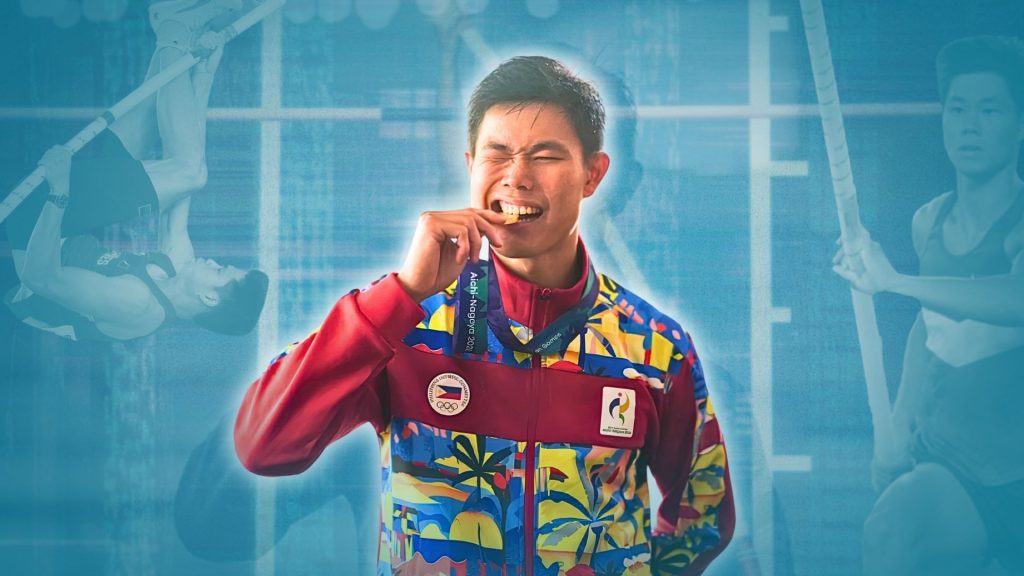
Marcos’ Gintong Alay, launched in 1979 under the supervision of his nephew Michael Keon, is frequently cited as proof of his sports legacy. It did produce stars: sprinters Lydia de Vega and Isidro del Prado, swimmers Eric Buhain and Akiko Thompson, and boxers Mansueto “Onyok” Velasco and Roel Velasco, among others. National training centers were established in Baguio, with international coaches mentoring handpicked athletes.
However, Gintong Alay’s success was narrow and elite. It focused almost exclusively on track and field and a few select sports, leaving most athletes outside its fold without the resources to compete internationally. Grassroots programs, long-term athlete development, and sustainable funding were largely absent. While it created a few shining stars, it did not transform Philippine sports into a consistent powerhouse.
Gintong Alay demonstrates that the so-called golden era was not golden for most athletes or for the long-term growth of sports in the Philippines. Its achievements were selectively highlighted to serve political narratives, portraying a facade of national excellence while neglecting structural development and broader participation.
Spectacle over substance
Beyond athlete performance, Marcos’ regime also sought prestige through hosting international events. The 1975 “Thrilla in Manila” boxing match between Muhammad Ali and Joe Frazier, the 1979 World Basketball Championship, the 1981 World Chess Championship with Anatoly Karpov, and the World Cup of Golf are all cited as highlights of the era. These spectacles projected global attention onto the Philippines, emphasizing infrastructure and hospitality rather than athletic success.
Dr. Delupio also emphasized that the regime used sports as a diplomatic tool, engaging in “basketball diplomacy” with China and strengthening ties with the USSR and other socialist states. Hosting the 1981 SEA Games was similarly framed as an exercise in national unity, regional brotherhood, and international recognition. Dr. Delupio underscored how Marcos’ speeches repeatedly stressed values like discipline, perseverance, and national pride, but always in the service of legitimizing the New Society (Bagong Lipunan) and consolidating political control.
Economic limits to true development
The focus on hosting events for global spectators reflects a regime more interested in optics than in systemic athletic excellence. While infrastructure investments and international visibility were tangible, they cannot be equated with the true golden era of sports achievement.
According to Orville Solon and Maria S. Floro, who authored the paper “The Philippines in the 1980s: A Review of National and Urban Level Economic Reforms,” the Philippines in the 1970s and early 1980s faced significant economic and social challenges. This meant that poverty, inflation, trade deficits, and external debt constrained the resources available for broad-based sports programs. Juvenile delinquency, lack of access to facilities outside urban centers, and uneven training opportunities limited the pool of athletes who could compete at higher levels.
Legacy of a staged showcase
True athletic development requires sustained investment in grassroots programs, coaching, and equitable access. The Marcos era focused on a few elite athletes and spectacular international events, while politically expedient, it left the broader Philippine sports ecosystem underdeveloped.
The myth of a golden era is thus a selective narrative. While the Philippines did produce exceptional athletes, and international events brought temporary prestige, these achievements were politically leveraged to enhance Marcos’ legitimacy and distract from domestic problems. Medal tallies, international rankings, and the narrow scope of Gintong Alay’s impact all point to a sports landscape that was uneven, politicized, and more about image than substance.
When the Marcos regime touted sports victories as evidence of national strength, it conflated individual achievement with state success. The broader truth is that the so-called golden era was engineered for propaganda. Athletes shone, but the system supporting them remained fragile and politically motivated.[b]
No true golden age
If we measure a golden era by lasting infrastructure, widespread athlete development, and sustained international success, the Martial Law period was no golden age of Philippine sports. It was a meticulously staged showcase. A few brilliant athletes, high-profile tournaments, and carefully crafted speeches masking structural weaknesses and socio-political repression. Recognizing this reality honors the true achievements of Filipino athletes without glorifying a regime that sought to co-opt their victories for political gain. In short, the glory may have been bright, but it was a facade, shiny on the surface, hollow beneath.