








Now Reading: They care for our homes, but who cares for them?
-
01
They care for our homes, but who cares for them?

Philip Gabriel Caysido
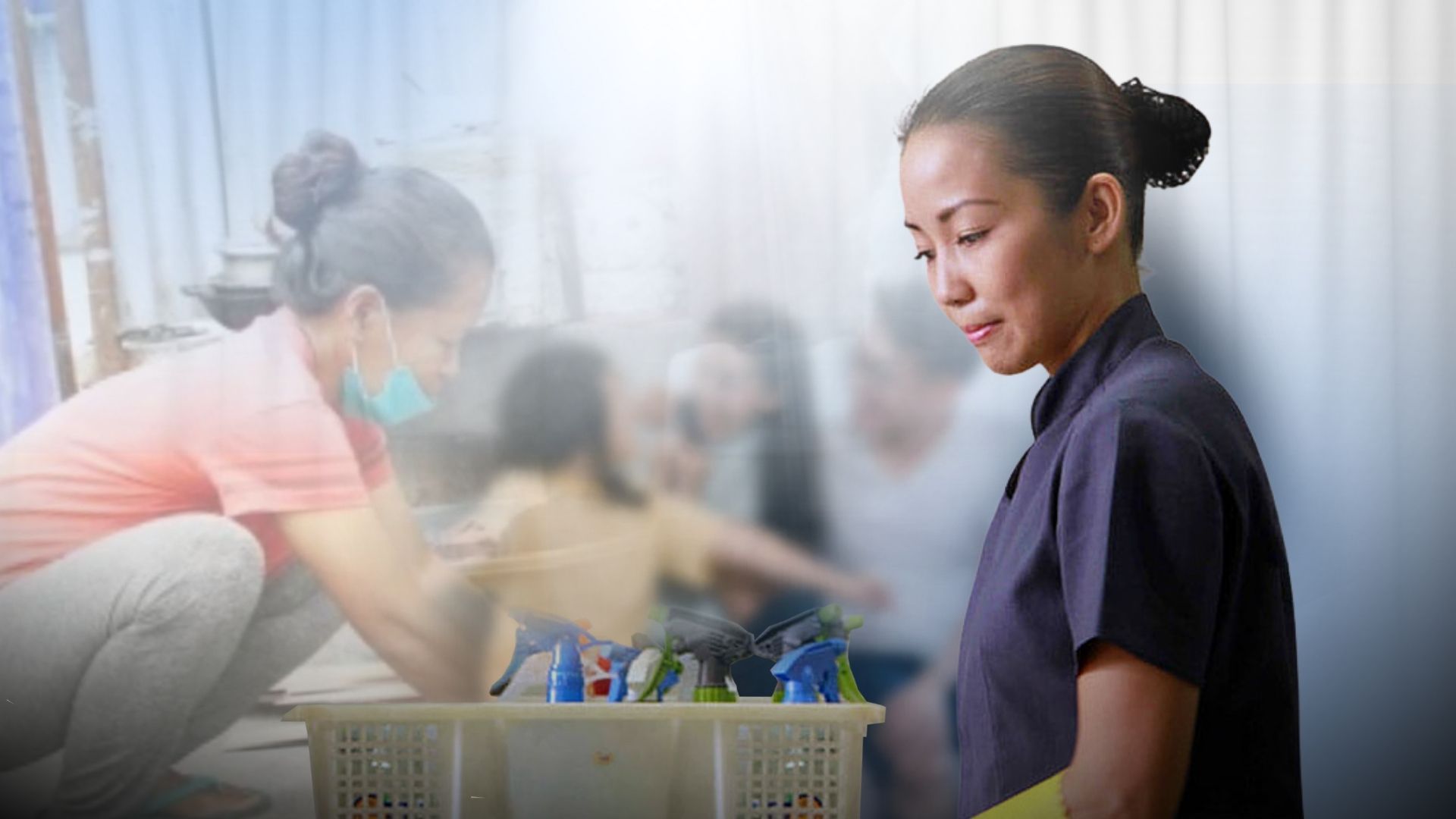
In the usual setup of a Filipino household, having an extra hand, or what many refer to as “kasambahay,” means having the privilege to lessen the burden of household chores, where the convenience of outsourcing domestic labor suddenly becomes an undeniable luxury for many.
If a family ever needs one, they don’t usually run background checks or create labor contracts. Instead, the mindset is simply finding a “kakilala” from the family’s relatives.
Apparently, the real irony lies in how Filipino culture cherishes the values of close family bonds, while also normalizing a “yaya culture” where the lines between professional helper and extended family member often get blurred.
Cost of systemic neglect
In the Philippines, the practice of “yaya culture” is not the usual transactional employment arrangement where boundaries are made clear. Rather, hiring a domestic helper goes beyond a standard employer-employee relationship bounded by cultural values and social norms.
Filipino families often tell their kasambahays that they are ‘just like family.’ And because they are “family,” it becomes culturally difficult for the worker to demand standard labor rights, even in terms of regular working hours and higher salary, without appearing ‘ungrateful,’ and therefore may potentially enable exploitation.
Seemingly, the irony continues when millions of Filipino families claim to value domestic helpers as their own flesh and blood, when behind the scenes, these same workers are making the biggest sacrifice of leaving their biological children and families behind to survive financially by sustaining the household of others.
Existing and notable studies indicate that within local Philippine households, employers often use utang na loob, in approaches such as advance payments and gifts, as a way to hide professional boundaries and suppress formal labor demands and a mechanism for control.
In the case of Elvie Vergara, a 44-year-old domestic helper in 2017 who worked at the family of Jerry and France Ruiz in Mamburao, Occidental Mindoro, the tragedy of her experience shows how easily labor can be dismantled by manipulation and control.
Vergara was falsely accused by her employers in 2020 of stealing cash and valuable items, and was subjected to extreme violence, including severe physical beatings with blunt objects and prolonged confinement, that ultimately left her permanently blind and severely deformed.
In just a single stroke of manipulation, Vergara’s employers completely stripped away her identity as an employee with legal rights.
Yet, despite the protections explicitly mandated under the Republic Act 10361 or the Domestic Workers Act, safeguarding their welfare remains a challenge when modern legal structures lose ground to loose cultural traditions, leaving the kasambahay vulnerable within the very homes they maintain.
How the doors open for exploitation
The widespread reliance on ‘yaya culture’ began when traditional single-income Filipino families were forced to transition into modern, dual-earning households.
Historically, the traditional gender gap persists in the Philippines, as data from the World Bank Gender Labor Data indicates that the male labor force participation rate remains high at approximately 75%, while the female participation rate is significantly lower at around 49%.
Meaning, households then relied on one family member as the ‘breadwinner,’ allowing the other partner to manage the home entirely, which is why hiring kasambahays back then was nothing more than a status symbol used by some to show elite wealth
As time goes by, middle-class families experience heavy economic pressures, such as rising inflation, which means that both parents must work full-time to stay afloat.
Accompanied by the massive evolution in cultural mindsets, about 71% of Filipinos explicitly agree that a working mother can provide just as secure and warm an upbringing as a stay-at-home mother, according to the data from the November 2025 Social Weather Surveys (SWS).
With both parents working, someone has to manage the home and look after the children — and that is where the demanding role of domestic helpers comes in.
When the reliance on domestic help sustains the modern Filipino workforce, with the workers being completely concealed from public scrutiny, it inevitably opens the doors for exploitation.
When helpers suddenly become helpless
In a report from the International Labor Organization (ILO), there are nearly two million domestic helpers in the country.
Despite the informal practice in most household hiring, the law provides a clear legal basis for treating domestic work as formal employment. Under RA 10361 or the Batas Kasambahay Act, workers are legally entitled to several core protections:
- Mandatory written employment contracts
- Regulated minimum wages
- Designated rest periods
- Enforced social security coverage
- Direct protection against abuse
- The right to organize and form associations to shape their own workplace rules
According to the 2019 Survey of the Department of Labor and Employment (DOLE) and the Philippine Statistics Authority (PSA), years after the law was implemented, with still 1.4 million kasambahays:
- Only 2.5% (roughly 35,000 workers) out of the 1.4 million kasambahays (including yayas) have formal written employment, while the remaining percentage rely entirely on verbal agreements.
- About 83% are not covered by any social security benefit
- 36% of live-in domestic workers reported working 7 days a week with zero rest days, despite the Batas Kasambahay explicitly mandating a 24-hour weekly rest period.
- Only 41% of workers are aware of Batas Kasambahay
When workers are entirely unaware of their legal rights under the Batas Kasambahay, they have no frame of reference to realize they are being exploited.
Hence, a domino effect happens when most of them are unaware of their rights, leading to them being stripped of basic social security benefits, prolonged working hours, and formal contracts.
Many of these workers are recruited from impoverished, remote rural provinces to work in urban cities like Metro Manila, and often enter households with limited formal education and prior exposure to labor policies. And since their environment is highly restricted, often lacking stable digital access, they remain ‘cut off’ from awareness campaigns and information about their rights.
Yet, too often, they face low wages and long working hours, making them remain among the most vulnerable and exploited workers in society.
Globally, the Women in Informal Employment: Globalizing and Organizing (WIEGO) Statistical Brief reports that domestic workers earn, on average, only 56% of the average monthly wages of other wage-earning employees in the formal labor market.
Until we reconcile our cultural definition of family with our legal obligation to labor, domestic helpers will always be kept completely apart from the law.
Hence, the real question would be: Why does a law, with the very principle of protecting the rights of a vulnerable sector of workers, continue to falter, while society continues to rely on the cultural norms that exploit them?
A need to fill the Gaps
Yet, beyond systemic loopholes, severe gaps in current policy implementation leave these workers entirely exposed.
There is an obvious flaw in the workforce measures, such as the lack of streamlining for these domestic workers. Unlike corporations with HR departments, a standard family has to navigate these separate, often slow-moving bureaucratic systems manually.
And to register a kasambahay, a homeowner must formally register themselves as an employer with three separate government agencies— such as the Social Security System (SSS), Philippine Health Insurance Corporation (PhilHealth), and the Pag-IBIG Fund— secure employer ID numbers, compute monthly deductions based on wage brackets, and regularly remit payments.
Frankly, forcing everyday households to act like corporate enterprises slowly makes legal compliance a burden that most families simply choose to bypass.
Additionally, to think that designating the local barangay as the monitoring hub is already a contradiction due to privacy barriers, since labor inspectors cannot easily enter a family home to verify whether a contract exists due to constitutional rights.
The same protection that the law aims to reform is practically inaccessible for households when the policy implementation itself is a contradiction.
To protect, not to exploit
As the country earned international acclaim as a pioneering champion of labor rights when it was among the first countries to ratify the ILO Convention No. 189, it affirms that domestic helpers have the right to a safe and healthy working environment in households.
While the Philippines is often praised for progressive social legislation, passing a law is not the same as achieving justice.
And while a foundation for further progress exists, laws are only as powerful as their enforcement, and the true measure of the domestic workers’ dignity is in the reality of our homes.
However, can we truly call ourselves a progressive, family-oriented society if our own economic survival depends on keeping two million of our most vulnerable workers outside the protection of the law?
And sometimes, the harsh truth of these family setups is that domestic helpers remain marginalized and are trapped in a cycle of systemic neglect where they are treated as cheap, exploited labor rather than human beings who deserve fair wages, legal benefits, and real accountability.