









Now Reading: TESTING ACCOUNTABILITY: The stories behind impeachment complaints lodged vs PBBM
-
01
TESTING ACCOUNTABILITY: The stories behind impeachment complaints lodged vs PBBM
TESTING ACCOUNTABILITY: The stories behind impeachment complaints lodged vs PBBM

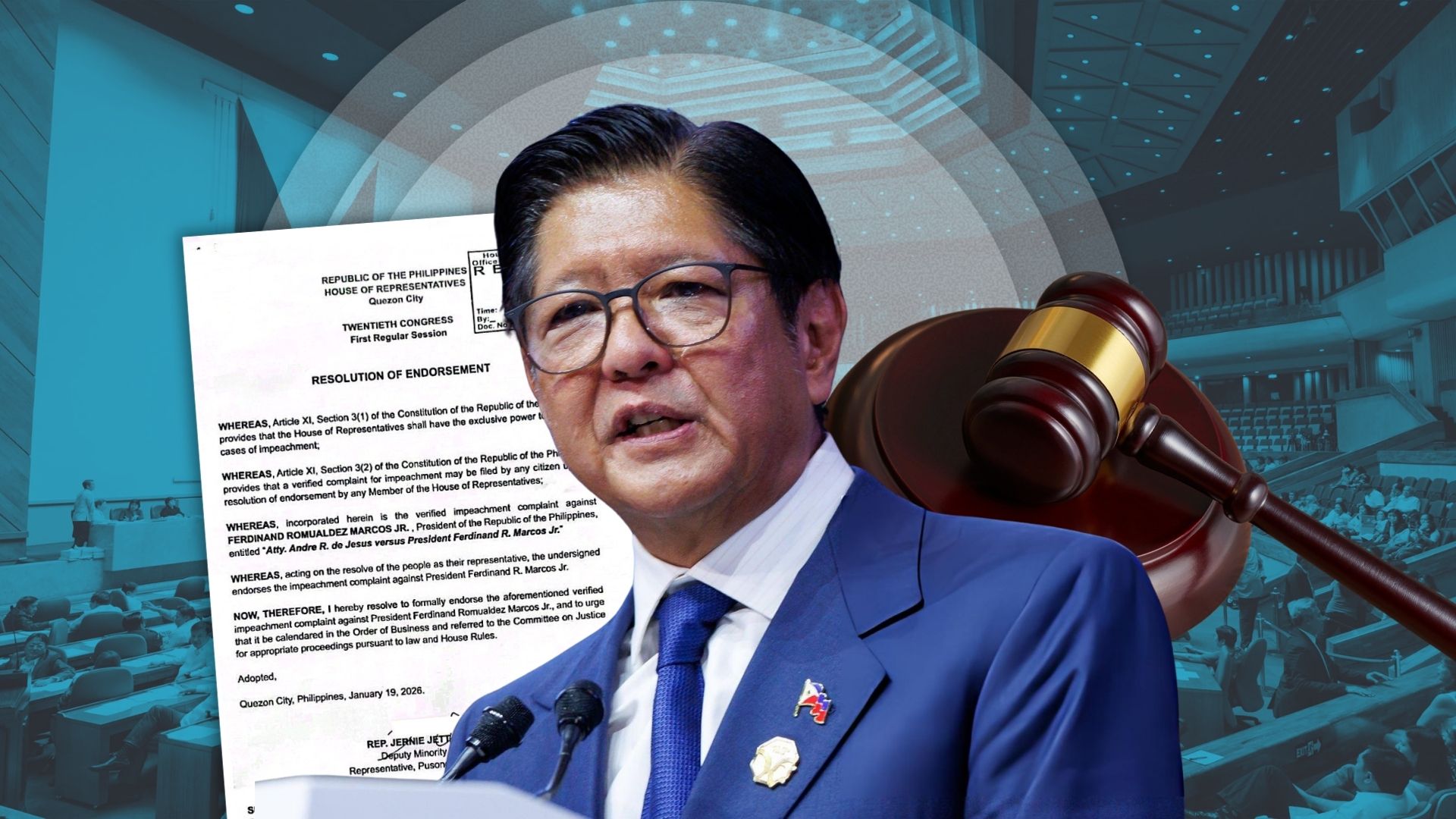
How many complaints does it take before accountability starts to matter? Despite impeachment filings against President Ferninand “Bongbong” Marcos Jr., the process has repeatedly stalled; now this raises doubt about whether accountability is indeed procedural or just performative.
In January 2026, two impeachment complaints were filed against the President, marking the first formal attempts to remove him from office through the constitutional impeachment process. Filed just days apart, the complaints accuse the President of constitutional violations, graft and corruption, as well as betrayal of public trust. These grounds are explicitly provided under Article XI of the 1987 Philippine Constitution.
While impeachment filings do not automatically mean removal from office, their referral to the House Committee on Justice places the Marcos administration under rare and serious institutional inspection.
The constitutional basis for impeachment: Legal framework and its process
Under Article XI, Section 2 of the 1987 Constitution, the President may be impeached for:
- Culpable violation of the Constitution
- Treason
- Bribery
- Graft and corruption
- Other high crimes
- Betrayal of public trust
The impeachment complaints filed against Marcos showed several of these grounds which argue that the President’s actions meet the constitutional threshold for accountability. These grounds are deliberately broad; this allows impeachment to address serious abuses of power or actions that undermine the rule of law. By explicitly listing both personal misconduct and official abuses, the Constitution ensures that no public official, not even the President, is above accountability.
Additionally, the impeachment process is carefully structured to combine legal examination with political oversight. Section 3 of Article XI grants the House of Representatives the exclusive power to initiate impeachment proceedings. A verified complaint may be filed by a House member or by a citizen, provided it is endorsed by at least one lawmaker. Once received, the complaint must be transmitted to the Committee on Justice, which evaluates whether the allegations are sufficient in form and substance. This step acts as a procedural protection and ensures that frivolous or unsupported complaints do not advance.
If the committee finds the complaint valid, it submits a report and corresponding resolution to the House plenary. At this stage, at least one-third of all House members must vote to affirm the Articles of Impeachment before the case can be sent to the Senate for trial. The Senate then conducts the trial, with the Chief Justice presiding if the President is being tied. Conviction requires a two-thirds vote of the Senators, which is intentionally difficult to achieve.
This constitutional framework ensures that impeachment is a formal mechanism to hold the highest officials accountable. In the case of Marcos, the complaints are being evaluated under this process.
The first impeachment complaint
The first impeachment complaint was filed by Atty. Andre De Jesus on January 19 for the alleged Constitutional violations and corruption. It was endorsed by Pusong Pinoy party-list Rep. Jernie Jett Nisay, a House Member, making it valid in accordance with the constitution. In his 14-page complaint, De Jesus accused Marcos of:
- Allegedly ordering or enabling the kidnapping and surrender of the former President Rodrigo Duterte to the International Criminal Court (ICC), which de Jesus claims violates the Constitution and betrays the public trust.
- Allegedly being a user of illegal drugs, which impairs the President’s actions and judgement.
- Failing to veto unprogrammed appropriations and allegedly other unconstitutional provisions of the General Appropriations Bill for 2023, 2024, 2025, and 2026.
- Allegedly benefiting from kickbacks linked to budget insertions and particularly provisions involving discretionary and questionable funds, or the so-called “ghost” flood control projects.
- The creation of the Independent Commission for Infrastructure, which the complaint claims was designed to shield allies involved in corruption.
These accusations combine legal constitutional violations with highly political and controversial allegations that would require strong evidence for it to be processed.
The second impeachment complaint
Just a few days after the first impeachment complaint was filed, another complaint followed shortly. The second complaint was filed on January 26, 2026, by leaders of the Makabayan coalition and endorsed by progressive party-list lawmakers from ACT Teachers, Gabriela, and Kabataan. Unlike the first complaint, which included both personal and constitutional allegations, this filing focuses primarily on governance and corruption issues.
Makabayan’s complaint specifically alleges that President Marcos committed betrayal of public trust through the adoption of the Baselined-Balanced-Managed (BBM) Parametric Formula for allocating infrastructure projects. According to the complainants, this formula allowed the concentration of budgetary allocations into projects that were allegedly mismanaged or artificially inflated. By targeting infrastructure funds, the complaint draws attention to public projects that directly affect communities as well as government transparency.
The complaint identifies several specific concerns allegedly enabled by the BBM Parametric Formula:
- Ghost flood control projects – funds were allegedly allocated to projects that were never completed or implemented.
- Overpriced and substandard infrastructure – some projects were reportedly completed below expected quality standards, while budgets were disproportionately high.
- Budget manipulation favoring political allies – allocations allegedly benefited officials and contractors with political connections rather than serving the public interest.
By focusing on public funds and project allocation, the complaint frames impeachment as a mechanism to address systemic corruption rather than individual misbehavior. This approach directly connects the executive’s decisions to tangible outcomes affecting citizens.
Although the second complaint does not make personal allegations against President Marcos, it carries significant political and legal weight. The procedural process still applies: the House Committee on Justice must evaluate the complaint for sufficiency, and at least one-third of House members must vote to affirm it for consideration in the Senate.
Legal and political implications of the complaints
The referral of impeachment complaints to the House Committee on Justice signifies that they are procedurally valid, but this step alone does not determine their success. Prior to this, committee is tasked with consolidating the complaints and evaluating whether they are enough in substance, involving hearings, deliberations, and a vote by the committee’s members.
Historically, impeachment proceedings in the Philippines have succeeded only when the sitting president loses the support of Congress. Given President Marcos’ strong legislative backing, political analysts view conviction as unlikely. However, impeachment is also a tool for institutional accountability and public trust.
Even without conviction, the impeachment proceedings can have significant consequences:
- Expose alleged misconduct
- Force disclosures
- Dominate legislative agendas
- Shape public perception of the administration
Thus, while the legal path forward is narrow, the political implications of the complaints extend far.
Malacañang’s response
Palace Press Officer Claire Castro stated that while the President will not interfere with the actions of the House of Representatives, impeachment efforts have broader consequences. She noted that, “the filing of an impeachment complaint does not only affect the president but also the country and its economy.”
Castro stressed that impeachment proceedings could only distract from the governance and economic priorities. According to her, the administration remains focused on delivering services and improving living conditions, despite the political challenges posed by the complaints. The Palace’s response reflects a common executive stance during impeachment attempts; this portrays the complaints as political disruptions rather than legitimate threats. By framing impeachment as potentially harmful to economic stability, Malacañang seeks to reassure the public and other observers.
At the same time, the administration’s acknowledgment of the process highlights the legitimacy of impeachment as a constitutional mechanism. The President’s decision not to obstruct proceedings signals adherence to democratic norms, even as the Palace downplays the likelihood of removal.
Whether the impeachment complaints advance or stall, they show how impeachment serves as a reflection of broader struggles over the public trust in Philippine democracy.
Broader impact on governance: How impeachment shapes state institutions
The filing of impeachment complaints against the President has consequences. While impeachment is constitutionally designed as a tool for accountability, its proceedings require substantial attention and resources from the legislative and judicial branches.
Committees must review complaints, hold hearings, and deliberate on evidence, which can divert time and focus from routine governance. In this sense, even procedural steps in impeachment can temporarily reshape how government bodies operate and prioritize their agendas.
By formally reviewing allegations of betrayal of public trust, graft, or constitutional violations, Congress asserts its role in overseeing the executive. This process reminds state agencies and officials that actions, especially those involving public funds and policy implementation are subject to examination. At the same time, the process can create tensions within state institutions. Agencies involved in investigations, budget oversight, or legal review may experience increased political pressure, as their findings could influence high-stakes political outcomes.
The executive branch may also face constraints in executing policies if legislative attention is consumed by impeachment hearings. For instance, departments responsible for social services could see delays in implementation as lawmakers focus on reviewing allegations and preparing reports.
Furthermore, impeachment proceedings influence public perception of governance. How the House of Representatives, the Committee on Justice, and other institutions handle complaints can either lower public confidence or foster skepticism. Transparent and fair handling of complaints strengthens institutional credibility, while perceived bias and procedural delays can erode trust in state mechanisms.
Even if impeachment does not result in removal from office, its broader impact on governance is significant. The process creates a precedent for future accountability that also encourages compliance with laws as well as constitutional duties.
It demonstrates how impeachment functions as a governance tool; this ensures that state institutions remain active participants in upholding the balance of political power within the Philippines.