










Now Reading: NEA vows to bring power to all last-mile schools in three years
-
01
NEA vows to bring power to all last-mile schools in three years
NEA vows to bring power to all last-mile schools in three years

Kirsten Mendoza
The National Electrification Administration (NEA) has renewed its pledge to energize every last-mile school in the country within the next three years.
Administrator Antonio Mariano Almeda made the call on August 9, for support from electric cooperatives during the closing of the three-day NEA-EC Convergence at the SMX Convention Center in the presence of Education Secretary Sonny Angara.
Almeda reminded attendees that 2,359 schools still need electricity and promised President Ferdinand Marcos Jr. that 295 will be energized by the end of 2025.
He said the remaining 1,900 schools will be completed before the end of Marcos’ term in 2028.
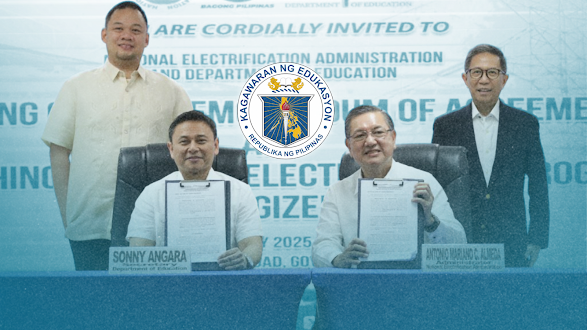
Earlier this year, NEA and the Department of Education (DepEd) signed a memorandum of agreement to provide reliable power to last-mile schools in off-grid and underserved areas.
Moreover, the University of the Philippines (UP) is helping design electrification systems that are sustainable, scalable, and suited for remote communities.
In June, Datu Saldong Domino Elementary School in Buenavista, Agusan del Norte became the first beneficiary of the program, now equipped with solar power and internet connection.
Angara said electricity in last-mile schools should be treated as a basic right and urged NEA and cooperatives to continue working with DepEd to meet the needs of learners.
He called for unity in ensuring every Filipino child receives an equitable and relevant education with access to power as a non-negotiable.
The NEA-EC Convergence, themed “Powering the Future,” gathered 121 electric cooperatives nationwide and coincided with NEA’s 56th founding anniversary and the 16th National Electrification Awareness Month.