










Now Reading: BRUSHSTROKES BETWEEN RUSH AND REFUGE: In streets that refuse to rest, Tatay William’s 150-peso obras paint solace
-
01
BRUSHSTROKES BETWEEN RUSH AND REFUGE: In streets that refuse to rest, Tatay William’s 150-peso obras paint solace
BRUSHSTROKES BETWEEN RUSH AND REFUGE: In streets that refuse to rest, Tatay William’s 150-peso obras paint solace

G.H. Villagracia
Cebu never learned to pause. Horns blare from stalled jeepneys, sunbeams slice through smoke-filled lanes, and strangers brush past strangers without a glance, without slowing down. The city is a gray canvas of ceaseless motion that moves without a moment’s rest.
Yet amidst the unyielding hustle, acrylic paint drips and careful brushstrokes in the streets tell a different story—calm seeping into the chaos like colors breaking through the monochrome, one 150-peso painting at a time.
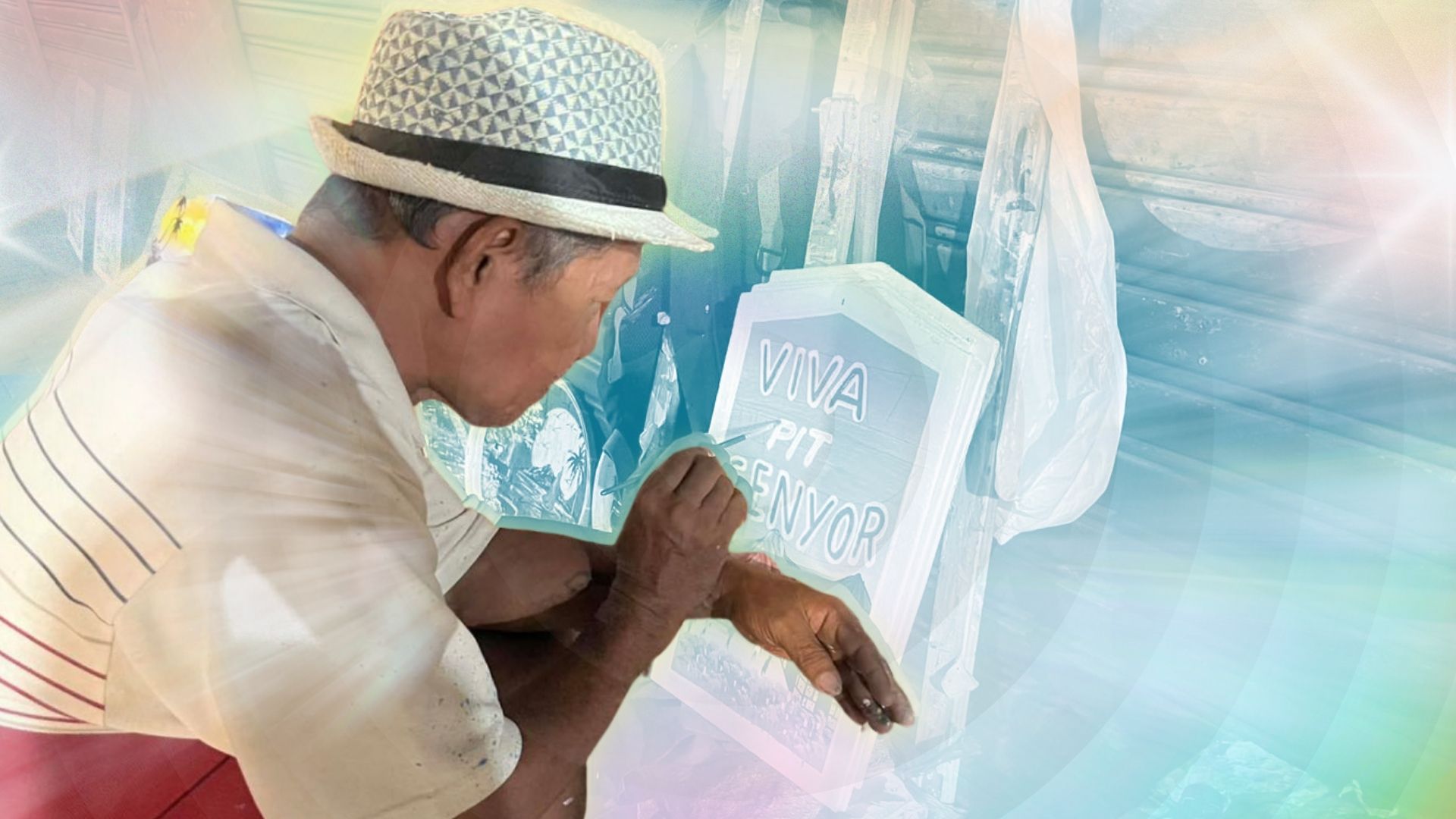
When the sun descends, right before Cebuanos brace for the evening rush, 65-year-old William Avila lays out his artworks along the busy Osmeña Boulevard and begins to color his canvas as he has for 47 years, hoping that tired passersby find refuge in his affordable obra maestras.
“Unta makawala ni (ang mga paintings) sa ilang kakapoy,” Tatay William shared. “Sa panahon na naa silay problema, ma-feel unta nila na mawala, o at least man lang magamay, kay naa silay mga paintings na bugnaw sa mata unya barato ug pangmasa.”
(I hope these [paintings] can ease their fatigue. When they have problems, I hope their troubles ease, or at least are softened, because they have paintings that are easy on the eyes, affordable, and for the masses.)
First strokes on the canvas
Tatay William was just a high school student when he realized he had a gift for the arts, just like his father. At 18, he began learning more through the family’s art business, serving as his father’s right hand. But, despite this, his desire to grow as an artist was far from satisfied.
“Gusto sab ko maka-experience sa lain,” the painter recalled. “Nisulod ko’g mga shop, nanarbaho ko bahala’g walay sweldo kay ang tuyo nako makakat-on ko.”
(I also wanted to gain experience from others. I joined different shops and worked even without pay because my goal was to learn.)
After high school, he pursued architecture at the University of Southern Philippines Foundation (USPF). However, financial constraints cut his studies short in his second year, and a brief plan to work abroad never materialized.
Back in Cebu, he dove into lettering, first with advertising and billboards, then murals as digital tools took over. Walking from school to school on commissions from principals, deans, and teachers, he slowly built a name for himself, carving his path as a Cebuano artist.
“Basta about sa art, di jud ko mobalibad,” he expressed. “Malipay raman sab ko. Makawala siya sa ako kakapoy ug kalaay. Unya bisag senior na ko, makapuhonan gihapon ko.”
(When it comes to art, I never say no. It brings me joy. It eases my fatigue and weariness. And even when I am already a senior, I can still earn from it.)
A 150-peso respite of colors
These days, the 65-year-old artist sits along the old concrete sidewalks directly across from Fuente Osmeña Circle, selling his paintings from four in the afternoon to nine in the evening every Monday, Thursday, and Saturday.
Because of this, he has become a fixture in the path of students, workers, and wanderers streaming from nearby establishments caught in the daily haste of the commute home.
But despite this steady flow of people, Tatay William keeps his paintings affordable, pricing most of his works at 150 pesos. For him, art is meant to be accessible to everyone.
“Tanan tao nga naglakaw sa dalan, di jud ka maka-isip nga datu na sila,” he said. “Naay estudyante, naay mga trabahante, mga janitor, mga naglisud sa trabaho. Ang ako lang, bisan pa sa ilang kapobre o kalisud, unta makatabang ko nga naay art sa ilang mga balay nga maganahan nila.”
(Not everyone walking along the streets is wealthy. There are students, workers, janitors, people struggling with their jobs. For me, even with their hardships and struggles, I hope I can still help by putting art in their homes that they can enjoy.)
Before that, the Cebuano painter sold his works at an even lower price.
“Sauna 100 pesos ra baligya nako. Pero nisaka man ang presyo sa pintal og plywood, gi 150 nalang nako.”
(I used to sell them for 100 pesos. But since the price of paint and plywood went up, I just made it 150.)
Yet beyond the price itself, he hopes people see his paintings the way he intends them—small canvases of shelter amid the city’s restlessness, an escape from the seemingly endless noise.
“Kung motan-aw ka, parehas anang island na painting, naa juy parte saimo sarili na maka-ingon og ‘kung dira lang ko nag-puyo, mahapsay akoa huna-huna kay mura’g naa ra ko sa probinsya, kalma, hilom,’” he said. “Kana akoa gusto ma-interpret nila.”
(When you look at it, like that island painting, for example, there is a part of you that would say, ‘If I lived there, my mind would be at peace because it feels like being in the province, calm, quiet,'” he said. “That is what I want them to interpret.)
Moreover, in a time dominated by artificial intelligence and commercialization, Tatay William believes handcrafted art remains unmatched, sharing that his paintings are inspired by the mountains, rivers, seas, and scenes he has encountered throughout his life.
“Lahi ra kaayo ang mano-mano,” he stressed. “Unique jud kay di ka basta basta makahimo og daghan o ma-replicate nimo. Unya kaning (mga paintings) gikan jud ni sa akoa experience.”
(Handcrafted work is really different. It is unique because you cannot just make a lot of it or easily replicate it. And these [paintings] come directly from my own experiences.)
Painting amidst the fading hues
Every selling day, Tatay William pedals his three-wheeled cart to his usual corner in the alley. There, he works under the open sky, at the mercy of heat, dust, smoke, and the sudden Cebuano rains.
During a recent drizzle, he scrambled to cover and pack his life’s work, but the rain was faster than his hands. Resigned, he watched as the water met the pigments, trusting the rain would stop soon.
“Naa juy panahon na mapa-ulanan nalang nako,” Tatay William said. “Ang uban (paintings) mahipos pa o ma coveran noon. Pero usahay magpa-silong nalang ko’s ako karwahe.”
(There are times when I just let the rain fall on them,” Tatay William said. “I can still tuck away or cover some [paintings]. But sometimes, I would just take shelter in my cart.)
With the vulnerabilities he gets exposed to, the city’s relentless motion, and his age finally gaining on him, the old artist, the man who paints solace for others, also wishes to catch a moment’s breath of his own.
“Usahay bation kog kakapoy. Mura’g wala nay pahuway,” he lamented. “Unya kay wala may nagbuhi nato, mapugos jud kog paninda. Pero okay raman, ang ako lang kay maayo akong panglawas”
(Sometimes I feel so tired. It is like there is no rest. But since there is no one else to support me, I am forced to keep selling. But it is okay, my only wish is for my health to be good.)
Right now, Tatay William dreams of having an art shop he could call his own, a place where he no longer has to pedal against the city’s rush, a place where the rain can no longer reach his canvases.
“Gusto ko mag open og shop kung naa nakoy sakto na puhonan,” he shared. “Kapoy na mag-bakwit bakwit unya naa pajud sa gawas. Nindot na’ng naa koy pondo na shop.”
(I want to open a shop once I have enough capital. It is tiring to keep moving from place to place, especially being out here in the open. It would be nice to have a permanent shop of my own.
The urban hustle may weigh on his shoulders from time to time, but his love and respect for the work never faded. For Tatay William, being a local artist in Cebu is a lifelong commitment in service of the craft itself and of the people.
“Kinahanglan ipadayun jud nimo (ang pagka-artist). Kabilin ni nimo,” the Cebuano painter imparted. “Imo jud dapat na bairon. Kinahanglan jud ka magtoun. Kaning art, di jud ni basta-basta.”
(You must keep going [on being an artist]. This is your legacy. You must sharpen it. You really need to keep learning. Art is no small thing.)
Pigments along calm and chaos
Today, as traffic stalls along Osmeña boulevard and a hundred hurried footsteps continue to press its already worn walkways, Tatay William Avila remains on his corner, arranging landscapes of islands, rivers, and quiet shores against a backdrop of smoke and noise.
For 150 pesos, a student can bring home a sunset. A worker can hang a piece of relief on a concrete wall. A wanderer can pause, even briefly, before stepping back into the rush.
At its very core, Cebu City is a place that never knew how to slow down. It refuses to stop for anyone. It is a canvas of black and white moving without pause, without rest, without catching even a single breath.
But amidst all of these, along its restless streets, colors carefully stroked onto plywood offer retreat from the unforgiving pace.
And just like how these acrylic hues bleed calm into the chaos and layer stillness over the motion, the wrinkled hands that brushed them remain the truest pigment of all, painting refuge for others while standing in the very rush they seek to soften.