






Now Reading: Can horror be empathetic?
-
01
Can horror be empathetic?

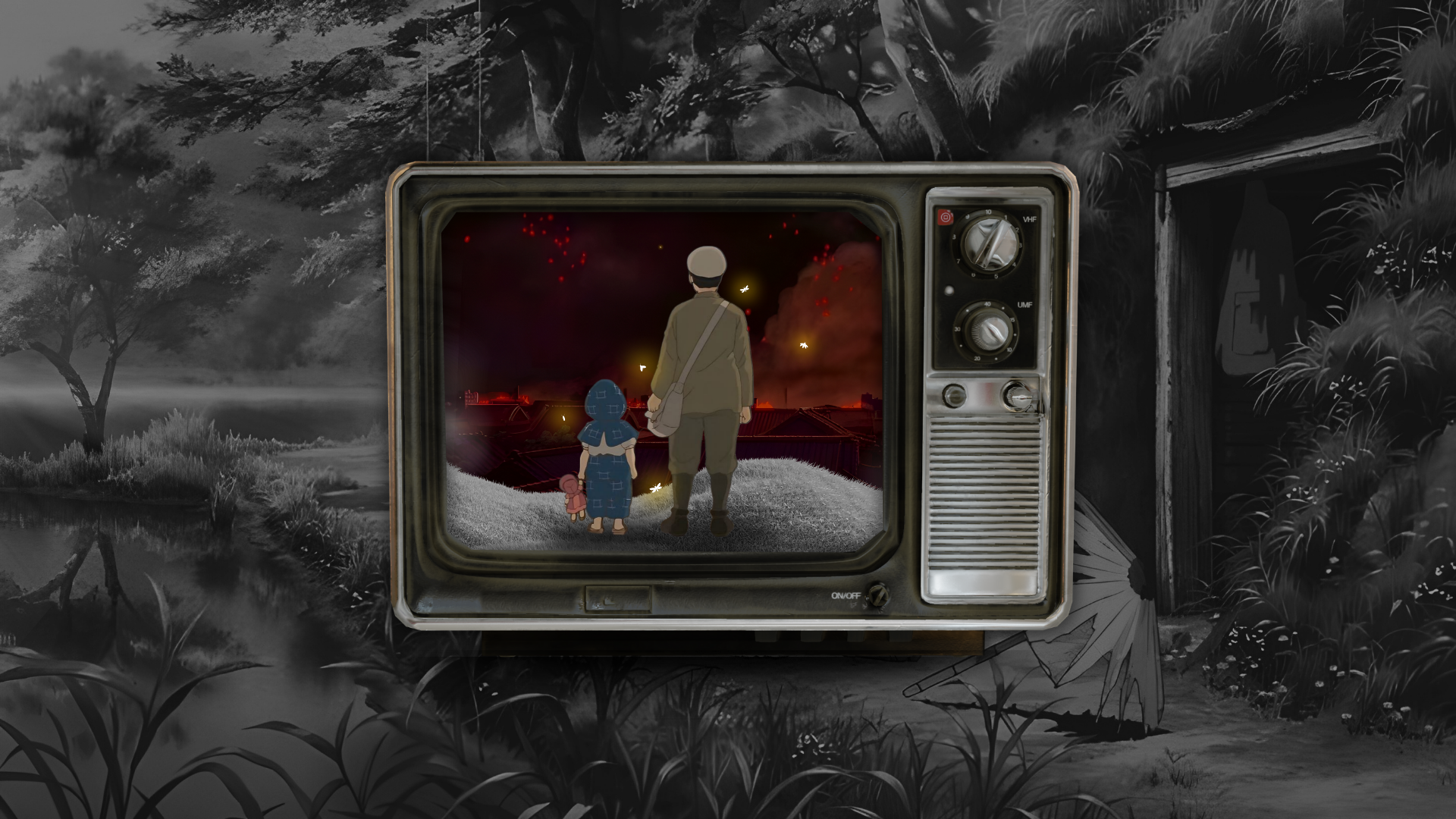
While Studio Ghibli films are nowadays known for their wholesome “slice of life” films, their 1988 film Grave of the Fireflies was a different kind. It explored the dark themes of melodramatic-children and anti-war genres—that I believe can also be considered, especially visually, as a horror film.
The horror of metamorphoses
It is a horror film if we base the definition of “horror” under Barbara Creed’s Horror and the Carnivalesque where she explained that “The modern horror film is able to depict in graphic detail the various metamorphoses that the body undergoes when attacked.”
And the film showcased this through Seita and Setsuko’s mother, where Seita showed changes through his rapid “maturation,” and his mom’s beautiful image as a mother turned into a burnt mummified-body.
But the most interesting visual case study for me is Setsuko’s character, specifically during the film’s ending scene, because her character properly showed the horrifying process of the body decomposing under the siege of an occurring war.
The horror of a child’s body
I believe that psychoanalyzing Setsuko’s body in the ending part of the film through Creed’s idea of the “mortal body” further the discourse on the functions of horror cinema as an empathetic counter-memory (simpler terms: alternative forms of not forgetting, remembering) in recounting the lived experiences of war victims in our present culture and society.
Even though Setsuko’s mortal body is not considered a monstrous body because it is clearly materialized in the film that she is a child through her body size, her clothes, her voice, her language, and her overall innocent image as a character.
But, this does not exempt her body from embodying the “grotesque” as an abjection from the patriarchal abuse that she is experiencing because she is the most vulnerable victim in the film.
The film showed the physical transgressions, or the horrors, that were inflicted in Setsuko’s mortal body to the spectators through ‘close-up shots.’ Through this filmic movement, it shows how “everything and every part of the body has become horrifying.”
In the film’s ending scene, this is seen by the close-up shots of Setsuko’s body being infested with rashes (which revealed to be caused by malnourishment), Setsuko’s bulging rib cages because her body’s extremely malnourished, the dying state of Setsuko’s mortality, and finally, Setsuko’s corpse before being cremated by his brother Seita.
Viewing horror turns empathetic
In these scenes, the spectators might be, or surely, emotional and horrified because, through Setsuko, they could also see the possibility of their body and their “selves” as prone to destruction—as “transitory, fragile, and fragmented.”
That is why when we, the spectators, look at her body, as it goes through the horrifying metamorphoses of the attacked body, our gazes now envisions (and are scared to be of also) a despondently poor, malnourished version of ourselves too in the midst of the war. The debilitating effect of the very mayhem that is happening right now in our quotidian reality, at the state of our world under late-stage capitalism.
Thus, seeing the possible politically subversive power that this film has—in terms of challenging the spectatorship and of the classical (a.k.a., purist) body—may be very complex because it both (1) reconfirms the power and the status of the bourgeoisie identities over ourselves/our bodies as below them (i.e., easily targeted, killed, etc.), yet (2) it does not alienate its viewers in spectating (and feeling with) this film despite its unsettling nature.
This film does that because it asks for our empathy—to grieve for and remember the historical myriads of Setsuko’s that were left unwritten, and unrecognized, with them.
On empathetic horror
At last, this film analysis/commentary hopes to extend the functions of horror cinema. Especially in our present time in both authenticity-driven and craving culture and society, proposing the idea of “empathetic horauthenticity-drivenror,” which is inferred in the film Grave of the Fireflies, can possibly be a different perspective in “the experience of viewing horror.”
I believe that, in our ferocious world right now, reinforcing or developing the spectator’s holistic sense of their body and self is already not enough.
The mere idea of possibly empathizing with the horror body subjected and projected to the screen can be a revolutionary act that practices the seeing of an art, like films, as a way of understanding and navigating the heavily nuanced world of humans and their respective psyches.