







Now Reading: Compliant no longer
-
01
Compliant no longer


On this day, the Filipino people converge to reject modern-day imperialism under the Trump administration’s extractive geoeconomic foreign policy. Our soil, drenched in the blood of our people, and our resources that have been covet by colonizers not long ago will never be sold to them again
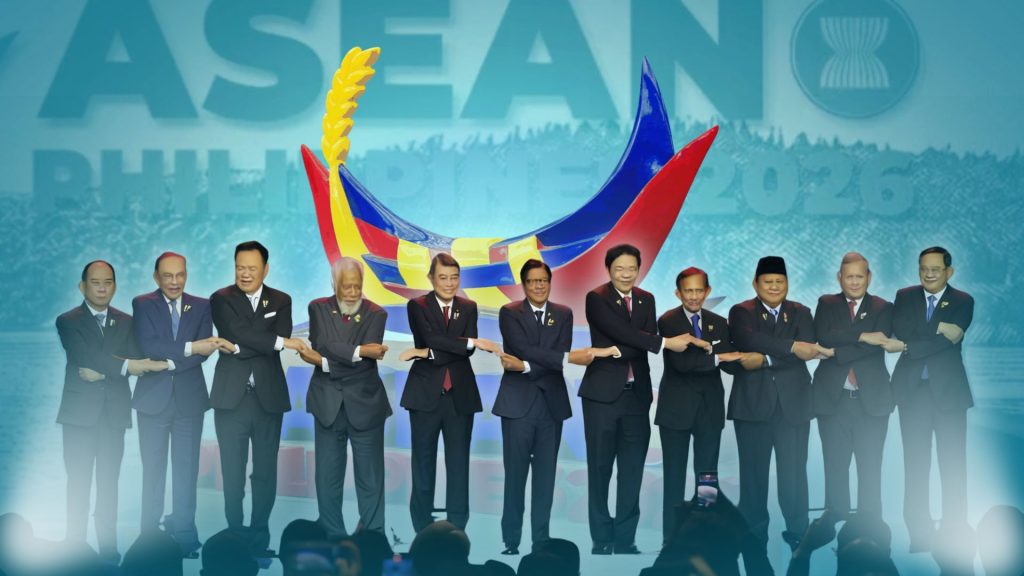
As the closed-door diplomatic meetings and economic deals unfold in 79th ASEAN Summit, we come to question the strength of our national sovereignty and whether or not the Philippines is being bartered away.
Behind the pristine venues of the Summit in Metro Manila, are the unfortunate realities of Philippine society. Poverty, struggle, and popular discontent seem to not have a place in what is taking shape under the banner of international integration. What is occurring is not a partnership among equals, but a structural subordination of the country to external strategic and economic interests.
This control and containment of public spaces to project stability and capital came at the cost of a staggering ₱22.9 billion hosting budget. The Malacanang defends this expenditure as a necessary investment for 550 official meetings. All this for status attribution that may not otherwise even be granted. What about the chronic underfunding of ssential domestic public services? What about our youth who strife under nationwide classroom shortages and our sick loved ones persevering in spite of underresourced public health infrastructure?
Not only this, but state agencies deployed 2,637 Metropolitan Manila Development Authority (MMDA) personnel alongside over 4,000 regional police forces. Security is indeed a top priority given the plethora of state VIPs and national leaders but what about the aggressions of the police against their own constituents? As summit proceedings commenced, state forces violently dispersed demonstrations in Metro Manila and Muntinlupa, arresting nearly 300 protesters and detaining activists to project an illusion of domestic order.
This suppression of the state apparatus victimized members of the youth and working masses who rose up in the streets to fight for their advocacies. On the National Youth Day of Action, thousands of students took to the streets in a sweeping nationwide walkout to reject Donald Trump’s visit and the U.S.-led Pax Silica initiative. Mobilizing across 42 universities in nine regions, the youth demonstrated that national dignity cannot be quarantined by police barricades. From the campuses of the University of the Philippines Diliman, Polytechnic University of the Philippines, and Mindanao State University to the classrooms of Ateneo de Manila University and Manila’s University Belt, students walked out to defend national sovereignty.
At UP Diliman, students marched alongside members of the Indigenous Ayta community, asserting that our land, labor, and ancestral domains will not be sacrificed for foreign military-industrial interests. Their protest struck directly at Pax Silica, a framework centered on a 4,000-acre Economic Security Zone in New Clark City, Capas, Tarlac. Under the banner of supply chain resilience, this initiative threatens over 1,620 hectares of agricultural and ancestral lands while endangering local water tables and energy supply grids. It seeks to reduce Philippine critical minerals, such as unrefined nickel ore, and semiconductor packaging facilities into cheap inputs for U.S. artificial intelligence and defense technologies.
A regime willing to brutalize its own citizens is no ally in the fight against turning our homeland into an imperialist military outpost, an environmental sacrifice zone, and a site of labor exploitation. The nation’s vibrant vibrant counter-hegemony, posits that true national legitimacy resides not in state executive decrees, but in the popular will of the sovereign populace.
Pax Silica will never represent genuine national interests. Historically speaking, the Global South has always been a hotspot of raw capital extraction by imperial powers. Under such a deal, the Philippines is positioned to become a low-cost supply source of labor, unrefined nickel ore, raw land, water to fuel the artificial intelligence, advanced semiconductor, and defense-technology industries of the U.S. and its core allies. Moreover, no comprehensive, transparent Environmental Impact Assessment has been made public for the New Clark City zone, concealing the immense burden the hub will place on Central Luzon’s local water tables and energy grids. With the glaring threat of resource depletion, what dreary future might our future generation encounter?
The economic subjugation inherent in Pax Silica cannot be separated from the rapid militarization of the Philippine archipelago. Though the security dilemma may explain heightened national security initiatives, it is worth questioning the pattern of the Marcos administration’s deepened its military integration with the U.S. Indo-Pacific command, granting U.S. forces expanded access to nine strategic military bases under the Enhanced Defense Cooperation Agreement (EDCA). This rhetoric of joint combat exercises, such as Operation Balikatan, the deployment of advanced U.S. intermediate-range missile systems, and expanding bilateral defense pacts, including emerging defense cooperation and free trade agreements with middle powers like Canada is not just deterrence of the “China threat” but a volatile stategic entanglement.
As the archipelago converts into a forward logistics base and frontline target in major-power geopolitical competition between Washington and Beijing, once armed conflict erupts, the Philippines will serve as a likely primary battlegrounds placing Filipino civilian populations directly in the line of fire to serve foreign hegemony.
Demanding, “Trump Out!” is not a naive desire of isolationalism. Pax Silica’s extractive geoeconomics, and state-sanctioned repression during the 79th ASEAN Summit poses an existential test for the Filipino nation. True national security cannot be purchased through unequal economic treaties, foreign military umbrellas, or the sacrifice of ancestral lands and working-class livelihoods.
What the Filipinos dedicate their voices, and ultimately, their lives to is reclaiming our sovereignty and prevent our home from becoming a foreign military outpost or a raw-material enclave for foreign tech and AI monopolies.
We seek a guarantee of the protection of ancestral domains, enforcing strict environmental safeguards, and directing national resources toward genuine domestic industrialization that serves the Filipino people in a comprehensive foreign policy guided by strategic autonomy.
Until national policies are rooted in sovereign self-determination rather than neo-imperial compliance, the Filipino people will continue to mobilize, resist, and demand that our land, labor, and future remain unbowed and unsold.
Trump, Out! Reject Pax Silica!