











Now Reading: EXPLAINER | Tensions on the edge: The Thailand-Cambodia flashpoint
-
01
EXPLAINER | Tensions on the edge: The Thailand-Cambodia flashpoint
EXPLAINER | Tensions on the edge: The Thailand-Cambodia flashpoint

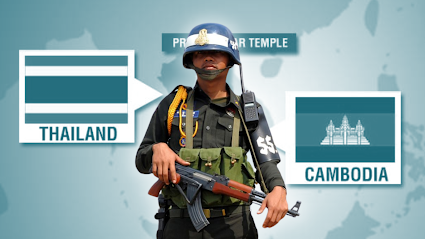
The century-old territorial rift between Thailand and Cambodia has reignited with chilling force. On Thursday, Thai airstrikes hit Cambodian military targets following mutual accusations of rocket fire and cross-border aggression. At least 11 Thai civilians, including an eight-year-old boy, and one soldier are dead. The extent of Cambodian casualties remains unclear.
This latest spasm of violence is not merely a border skirmish. It is a volatile convergence of old cartographic wounds, simmering nationalism, and political fragility in both capitals.
A Dispute etched in colonial Ink
At the core is an unresolved border — 817 kilometers of historically fraught terrain, mapped under French colonial authority during its occupation of Cambodia in the 20th century. When France withdrew in 1953, it left behind not clarity, but cartographic ambiguity.
That ambiguity has become ammunition. Though legal battles — such as the Preah Vihear Temple ruling at the ICJ — have sought to settle ownership, neither side has yielded claims fully. Every few years, the ghosts of those maps re-emerge, often inflamed by domestic politics.
Landmines, airstrikes, and trade retaliation
This latest rupture traces back to May, when soldiers exchanged fire near contested land, killing a Cambodian troop. A diplomatic tit-for-tat followed: Thailand tightened border protocols, while Cambodia retaliated with bans on Thai media, produce imports, and even bandwidth sourced from Thailand.
On Wednesday, matters escalated: Five Thai soldiers were maimed by landmines near the northeastern border. Thai officials alleged the mines were freshly laid, prompting the closure of border crossings, the expulsion of Cambodia’s envoy, and a diplomatic downgrade. Cambodia rejected the claim, recalling its Bangkok staff and accusing Thailand of military aggression.
The following day, Thailand launched airstrikes, a rare and dramatic escalation.
After four deadly days, diplomacy stepped in — or at least attempted to. Under the mediation of an unlikely figure, US President Donald Trump, both countries agreed to hold ceasefire talks in Malaysia on Monday. The negotiations come on the heels of a border clash that left at least 33 dead and displaced thousands.
Fragile thrones, fragile borders
In Phnom Penh: Dynastic transition under pressure
Cambodia’s new leader, Hun Manet, governs under the long shadow of his father, Hun Sen, who ruled for nearly four decades and now serves as Senate President. Analysts, including Matt Wheeler of International Crisis Group, suggest stoking nationalist sentiment may be a tactic to buttress Hun Manet’s political legitimacy, which remains nascent and heavily inherited.
The crisis also diverts public attention from looming economic hardship: a 36% U.S. tariff on key exports is scheduled to take effect on August 1, threatening already strained livelihoods.
In Bangkok: A leaked call, a dented party
Thailand, meanwhile, is reeling from its own crisis of leadership. Prime Minister Paetongtarn Shinawatra is suspended from office, her ruling Pheu Thai Party wobbling under pressure. The backlash was swift after a leaked phone call revealed her deferential tone toward Hun Sen, calling him “uncle” and promising to “take care of” requests.
Worse still, she criticized a senior Thai military official, alienating an institution historically known for intervening in governance. The episode not only sparked accusations of favoring personal ties over national interest, but deepened a growing perception of civil-military discord.
“They don’t have much option but to go along with what the military wants,” notes Tita Sanglee of ISEAS–Yusof Ishak Institute. At this moment, a stronger military posture may be seen as the only viable political currency.
Diplomatic dead ends
ASEAN’s silence, China’s shadow
Cambodia has asked the International Court of Justice to intervene, but Thailand does not recognize its jurisdiction rendering legal arbitration largely symbolic. Meanwhile, ASEAN, chaired by Malaysia, has urged restraint. But the bloc’s foundational principle of non-interference neuters its ability to mediate meaningfully.
That leaves China — economically entwined with both, but especially aligned with Phnom Penh — as the only external actor with potential leverage. Yet Beijing’s perceived partiality makes its involvement diplomatically delicate, especially for Bangkok and regional neighbors already wary of Chinese expansionism.
And so, the Philippines — under President Ferdinand Marcos Jr. — has offered an alternative voice. Cautioning that this could spiral like previous clashes, he emphasized the need for compliance with international law, adding that the Philippines stands “ready to assist in any way to help restore peace.” His statement echoed broader ASEAN anxieties: “We urge both nations to settle the dispute peacefully and in accordance with international law.”
What now?
Caretaker PM Phumtham Wechayachai insists that no war has been declared and that hostilities are contained. But the death toll, severed diplomatic lines, and weaponized nationalism tell a different story.
Cambodia has turned to the United Nations Security Council, accusing Thailand of “unprovoked military aggression.” Yet the UNSC’s ability to act swiftly, or at all, remains uncertain.
A century on, still no peace
What began as an imperial oversight has become a 21st-century tinderbox, fueled by old grudges and present-day power plays. In a region already uneasy about geopolitical imbalances and economic stress, the Thailand–Cambodia dispute is no longer a local flare-up.
It’s a test of regional diplomacy, leadership under pressure, and whether Southeast Asia can contain its own ghosts before they escalate into infernos.
For continuing coverage, follow BBC News, Reuters, and International Crisis Group.