






Now Reading: Ghosts in the flood
-
01
Ghosts in the flood

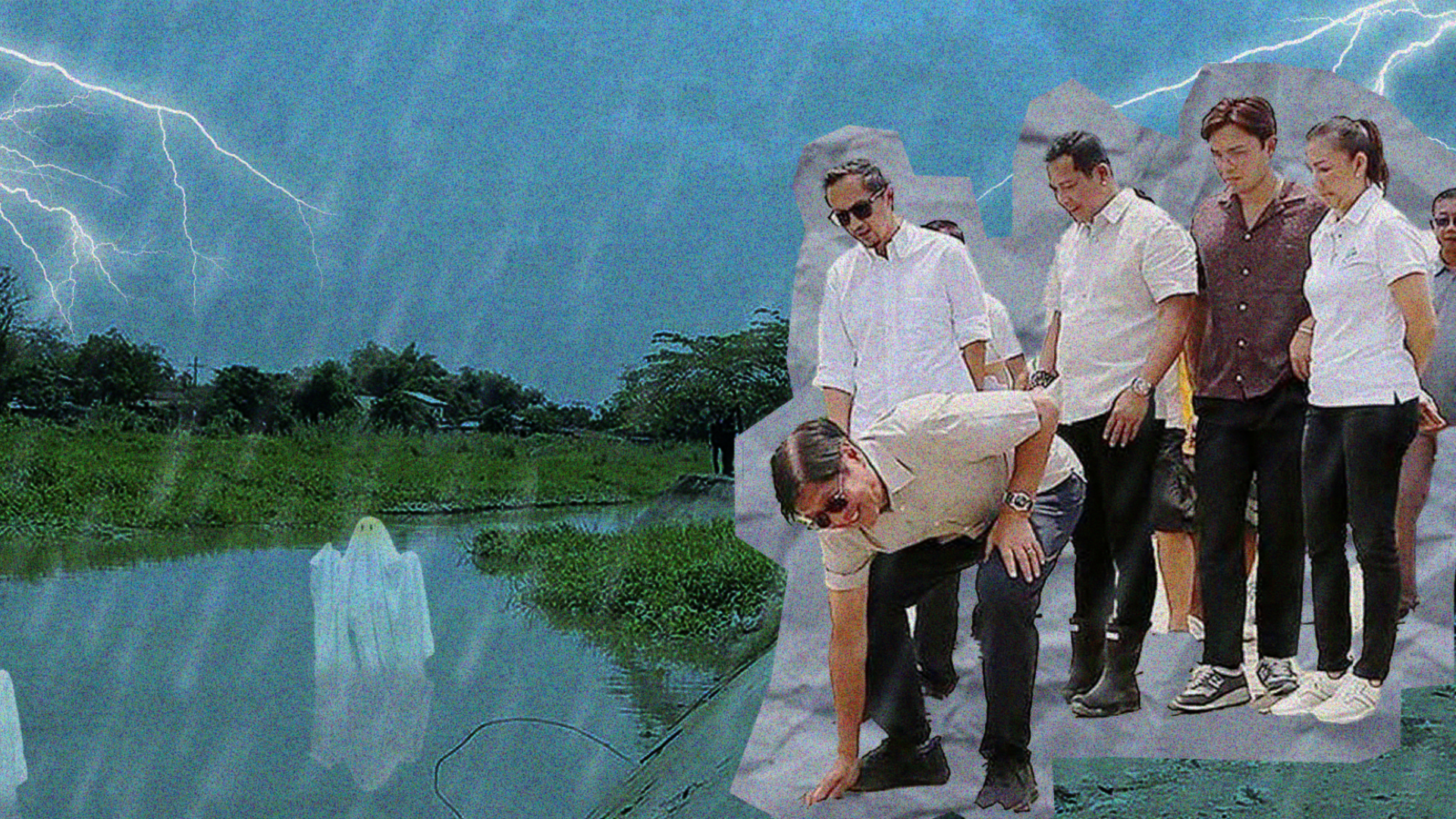
“I’m not disappointed, I am very angry.”—that’s how President Ferdinand Marcos Jr. proclaimed himself as he inspected the infamous ₱55-million “ghost” riverwall in Baliuag, Bulacan.
Standing before the unfinished structure, he channeled what every Filipino has long felt: outrage. Outrage at wasted money, outrage at empty promises, outrage at seeing another glaring symbol of corruption dressed up as development.
But the difference is this—while ordinary Filipinos drown in floods, government officials drown in excuses. Let’s be blunt: this is not just a wall that never rose. This is trust that was never built.
Bulacan has swallowed nearly half of Central Luzon’s flood control budget since 2022, and yet, time and again, the province ends up underwater. Billions gone, lives disrupted, homes washed away—and then we discover a “project” that exists only in paper and presidential press releases.
Anger is not enough. What we need is accountability that actually leaves a mark—legislation that punishes ghost projects, transparent bidding systems, and audits that are timely, and not ceremonial.
Consider this, if ordinary Filipinos can track a delivery from Lazada or Shopee in real-time, why can’t they track the progress of a billion-peso riverwall funded by their taxes?
If private companies can blacklist unreliable sellers overnight, why then does the government take years—and often never—to ban erring contractors? Accountability is not just paperwork; it is infrastructure in itself. Build it right, and every ghost project collapses before it begins.
And here lies the problem—Marcos’s fury makes headlines, but fury fades. The cameras leave, the speeches end, and people move on. But the floodwaters? They don’t care. They keep rising.
For years, Filipinos have been sold the dream of flood mitigation, yet what we get are ghost projects, substandard work, and contractors who somehow always manage to stay in business despite investigations. How many times do we have to hear about “strong words” before we see strong reforms?
The truth is, anger is the easiest political tool to wield. Any president can frown in front of cameras.
What’s difficult is cleaning up the entrenched networks that breed these scams: the monopolized contracts, the favored contractors who win bids like clockwork, the local officials who sign off on paperwork while turning a blind eye to construction sites that remain unproductive.
This is not just corruption—it’s collusion. And unless those layers are ripped apart, Bulacan’s ghost wall will not be the last.
Let’s also remember who pays the price. It’s not the contractors sipping liquor after a padded deal. It’s not the politicians who will simply move on to the next ribbon-cutting.
It’s the jeepney driver whose home gets flooded every monsoon, the sari-sari store owner who loses income each time the river swells, the students whose classes are suspended for weeks, whose schools double as evacuation centers, whose education drowns in the same waters that flood their homes. Infrastructure is supposed to be protection. But here, protection is the ghost.
Every storm sets their future back a little further, making resilience less of a choice and more of a burden handed down by a government that fails them.
Yes, the Commission on Audit, the Bureau of Internal Revenue, and the Senate Blue Ribbon Committee are now circling the issue.
And yes, investigations are given but let’s not kid ourselves—we’ve been here before. Countless concerns have ended with grandstanding, finger-pointing, and fancy reports that gather dust in archives.
Where are the convictions? Where are the blacklisted contractors? Where are the systemic reforms to stop billions from vanishing into thin air? Anger without consequences is just performance.
Here’s the uncomfortable truth: the unfinished wall in Baliuag is not an anomaly—it is the system. It is the blueprint of how public funds are siphoned, how oversight is gamed, and how leaders pretend to be shocked every time the rot is exposed.
Marcos can say he is “very angry.” But Filipinos are not just angry—we are exhausted. Exhausted from storms that flood our homes, exhausted from scams that flood the news, exhausted from promises that, like that riverwall, never materialize.
If walls can vanish into thin air, what more for a government built on ghosts? Budgets? Reforms? Justice? Filipinos are asked to be resilient with every disaster. But maybe it’s time the government proved resilient too—resilient against corruption, resilient against incompetence, resilient against its own ghosts.
Until then, every flood will remind us that the water keeps rising, but accountability never does.