










Now Reading: It’s all in the math
-
01
It’s all in the math

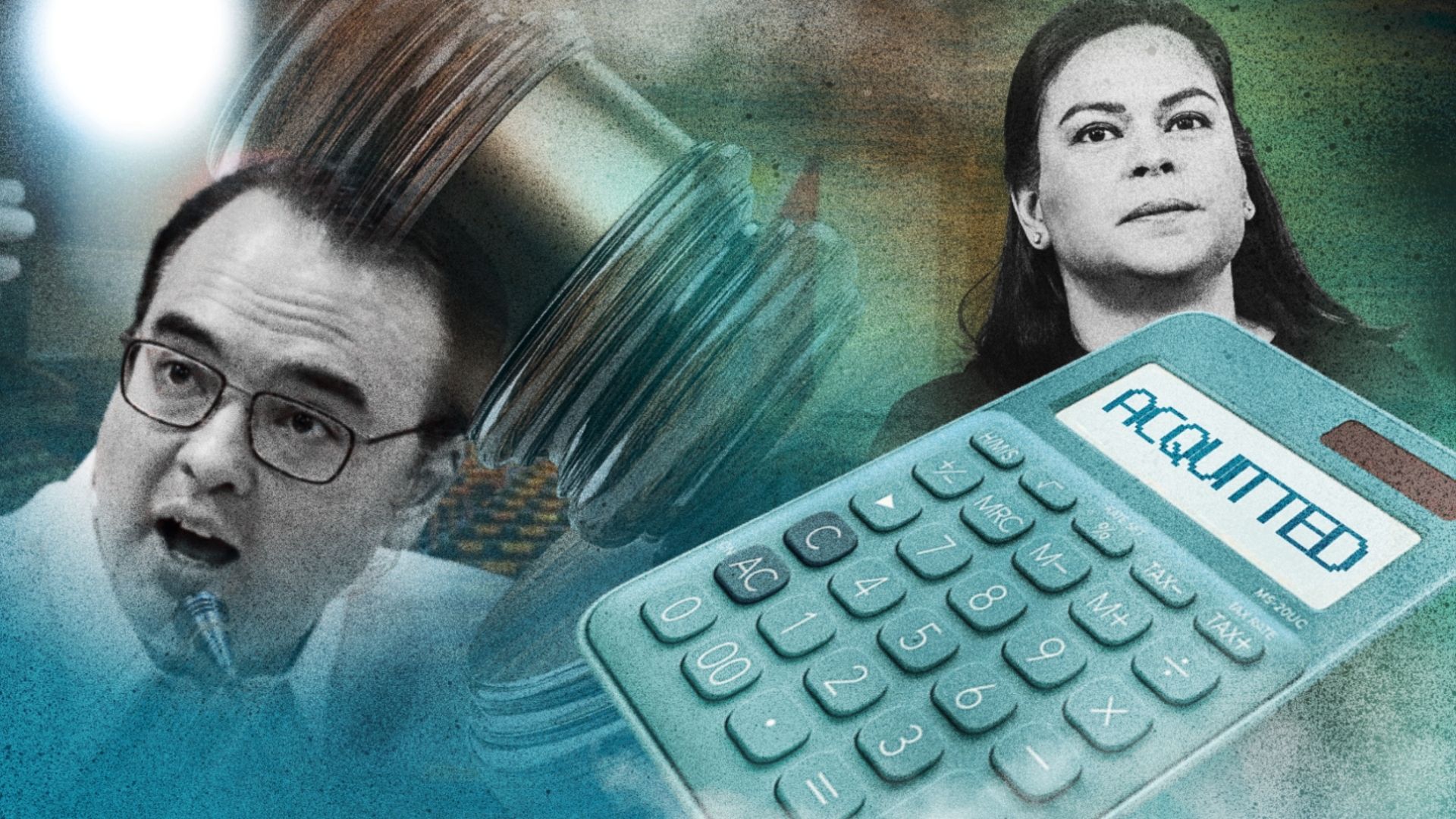
Fact 1: The senators who voted for Alan Cayetano are all known Duterte allies.
Fact 2: It happened on the same day the House impeached Vice President Sara Duterte.
Once the gavel falls in the Philippine Senate, will it be a beacon of the triumph of the law or merely the closure of a high-stakes arithmetic exercise? How will we draw our conclusions?
As the impeachment trial of Vice President (VP) Sara Duterte looms, the Philippines is entering an extraordinary state of affairs where 40% of citizens have already reached a verdict: that the strength of evidence is secondary to the thunder of the majority will. But in this quintessentially political arena, the search for factual truth is being outpaced by a so-called trial by numbers.
While the House of Representatives has delivered a massive mandate for impeachment, the mathematical reality of the Senate suggests that the most probable outcome is already written in the ledgers of political alignment: acquittal
On May 11, 2026, the House of Representatives voted to impeach the Vice President for the second time with a resounding tally of 257 in favor, 25 against, and 9 abstentions. This figure far exceeded the constitutional requirement of 106 votes, signaling a peak of public and political pressure driven by allegations of misusing ₱612.5 million in confidential funds and making security threats against the President. With 13 senators already voting as a united front, the 16-vote threshold for conviction appears nearly impossible to reach.
However, the momentum of the House is about to hit a mathematical brick wall the very same day in the upper chamber. This is much indicative of the past outcome in the 2025 proceedings, where the Senate voted to archive the case on August 6th, effectively concluding the process without a trial. This is on top of the Supreme Court declaration that the articles of impeachment were unconstitutional on a technicality, citing a violation of the one-year rule.
To convict a Vice President, the Senate requires a two-thirds supermajority, or 16 out of 24 votes. Conversely, the Vice President only needs 9 senators to vote for her acquittal to remain in office. This numbers game shifted conclusively with a surprise leadership coup where 13 senators ousted Tito Sotto and installed Alan Peter Cayetano as Senate President. This new majority bloc, which includes the spectacle of Senator “Bato” Dela Rosa’s heated return and other Duterte-aligned figures like Bong Go and Imee Marcos, effectively serves as a smoke-screen for the no-show VP
Furthermore, the recent survey by WR Numero survey shows that this political math is also mirrored by a troubling sociological trend. A significant approximate 40 percent of Filipinos believe that lawmakers should base their impeachment vote on the majority will, while only 30 percent believe that the decision should be driven by the actual evidence presented during the trial. And when only one in 10 citizens believes a lawmaker should vote based on their personal conscience, the Senate is pressured to act as a pressure cooker of public opinion rather than a court of law
While the voices of the people are indeed the heartbeat of a democracy, this mindset is a precarious path. If we allow public sentiment to completely override factual proof, we risk turning a serious constitutional process into a mere popularity contest, potentially damaging the long-term stability of our justice system. A conviction on the basis of numbers without substantial evidence will always lack long-term legal stability.
So then, what’s the next step in the formula? What are the actual paths forward in this political labyrinth? While the House has already played its part, the Senate remains a chamber of three distinct possibilities, each governed by its own rigid arithmetic.
The first, and most dramatic, is a conviction and permanent disqualification. For this to occur, the House prosecution must secure a two-thirds supermajority, or 16 out of 24 votes. The stakes here are absolute; a guilty verdict would not only remove the Vice President but would legally terminate her 2028 presidential bid. But, given the circumstances, this is a low-probability scenario. Reaching 16 votes is a tall order in the face of the newly-formed 13-member majority bloc, fracturing current political alliances.
The second possibility is a procedural death or delay. This trial does not exist in a vacuum; it is subject to the maneuvers of Senate leadership and the oversight of the Supreme Court. With Senate President Alan Peter Cayetano now at the helm, the chamber can use a simple majority of 13 votes to pass procedural motions that could effectively archive the case or delay the trial indefinitely. As previously discussed, we have seen this play out before. Duterte’s legal team is already pursuing a similar route, filing for a Temporary Restraining Order (TRO) to halt the process before it can even begin.
This leads us inevitably to the most probable outcome: acquittal. To survive, the Vice President does not need to prove her innocence; she only needs to hold the loyalty of 9 senators. In layman’s terms, what’s shielding the VP is not legal theory but a tactical headcount.
Senators Bong Go, Bato dela Rosa, Imee Marcos, and the Cayetano siblings possess enough votes to block a conviction. Unless seven members of this bloc decide to commit political suicide by turning against their own majority, the path to 16 votes is closed; the numerical reality is tremendously unchanged.
Ultimately, we are witnessing a dangerous disjuncture in our democracy. While the House’s 257 votes represent a peak of public demand for accountability, they are functionally irrelevant if they cannot penetrate the Senate’s “thirteen.” The final verdict is penned by a pre-arranged political headcount rather than a rigorous and veracious search for truth. We are met with a crisis of legitimacy that will taint the Philippine’s poolitical institutions for years to come.
The VP’s office may be secured, but the nation will remain divided. Supporters will see it as a vindication of a persecuted leader, and critics will analyze it as a political hit job. In the end, the Senate may find that while they can balance the books of political survival, they cannot so easily restore the public trust. After all, when justice is reduced to a tactical headcount, the law loses its voice.
In this chamber, it’s not about the truth, and it’s certainly not about the evidence. It’s all in the math.