








Now Reading: LGBeaTs on Q!Meet these 11 songs to shape the perfect pride playlist
-
01
LGBeaTs on Q!Meet these 11 songs to shape the perfect pride playlist
LGBeaTs on Q!Meet these 11 songs to shape the perfect pride playlist

Aldrich Allaga and Aaron Dave Mendina
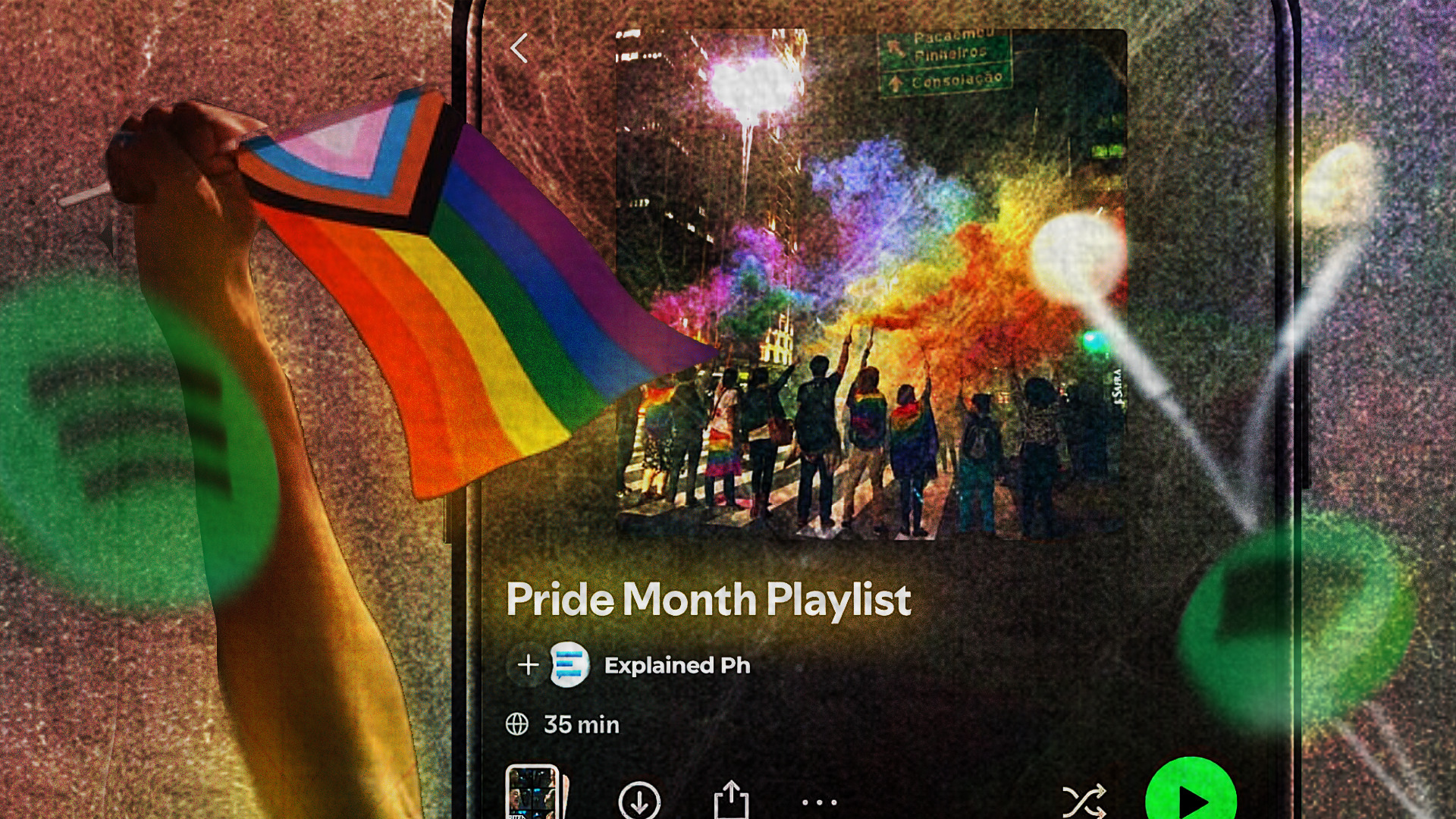
Pride Month wouldn’t be complete without the songs that accompanied our canon events and gave music to our lived realities.
From glittering, modern Chappell Roan bangers to powerful, nostalgic Disney anthems, these tracks are the perfect mix of LGBTQIA+ kilig and longing that make for one hell of a pride month playlist.
“Straight hair, straight A’s, straightforward, straight girl— Little Miss Perfect, that’s me.”
— Little Miss Perfect, Write Out Loud (2019)
“Crush ng bayan,” student council pres, and oh-so “straight,” but what happens when imperfection starts to seep through the facade of ‘Little Miss “Perfect?’
As one of the winning songs in the “Write Out Loud” contest in 2019, this song perfectly captures the struggles of a closeted teenage girl who struggles to find individuality amidst rigid societal expectations.
Inspired by the 13 Reasons Why character Courtney Crimson, lyricist Joriah Kwamé mentions the specific scene where she, the supposed “Little Miss Perfect,” was pictured kissing another girl from outside her window, prematurely outing Courtney before she even fully knew she was lesbian. Since then, the song has been adapted into the musical Noelle with similar themes of disrupting a typically rigid status quo.
For the confused young girls who get tired of being asked, “Where’s your boyfriend?”
“What a sight for sore eyes
Brighter than the blue sky
She’s got you mesmerized while I die”
— Heather, Conan Gray (2020)
Released as the sixth single of Conan Gray’s debut album Kid Krow, ‘Heather’ is an essential in the repertoire of LGBTQIA+ songs of yearning and despair, notable for being the song on the album that even the songwriter always cries to.
The three-minute track is a masterpiece of vulnerable storytelling, with Conan’s vocals cradling the quiet yet immensely painful ache of unrequited love — and the self-conflict that comes from hating someone perfectly innocent.
The song chronicles a love story from Conan’s perspective, detailing the sadness and envy that come with your love interest having feelings for the perfect girl while you watch from the sidelines, carrying his sweater.
In the recently released Lost Verse Version of the song, this dynamic is further deepened, with the last verse ending in: “’Cause isn’t she perfect? The lipstick on her lips. I wish I could kiss her to know why you love her.”
For the closeted boys who fell for their best friends, wishing they were Heather.
“Good luck finding a man who has the means to rhinestone cowgirl all night long “
— The Giver, Chappell Roan (2025)
She gets the job done — with a touch of rhinestone cowgirl that no man can quite match. Debuting into country music, Chappell Roan’s ‘The Giver’ is more than just a sapphic anthem; it’s Chapell’s way of subverting the traditional role of men as providers, proving that no one can please women the same way a woman herself does.
“I think I have a special relationship to where I’m from [Springfield, Missouri],” Chapell shares in a Genius interview, hinting at a possible genre-bending second album.
She posts on Instagram, “The Giver is my take on country xoxo may the classic country divas lead their genre, I am just here to twirl and do a little gay yodel for yall *✲☆⋆.”
For the girls who just wanna have fun (in glittered cowgirl boots, of course)!
Tim I Wish You Were Born a Girl
“I know it’s not possible now
I just never met a girl I like half as much as you”
— Tim I Wish You Were Born a Girl, of Montreal (1997)
While sonically a much more upbeat song than our other mentions in this list, ‘Tim I Wish You Were Born a Girl’ hides a heartbreaking reality beneath its playful guitar strums. The song delivers a unique narrative on heteronormativity in the 1990s in just under two minutes, with the singer romanticizing the mundane things in life as long as it was with Tim.
Ultimately, however, the song ends in resignation, with the singer acknowledging that the domestic dream would just not be the same with two male best friends.
In a fan-made animation posted on YouTube back in 2021, Tim is not characterized as a girl, even when the narrator sings that he wishes he were — implying that he doesn’t actually wish for a female Tim, rather yearning for a world that would accept them both as who they are.
Of Montreal, an American pop band formed in 1996, penned this underrated gem of an LGBTQ+ track. Even 30 years later, the indie pop anthem still hits home for the closeted full of love.
For everyone who ever had to hide an entire lifetime of love inside a “what if.”
“And I’m all mixed up, feeling cornered and rushed. They say it’s my fault, but I want her so much.”
— All the Things She Said, t.A.T.u. (2001)
Ironically, the music video of this 2002 Russian classic by Lena Katina and Julia Volkova (t.A.T.u.) is banned in its own country, featuring scenes of schoolgirls kissing tagged as “LGBTQ+ propaganda.” Detailing the intensity of forbidden love and societal disapproval of same-sex relationships, it’s coincidentally perfect given the song’s surrounding controversies.
Nevertheless, ‘All the Things She Said’ has experienced a recent resurgence with its inclusion in “Heated Rivalry,” a developing series on the passionate affair between two gay rival hockey players and their gradual process of acceptance. The scene in question is a tense, sizzling exchange between Shane Hollander and Ilya Rosanov, both of whom are trying to “one-up” by dancing with strangers, skating “on thin ice” between passion and envy.
For the long-distance lovers who cannot be stopped by circumstance.
“I’m listening to the songs you told me to
I don’t really like them, but I’ll pretend for you
I’ll learn some lyrics so I can sing when you do
But I keep thinking, ‘If only you knew’”
— A Shitty Gay Song About You, Ezra Williams (2018)
‘A Shitty Gay Song About You’ is an intimate, almost bittersweet ukulele ballad about hidden feelings for a straight friend. The two-minute single storytells the universal experience of learning someone’s interests and hobbies to get closer to them, listening to their rants and problems while secretly smiling at the thought that you were the solution they needed.
Ezra Williams also touches on the giddy, canon event of your crush being absolutely oblivious to your feelings, thus looking for other mediums to express your affection. They end the track with, “But I hope when you hear it, you’ll add it to a playlist of your favourite songs of all time.” This is a quiet contentment at a love not yet entirely confessed, but still expressed.
For those who fell for their straight best friend, hiding confessions within playlists.
This Guy’s In Love With You Pare
“Until out of the blue I’m feeling so true, bigla nalang sinabi sa akin that, ‘This guy’s in love with you pare.” —This Guy’s In Love With You Pare, Parokya ni Edgar (2002)
With another early 2000s LGBTQ anthem, Parokya ni Edgar explores the shift in friendship dynamics after a close male friend suddenly falls in love with him. From stolen stares to late-night sleepovers, the song is a reminder that actions often speak louder than words, especially when the closet is practically transparent.
Although the lyrics may seem a bit stereotypical, they definitely highlight the relatable feeling of throwing rocks at someone’s window just for them to be… well, dense to say the least, before that Eureka moment hits— “Oh, no, my best friend’s gay.”
For that quiet yearner who should definitely ruin the friendship.
why did you invite me to your wedding
“We used to make fun of kids marrying young
But it’s not as funny when it’s someone you loved”
— why did you invite me to your wedding, Kevin Atwater (2023)
Kevin Atwater delivers a profound, heartwrenching love letter that comes a lifetime too late in his single ‘why did you invite me to your wedding’. In less than three minutes, the artist crafts a quiet, restless narrative after receiving a drunk wedding invitation from the man who used to be his world. Atwater’s steady yet fragile voice anchors the devastating storyline, as he embraces the rush of still being remembered while drowning in the realization of a forever unrequited romance.
The song unravels a history of intimate boyhood, recounting memories of a sudden middle-of-the-night kiss, the nervousness that soon followed, and the relief that came crashing down in the form of acceptance. Despite this, he finds that his past love followed a conventional, almost expected trajectory — affirmed through a wedding invitation received at 1 in the morning. After a few verses of internal turmoil, he accepts the finality of an unreturned love, choosing not to reply than to relive ghosts of a supposed to be buried past.
For the ones who had to learn to love the memory, letting go of the person who made it.
“When’s it my turn? Wouldn’t I love, love to explore that shore up above? Out of the sea, wish I could be part of that world.”
— Part of Your World, Jodi Benson (1989)
Unbeknownst to many, ‘Part of Your World,’ which was co-written by Howard Ashman, was initially written from the lens of his personal experience as an openly gay man, accompanied by deep yearning and questioning where he truly belonged.
Today, the song is best known for its inclusion in both the animated and live-action “The Little Mermaid” and still echoes the same, albeit cinematic longing; however, the classic tale written by Hans Christian Andersen was coincidentally also a “love letter” to an unrequited same-sex attraction towards his crush, Edvard Collin. This has left fans wondering if The Little Mermaid itself has been an allegory all along for seeking acceptance.
For the ones in the closet who desperately crave a hug.
The Predatory Wasp of the Palisades Is Out to Get Us!
“Oh, how I meant to tease him
Oh, how I meant no harm
Touching his back with my hand, I kiss him
I see the wasp on the length of my arm”
— The Predatory Wasp of the Palisades Is Out to Get Us!, Sufjan Stevens (2005)
‘The Predatory Wasp of the Palisades Is Out to Get Us!’ is an epic, monumental memoir where Sufjan Stevens retells the pivotal moment when a childhood friendship clumsily morphs into a profound romantic awakening. Taking place in a religious summer camp memory, the singer navigates blossoming feelings in a setting where homosexuality is frowned upon. In this 5-minute ballad, the church is symbolized by a wasp, repeatedly stinging and eyeing the two boys for engaging in homosexual relations.
While Stevens boldly proclaims “We were in love!” in the chorus, the song concludes in quiet heartbreak as the songwriter reveals that his friend ran away. He confesses that he still loves him every day, and as he recalls his memories with him, he remembers the pain of terrible stings and terrible storms. The song is a beautiful but gut-wrenching portrait of a love that couldn’t survive in the face of religious guilt and peering eyes, and how it settles deep within one’s bones like a wasp resting on one’s arms.
For the boys who had to bury a beautiful thing in the quiet dark, just to keep the peace with a heaven that wouldn’t understand.
“Hand me a pen, and I’ll rewrite the pain. When you’re ready, we’ll turn the page together.”
— Chosen Family, Rina Sawayama (2020)
When pride isn’t as prideful as it should feel, Rina Sawayama knows just the right words to soothe the heartache into a lyrical masterpiece. Co-written with Danny Harle, the pop singer shared how this song was a “safe space” for the LGBTQ community, citing how common it was for people to be kicked out of homes for being queer. “Chosen family has been a queer concept for a long time, and it felt very special to be able to write that,” she shares with Genius.
A year after its release, Rina also uploaded a performance lyric video version with Elton John that featured the latter’s skillful piano and riveting vocals, evoking an even deeper sense of warmth, given Elton’s personal experience as an openly gay man.
For the ones who feel like they have nowhere to “belong.”
This Pride Month, may these songs be the needed embrace for anyone struggling with their gender identity — know that your stories are heard in each synth, drum, and hair-raising lyric from your favorite artists.
After all, what’s music if not a soulful universal language that binds us all, regardless of who we are?