





Now Reading: What the voyage of the Indigenous Taiwanese to Batanes tells about their thousand-year golden friendship
-
01
What the voyage of the Indigenous Taiwanese to Batanes tells about their thousand-year golden friendship
What the voyage of the Indigenous Taiwanese to Batanes tells about their thousand-year golden friendship

Top Saligan, John Luis Soriano, and Francheska Mera Rayo
Across the island-strewn expanse of the Pacific Ocean stood a friendship that not even time, colonization, and changing global trends could break. Despite being separated by hundreds of miles of waters, it remained alive to this day.
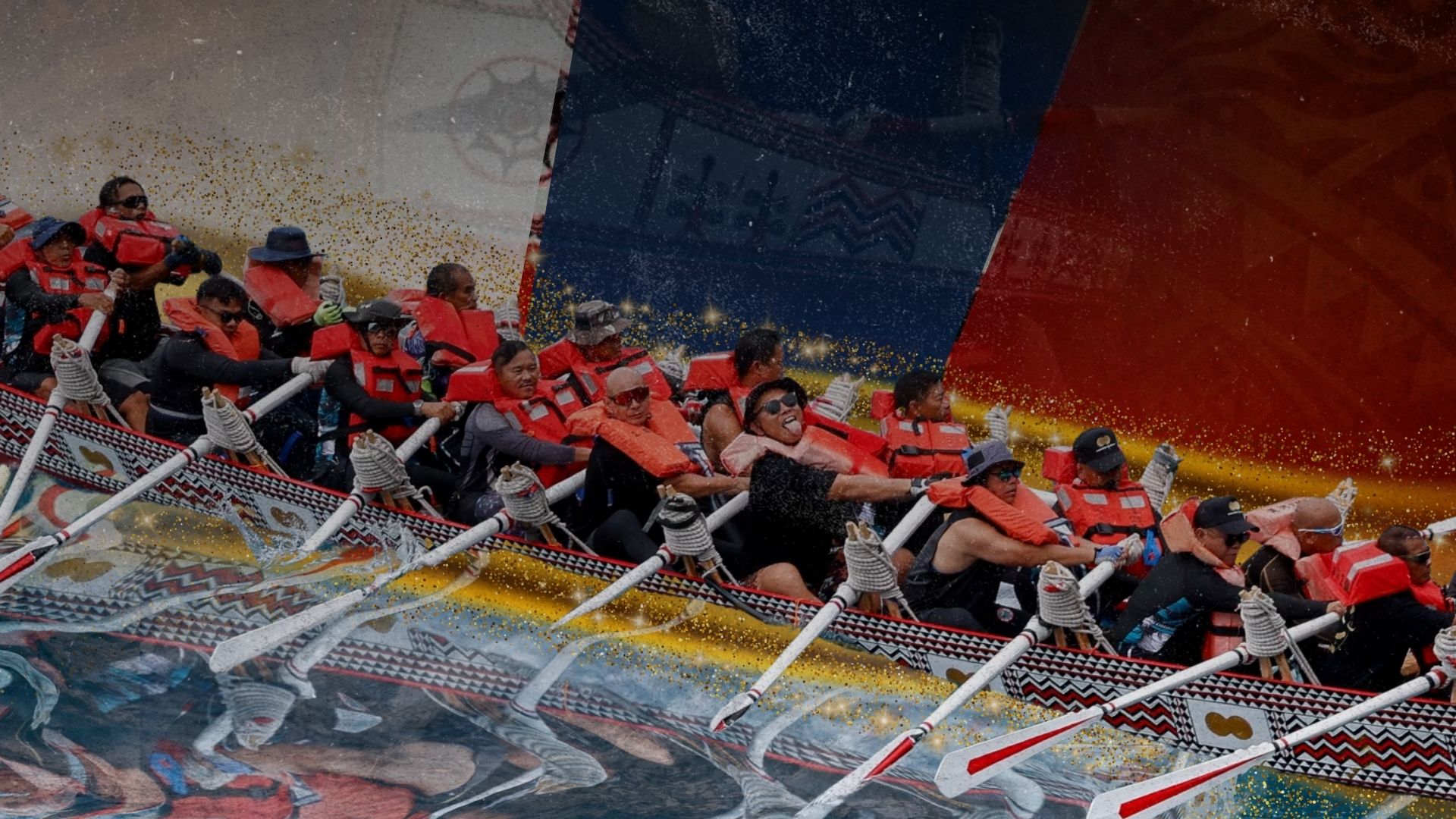
Last June 15, a group of indigenous Tao People of Taiwan set sail for the Batanes Islands under a government-backed project to revive a long-dormant maritime route that connected the cultures of the Tao and Ivatan peoples. The journey, taking 60 men paddling for 24 hours in a canoe named Ovayan, or Golden Friendship, is not only rekindling an ancestral flame between the islands, but also remembering the shared culture between them as Austronesians.
Brave of the seas
There is a lot to unpack when giving the word “Austronesian” a definite meaning, but it encompasses two main categories: the people and the language.
Although several theories exist, the most prominent one is the mass migration that happened at least 5,000 years ago, a massive sea-borne exodus from Formosa (Taiwan) in canoes. Braving through the Pacific waters, the people later known as Austronesians began settling in the outlying islands and archipelagoes such as Indonesia and the Philippines, and even reaching as far as Madagascar.
As these brave seafarers settled on land, they too brought the tongues they spoke before the migration, in time evolving yet keeping their distinct linguistic features as Austronesians through trade and interactions.
It is not difficult to spot the similarity among the spoken language of people living in the South East Asia region where the migration occurred. Taking the word “mata” (eye) for example, it carries similar meanings and translations between the Indonesian and Filipino language, despite the latter being an amalgamation of other languages brought by the colonization period.
The most prominent of it all is between the Yami language of the Tao people and the Ivatan language of the people in Batanes who happen to be the centerpiece of the Austronesian story. Their similarity is kept by a small crop known as “ubi” in Ivatan and “uvi” in Yami — apparently, yams are a testament to their roots as siblings, in both origin and language.
But their union as brothers separated by seas was not without interruption as conflicts and colonization occurred.
Waves, winds, and the gathering of ancestry
History is not just something left behind in old textbooks as it also lives in the saltwater that divides and unites us.
For centuries, the story of how the Philippines came to be was told from the shore, heavily influenced by Western perspectives that made our islands look like lonely spots on a map waiting to be discovered. But the voyage of the Golden Friendship (Ovayan) in June 2026 turned that old idea on its head.
When that 12-meter wooden canoe, built by hand by the indigenous Tao people of Orchid Island, Taiwan, crossed the 185 kilometers of rough waves in the Bashi Channel to land in Batanes, it proved a point. It showed that the ocean between Taiwan and the Philippines was never a barrier. It was a bridge, one that European and Asian empires tried desperately to shut down.
If you look at it from the cliffs of Taiwan, particularly through the oral histories of the Tao people of Orchid Island, their relationship with Batanes was defined by both deep kinship and vibrant trade. Indigenous folklore recounts the legend of Tao giant named Si Mangavang, who built a large chinurikuran canoe capable of carrying 16 people to sail south to Batanes.
There, he forged a close lifelong friendship with an Ivatan giant named Si Vakag, establishing a prosperous trade route where the Tao traded gold and weapons for Ivatan cowhide, which the Tao used to craft traditional body armor. However, this fluid, ancient highway came to a crashing halt in August 1895, when the Spanish Empire and the Empire of Japan signed the Convention of the Boundary between Japan and Spain in the West Pacific.
Desperate to secure their respective imperial holdings after Japan took control of Taiwan, these foreign powers drew an arbitrary political line right through the middle of the Bashi Channel. Suddenly, the Tao were stranded on the north side of a heavily policed imperial frontier, and their traditional cross-border voyages were strictly criminalized by colonial authorities.
From the Philippine side of the story, specifically from the shores of Batanes, Spanish colonization brought a forced, administrative dismantling of this oceanic kinship. Prior to Spanish arrival, the Ivatan maintained total autonomy over their northern trade routes and deep cultural ties to Orchid Island, utilizing fortified, high altitude cliff settlements known as idjangs to protect their independence.
However, the Spanish colonial administration found it incredibly difficult to tax or control a maritime population that could simply hop into their boats and vanish into the northern waves toward Taiwan. To break this regional self-reliance, Spanish Governor Joaquín del Castillo issued a degree in 1789 forcing idjangs to resettle into tightly monitored lowland coastal towns like Basco and Ivana.
When the Ivatan chief Aman Dangat led a fierce revolt against these colonial impositions, the Spanish authorities executed him and systematically restricted native resistance. By forcing the Ivatan inland and reorienting their entire economy toward mainland Luzon and Catholic bureaucracy, the colonial government effectively induced a collective amnesia, blinding them to their closest neighbors just a few kilometers north.
Four thousands years after their ancestors first navigated these waters, and over a century after colonial treaties tore them apart, the Golden Friendship (Ovayan) retraced that path across the Bashi Channel. It did not feel like a brand-new exploration; it felt more like a family reunion. The journey reminded people in both Taiwan and the Philippines that long before modern empires drew borders across the ocean, our ancestors were already crossing it to share stories, tools, and bloodlines.
The same water that carried them before the empires arrived still connects us today, proving that our history is not about the lines drawn by colonizers, but about a long, shared connection that survived waves.
Friendship against the roaring tides
No powerful waves could hinder a reunion that has waited for 300 years.
Seafaring was once a story passed down to their younger generations to preserve history. The locals of Orchid Island grew up listening to tales of facing the seas, and dreams have been fulfilled at this age, as they went against the raging waves of the route that had long been forgotten.
“Since childhood, they have grown up listening to the elders recount stories of seafaring, and it was only when they reached a certain stage of maturity that they began to realize their dream. In doing so, they have accomplished something that the older generations had long wished to achieve, fulfilling it at this stage of their lives,” says Sinan Lamuram, a wife of a rower, in an interview with Reuters.
Once, it had been the glint of the stars, the wind, and the currents that dictated the right direction towards our country’s island — but not this time. The indigenous Taiwanese community had aid from modern vessels that traversed along with them across the channel.
A friendship built millennias ago has unlocked an ancient sea route to be reunited. We are a country built on history. The Ivatan and Tao people may not have been reunited for 300 years, but their culture does not lie.
The cultures of both communities are more like brothers and sisters who lost each other along the tides of modernization and the passage of time.
This reunion is a testament to the bonds our ancestors have created with our neighboring communities as we carry histories in our Filipino blood due to choices made by those who came before us — where a loyal and impenetrable friendship was established long before our generation existed.
Through them, we are reminded of our origin, of the Austronesian kin that shares the same linguistic grounds as the native dialect that we speak through our tongues. The tides have moved in the right direction, and “Ovayan” has brought a long-lost friend to the Batanes Islands.
History has repeated itself for the better this time.
On June 16, the “Ovayan” arrived at Batanes Island, carrying not only a prosperous reunion but a promise of culture for the next generations to come.