










Now Reading: Silence, secrets, and six-shooters: A review of Wake Up, Dead Man
-
01
Silence, secrets, and six-shooters: A review of Wake Up, Dead Man
Silence, secrets, and six-shooters: A review of Wake Up, Dead Man

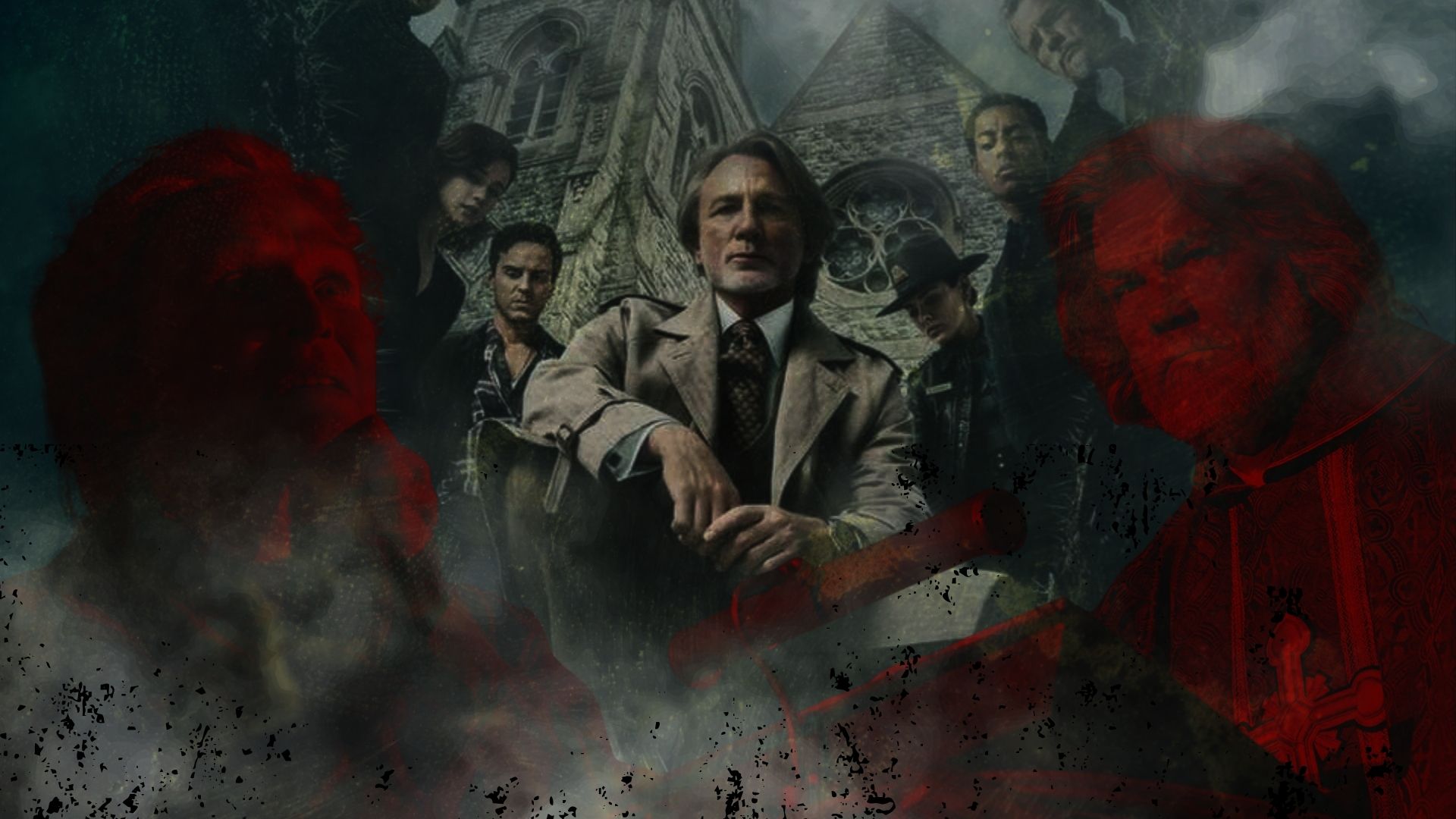
Benoit Blanc (Daniel Craig) is back, but the Southern sleuth with the honeyed drawl seems to have traded the sunny, neon-drenched puzzles of his past for something far more somber. In Wake Up Dead Man, writer-director Rian Johnson strips away the “old money” comfort of the original and the “tech-bro” flash of its successor to deliver a mystery that feels hauntingly intimate and unexpectedly spiritual.
The story begins not with a bang, but with a quiet, unsettling tension as Blanc finds himself entangled in a case where the stakes aren’t just about finding a killer. They’re about navigating a labyrinth of secrets buried deep within a community of faith, where every silence carries weight and every prayer might be a confession in disguise.
Set against the austere backdrop of a religious compound that teeters between sanctuary and prison, the film trades mansion opulence and Greek island excess for weathered wood, whispered prayers, and the kind of silence that weighs heavy on the soul. The setting itself becomes a character, all bare walls and flickering candlelight, a place where devotion and deception wear the same face.
This time, Johnson isn’t just interested in who did it, but in what confession costs and what redemption looks like when it’s painted in shades of moral gray. Without giving away the film’s many sharp turns, this latest chapter proves that while dead men may tell no tales, the world they leave behind is loud with the echoes of their sins. And sometimes, it takes more than a detective’s brilliance to unearth the truth. Sometimes it takes a guilty conscience, a crisis of faith, and the courage to speak when silence would be safer.
The Evolution of the Mystery Murder Franchise
With the arrival of Wake Up Dead Man, Rian Johnson has officially cemented the Knives Out series as a “chameleon franchise,” one that refuses to be pinned down or predictable. Unlike typical sequels that simply try to go bigger and louder, banking on spectacle to mask creative bankruptcy, this series thrives on shifting its DNA with each installment, reinventing itself while maintaining its core identity.
The original Knives Out (2019) was a cozy, “brown sweater” tribute to Agatha Christie, centered on the rot of traditional American wealth and the toxicity of inheritance. It felt familiar and comforting, even as it skewered privilege with a butter knife’s precision. Glass Onion (2022) swung the pendulum toward a vibrant, satirical critique of modern tech-billionaire ego, drowning us in Mediterranean sun and the hollow decadence of the ultra-rich who mistake cleverness for intelligence. Now, this third installment pivots again, trading the satire for a more gothic, soulful atmosphere: one steeped in shadows, moral ambiguity, and the kind of existential dread that lingers long after the credits roll.
What makes this approach so effective is Johnson’s understanding that detective stories are inherently adaptable vessels. By constantly changing the “flavor” of the mystery while keeping Benoit Blanc as our moral North Star, the franchise avoids the fatigue that usually plagues trilogies. We’re not watching the same detective solve variations of the same crime. We’re watching different facets of human nature examined through different lenses: greed, vanity, and now faith and guilt. Each film stands alone as a complete statement while contributing to a larger conversation about truth, justice, and the masks we wear.
It’s no longer just a collection of movies. It is an ongoing experiment in how to keep the whodunnit genre fresh, relevant, and deeply cinematic. Johnson has proven that the mystery genre doesn’t need superheroes or shared universes to build a franchise. It just needs a sharp mind, a willingness to take risks, and the understanding that the best mysteries aren’t just about solving crimes, but about exposing the human condition in all its messy, contradictory glory.
Hear No Evil, Speak No Evil, See No Evil: The Moral Architecture of the Trilogy
The “Three Wise Monkeys” motif (hear no evil, speak no evil, see no evil) serves as the hidden heartbeat of the Knives Out films, a thematic throughline that becomes more apparent with each installment. While the murderers are often loud and boastful, consumed by their own narratives and desperate to control how they’re perceived, Johnson carefully anchors each film with a protagonist who is defined by a specific sensory struggle.
These aren’t the traditional heroes of detective fiction. They’re not brilliant minds or hardened investigators. Rather, they are ordinary people with extraordinary moral clarity, each confronting a fight against a physical or circumstantial limitation that threatens to silence their truth. And although their circumstances vary wildly, Johnson’s main characters are the moral “true north” of their respective movies, proving that goodness often persists in spite of (or perhaps because of) silence or blindness. They remind us that heroism isn’t always loud or glamorous. Sometimes it’s simply the refusal to turn away.
In the first film, Marta Cabrera (Ana de Armas) embodied the struggle to “Speak No Evil.” Her physical inability to lie without vomiting was more than a comedic quirk or a convenient plot device. It was a biological mandate for honesty in a house full of deceivers, a body that rebelled against the very idea of complicity. She was a good person forced into a world where speech was a weapon, where every word could be twisted into accusation or ammunition. The Thrombey family wielded language like knives, cutting each other down with performative affection and backhanded compliments. Yet Marta’s truthfulness, the thing that made her vulnerable, became her greatest power. She couldn’t speak evil even when it might have saved her, and that integrity ultimately saved everyone else.
In the second film, Helen Brand (Janelle Monáe) represented the courage to “See No Evil.” More precisely, she had the courage to see the truth when everyone else chose to look away, to avert their eyes from uncomfortable realities in exchange for comfort and access. Surrounded by so-called “disruptors” who were blinded by Miles Bron‘s (Edward Norton) wealth and seduced by the promise of proximity to genius, Helen was the only one willing to look directly at the ugly reality of her sister’s death.
She refused the luxury of willful blindness that the others had purchased with their silence. Her clear-eyed vision cut through the glass palace of carefully constructed lies, providing the eyes that Blanc needed to dismantle a literal glass house. Where others saw innovation and brilliance, Helen saw a mediocre man who had stolen everything, including her sister’s life.
Now, in Wake Up Dead Man, the focus shifts to the final pillar: “Hear No Evil.” Father Jud Duplenticy (Josh O’Connor) exists in a world of religious echoes and divine silence, where prayers rise like smoke but answers remain elusive. The challenge becomes discerning the truth amidst a deafening cacophony of gossip, judgment, and doctrinal certainty. In a community where confession is sacred but secrets are currency, where whispers carry more weight than screams, the ability to truly listen becomes an act of moral courage.
To hear what’s being said beneath the words requires more than just functioning ears. It demands attention, empathy, and the willingness to believe what you’re hearing even when it implicates those you trust. Like Marta and Helen before him, Father Jud isn’t a traditional hero. He is a “good person” caught in a bad situation, navigating a world that demands he close his ears to the suffering of others, that he accept the official narrative and stop asking dangerous questions. His struggle is perhaps the most painful of the three because listening, truly listening, means bearing witness to pain you cannot immediately fix.
By linking these three characters across three films, the franchise suggests something profound about the nature of goodness in corrupt systems. Being “good” isn’t about being perfect, extraordinary, or even particularly brave at the outset. It’s about how we choose to use our senses when the world encourages us to shut them down. It’s about speaking when silence would be easier, seeing when blindness would be more comfortable, and hearing when deafness would be safer.
Johnson has created a trilogy not just about solving murders, but about the sensory experience of bearing witness to evil and choosing, against all survival instinct, to perceive it fully. In doing so, he’s elevated the detective genre into something richer: a meditation on what it means to be human in a world that constantly asks us to be less so.
Redemption vs. Justice: The Film’s Moral Complexity
Now, in most murder mysteries, the climax offers a clean satisfaction: the detective reveals the killer, justice is served, and order is restored. But Wake Up Dead Man refuses such tidy resolutions. Instead, it asks a far more uncomfortable question: what happens when solving the crime isn’t the same as healing the wound it created?
This is where Johnson’s script does its most daring work. The film doesn’t present redemption and justice as complementary forces working toward the same end. Rather, it positions them as competing needs that pull characters in opposite directions. Father Jud finds himself caught in this exact tension, torn between his duty to uphold moral law and his pastoral calling to offer grace to the broken. His crisis isn’t about discovering who committed the crime but about what to do with that knowledge once it’s unearthed.
The film suggests that in spaces of deep faith, the stakes transcend earthly punishment. Confession, in the religious sense, is meant to lead to absolution and transformation. But legal confession leads to incarceration and public shame. Can both coexist? Should they? The movie doesn’t presume to answer definitively, but it forces us to sit with the discomfort of the question.
What makes this approach so compelling is how it complicates our relationship with Benoit Blanc himself. In previous films, Blanc was the uncomplicated moral center, the arbiter of truth who cut through lies with gleeful precision. Here, his role becomes more ambiguous. He can solve the mystery, yes, but he cannot offer spiritual salvation. He can name the guilty party, but he cannot grant forgiveness. For perhaps the first time in the trilogy, Blanc seems to understand that his genius has limits, that some human problems cannot be untangled by logic alone.
The final act doesn’t provide the cathartic release we’ve come to expect from the genre. Instead, it leaves us with something messier and more honest: the recognition that in a world governed by both divine and human law, true resolution may be impossible. Some characters receive justice. Others receive mercy. A few receive neither. And the film is brave enough to let that ambiguity stand, trusting the audience to wrestle with the implications long after leaving the theater.
This moral complexity elevates Wake Up Dead Man beyond its predecessors. It’s no longer just about who did it, or even why. It’s about what we owe each other when someone falls, and whether a system built on punishment can ever truly make room for grace.
Beyond the Altar: A Wider Lens on Faith
For most films dealing with heavy religious themes, they tend to fall into two camps: the overly pious or the aggressively cynical. Wake Up Dead Man brilliantly avoids both traps. Instead of challenging the audience’s personal beliefs or attempting to deconstruct faith itself, the film acts as a window, widening our perspective on how religion shapes human behavior, for better and for worse.
In this story, religion is not treated as a plot device or a punchline, but as a living, breathing landscape where real people grapple with real questions. We see characters whose faith provides them with a profound moral compass, alongside others who use the same language of divinity to mask very human greed. By portraying religion through this multifaceted lens, the film moves away from the “black and white” morality often found in mysteries. It suggests that while a person’s beliefs may be fixed, the way they apply those beliefs in moments of crisis is where their true character is revealed.
Johnson doesn’t mock the faithful or sanctify them. He simply observes, with the same keen eye he brings to class warfare and ego, how faith functions as both sanctuary and weapon. The compound becomes a microcosm where devotion and manipulation exist side by side, where the same ritual of confession can liberate one soul and trap another.
Ultimately, the movie offers a more empathetic viewpoint than one might expect from a whodunnit. It acknowledges that for many, faith is a source of resilience and community, while for others, it is a shield behind which to hide their darkest impulses. By the time the credits roll, you aren’t necessarily questioning what you believe. You are, however, thinking more deeply about how others use their faith to navigate a world that is often silent and unfair. It is a sophisticated evolution for the franchise, proving that Benoit Blanc can handle the complexities of the soul just as easily as the clues of a crime scene.