









Now Reading: Streetfood for thought: Behind the scenes and streets of our visionary vendors
-
01
Streetfood for thought: Behind the scenes and streets of our visionary vendors
Streetfood for thought: Behind the scenes and streets of our visionary vendors

Francis Ampil, Reese Ancheta, Shaunte Felicity
In the life of the everyday Filipino, even a small relief—be it sweet or savory—is as good as any. We are no stranger to the days of carrying hefty bags, filled with school supplies for students and work items and documents for employees, up and down flights of stairs and through winding corridors and hallways.
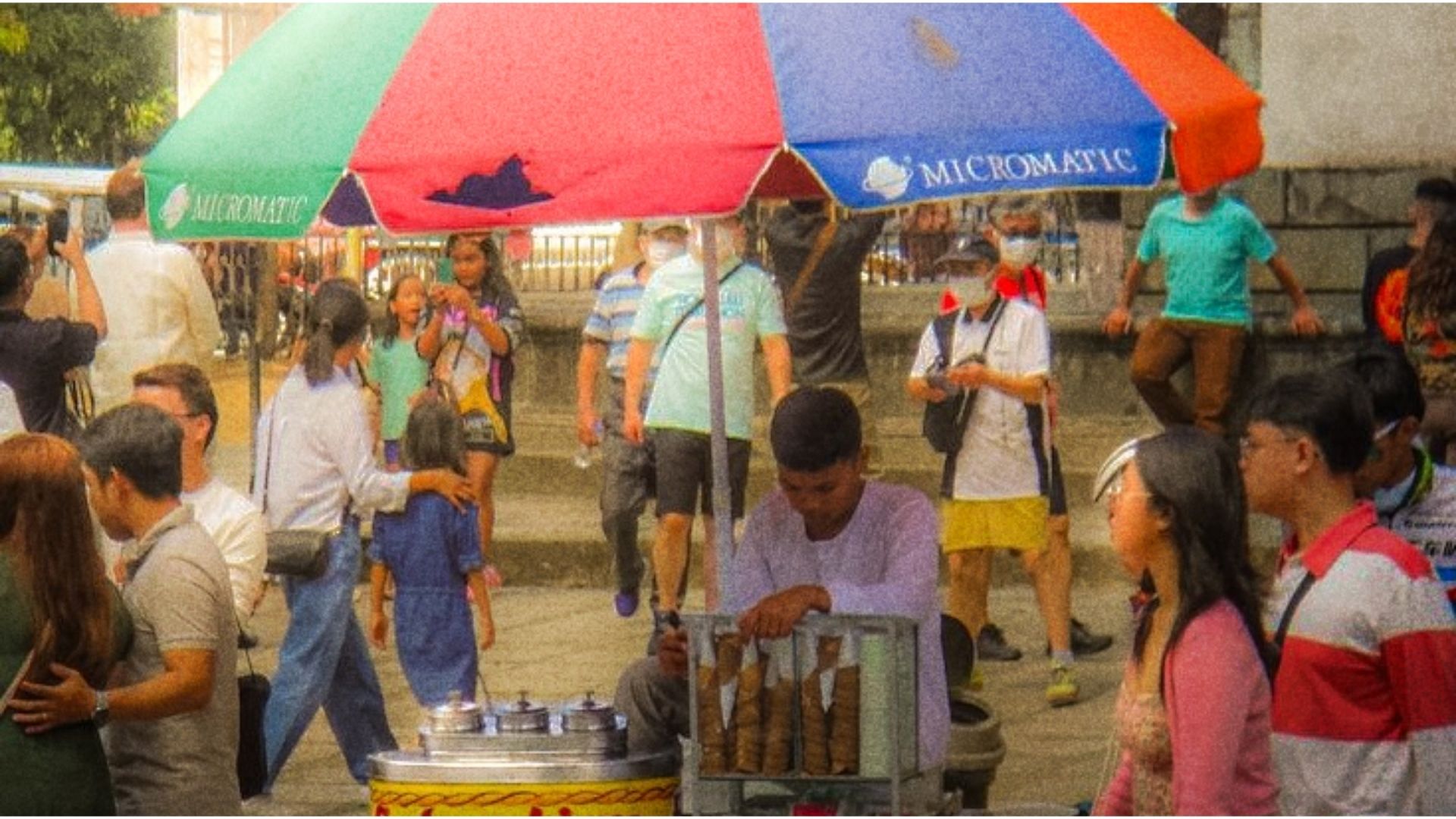
At the end of the day, through metaphorical blood and possibly real sweat and tears, we want to feel at peace. That is why, when we leave our workplace or school, there is no sight more comforting than the row of carts along the sidewalk and the vendors behind them, handing out fried siomai in a cup, Spanish bread in a paper bag, or isaw on a stick.
The street vendor is so commonplace in our culture that it might as well be an archetype. The actual image varies, but the essence remains: the kindly and almost parental kuya or ate who knows what a hard day’s work you’ve done and hands you a simple treat that makes it all worth it, not as immediately recognizable as your nearby fast-food chain or coffee shop, but priceless—figuratively—nonetheless. They are the unsung heroes of every 5:00 p.m. dismissal, overtime clock-out, or spontaneous hangout, refilling our cups when we’ve emptied them in the course of daily mundane and grandiose tasks.
But while what seems to us is a blip in the fast-track lives we live, a pit stop to refuel before we continue on our journey, we seem to them like the never-ending rush, that blurred crowd of hungry citizens who fill their pockets as they fill our mouths. So, knowing how well our street food vendors feed us, the real question is: how well do we feed them?
A recipe for success
For Alan Galang, the students of the University of St. La Salle-Bacolod have fed him and his wife quite well, with two kids having graduated from college, one just starting this year, two in senior high school, and one in elementary.
The owner of Manong’s Empanadas, the emerald green cart with an assortment of different flavors of empanadas at the tailend of USLS’ famous Hepa Lane—a row of food cart vendors with their own offerings—Alan has tended to the empanada cravings of Lasallians since 2009.Your average recent college graduate was only in the first grade when he set up shop.
At the start of a long day, when students wear their school uniforms and head to campus, Alan heads to the nearby market to procure ingredients like flour, sugar, salt, shortening, and the different fillings we’ve come to love enough for one week of selling beside USLS.
For him, the dough-making is the hardest part, ensuring that flaky crust is quality and composed for the tired students who bite into them: “Ma-take time ka guid kay […] kilanlan kwaon mo gid ang iya nga texture ya nga gusto mo bala […] haw, para ang aton empanada indi ma guba [..], (You need to take time because you need to get texture you want so our empanada won’t break)” he says.
It takes a day of preparation—cutting chicken, tuna, and cheese; making the dough; putting it all together—to create at least 200 empanadas daily. Not an easy task to accomplish, but one that usually pays off.
Times have changed, though, since they started the business twenty-five years ago. The state of economic flux has raised the prices of even our daily bread and butter—or, in this case, the empanadas students seek out and the ingredients used to make them.
Alan shared, “Pagsaka sang mga tanan na balaklon […] nag-increase kami [sang presyo ka empanadas] five pesos, teh [nag himo] siya thirty (When the price of everything rose, we also increased the prices of the empanadas by five pesos, so they now cost thirty pesos),” he said about the increasing inflation rate across the country.
For both customers and businesses, affordability is a key factor to a successful transaction. But when production costs rise even marginally, even five pesos can make or break the bank—whether making it home on pocket money for a student commuter or breaking even for vendors like Alan.
But according to Alan, his customers have had no problem with the price increase.
Alan’s empanadas often sell out their daily stock of 200 to 300 per day by 3 p.m., a sign to wrap up for the time being and ready oneself for the next day of sales. Summer semesters, however, are a different story.
“Subong […] medyo affected gid kami katama kay […] summer [subong, kag] wala klase. Indi kami subong makaubos 150 to 200 pieces ka empanada (Right now, we’re affected a lot because it’s summer, and there aren’t any classes. We can’t sell out even 150 to 200 pieces of empanadas),” he said.
The sweltering June day this interview was conducted, the shelves reflected such sentiment, holding delicious empanadas when only crumbs and flakes should remain with the ebbs and flows of student buyers—and that’s considering they’ve lessened their production of stocks this summer term.
Alan says the dough is lasting, but the texture itself begins to fluctuate, worsen, when left untouched for far too long—a notion that may reflect what many vendors may go through. In rain or shine, downpour or heatwave, the vendors we’ve come to love will be there, but when left untended to and waiting for far too long, one might wonder how long they’ll last.
Fortunately, the USLS’ student body will be back in full force with the approaching end of their summer break, thus one can expect the empanadas—familiar and fresh flavors—to be off the shelf in no time either. The empanada business has helped them send six kids through the different stages of education after all.
With the upcoming academic term, customers of Manong’s Empanadas, old and new, can expect new varieties of empanadas on their menu.One can refer to the side of their cart for said new flavor offerings.
But before the frenzy of the new school year, in the heat of the slow summer rush, Alan has a simple thing he wants to tell his buyers, that even a simple referral—to friends, family, peers, classmates—is all it takes to help. Word of mouth for mouthwatering food does, in fact, go a long way; twenty-five years and counting of active operations proves it.
Steam, sweat, and enduring dreams
From the streets of Bacolod to the sidewalks of Taft, Manila, a food cart looking humbler than most with its steady steam, earthy aroma of nuts, and the sweet scent of freshly cooked corn has kept a married couple going for more than two decades.
Rosita Corpin sells nilagang mani for 25 pesos kada takal. Together with her husband, she has been selling boiled peanuts, steamed corn, and sweet corn for more than 20 years, fueling generations of commuters who conquer the bustling avenue.
A favorite among daily commuters, peanuts have become a staple snack for Filipinos on the go. Its soft, moist texture, and earthy flavor makes it a simple yet satisfying snack, giving familiar flavors to students, workers, and passerbys who navigate the city. Selling at just 25 pesos per serving, Rosita shared that she is able to take home around 500 pesos—on a good day. Still, earnings remain uncertain. She emphasized that, “pag maulan na po, wala na kaming kita (if it rains, we do not earn anything).
While nilagang mani may seem simple to prepare, it still requires hours of labor, especially for vendors who have grown older with the trade. Rosita shared that every morning, she would have to go to her local market to purchase a new batch of shelled nuts. But before they can even be boiled, each one must be thoroughly cleaned to remove the earth that clings onto the shells, making the preparation so tasking, having to prepare hundreds or thousands of nuts per day.
Alongside Rosita’s peanuts, her husband’s steamed and sweet corn with cheese complete their humble business. Together, they earn approximately 1,000 pesos a day. At first glance, the four-digit figure seems enough, but the majority must be reinvested the following day to purchase bulks of fresh produce, leaving only a meager amount for their needs.
Despite the physical demand and uncertain income behind the delicious products, the Corpin couple continues to show up every day. They shared that the decision to keep selling corn and nuts is because “nakasanayan na.” Their practical way to sustain themselves has become a way of life, beginning with early mornings, long afternoons, and many faces purchasing their snacks.
Their cart is a testament to the competition that exists among street vendors, especially after having to be positioned side-by-side in a regulated area. In the stretch of Taft, there are similar vendors selling the same combination of snacks, also hustling in hopes of having enough customers to survive another day.
For the everyday Filipino who just wants to reach home, getting a bite from the street is no big decision. But for vendors, every purchase makes a difference.
The statistics behind the street food
It begets such a difference that street food selling is a prominent economic driver in the Philippines, simultaneously strengthening job opportunity and poverty reduction, according to a study on the role of informal street vending in our economic development.
Despite its significance not only in our economy, but our culture as well, it sits as a shadow industry, turned to by Filipinos who find themselves with little income, education, or chance at stable employment. Most street vendors even operate illegally because the required documentation—taxes, business registration, and the like—are out of the reach of their fiscal resources. Alan from Manong’s Empanadas is not alone in the difficulty of sales nowadays; a study involving six vendors showed a significant decline in sales and customers due to price increases.
The mix of the factors result in a cocktail of financial difficulties, operational challenges, restrictive regulations, and a lack of recognition, as detailed in a study that surveyed 40 street food vendors in Bayombong and Solano in Nueva Vizcaya. Though the vendors have coped through a high level of adaptability, expressing their emotional resilience and willingness to adapt to regulations and adjust operations, a buffer like this to stand strong against challenges does not guarantee a long-term solution to dissolve these challenges completely.
The same studies will also tell how the proper legalization and regulation of street food vending can help everyone involved: livelihoods of vendors can be improved, unemployment and poverty can be alleviated, and the economy can be further developed — all the while maintaining order in public, high-foot traffic spaces.
These streetfood vendors are craving something too
Most Filipinos rarely stop to think about those behind the food we enjoy so much on the streets. Society has made us so preoccupied with our own battles and responsibilities that grabbing a snack is just another asset to keep fighting.
But behind each plastic of nilagang mani or a medium cup of sweet cheese corn is a livelihood that chooses to endure. For how long can they endure without the proper support—in placement, financial assistance, skills development, and transparent regulation—however, is one thing we haven’t paid much mind to when paying for our treats.
Streetfood has long been an integral part of life’s hustle and bustle, filling rumbling stomachs between daily routines. But behind each empanada, tusok-tusok, sweet corn, or nilagang mani, are vendors who choose to start their days earlier, ending later, demanding more work than meets the eye.
It’s not a type of work solely driven by skill, but rather by perseverance and the everyday Filipino who chooses to support the local economy.