










Now Reading: The art of letting go of the ones we once loved
-
01
The art of letting go of the ones we once loved

The truth about letting go is far from simple. The more we cling to people, objects, or memories, the more they seem to trap us. While the world may casually advise us l to “just let it go,” we often remain trapped in the very patterns we long to escape.
This struggle isn’t new. How young were you when you were taught that letting go is “the best way to keep the peace”? Maybe it was surrendering your favorite toy to your younger siblings to prevent them from bawling, ceding the best part of the fried chicken, or giving them the remote control when you weren’t done watching your show so that they could watch cartoons. At some point, perhaps you were also forced to donate the clothes and shoes that had a very high sentimental value, just because they no longer ‘fit.’
The concept of letting go is something we begin to learn early in life; often not through formal discussion but through the subtle guidance of our parents, relatives, friends, and even mere strangers. Although we might never have fully grasped it, this art becomes natural for all of us as we navigate life.
What begins as reluctance to discard a childhood trinket can grow into a relentless grip on past hurts, old mistakes, and the festering resentment we hold towards others. This isn’t just about objects; it’s about the emotional baggage tethering us to what no longer serves us—old grievances in friendships that refuse to fade, the habits we’ve outgrown, the suffocating job we can’t leave, or the enduring sting of parental shortcomings that fuel our present-day frustrations. The question isn’t only what we hold onto, but also why letting go feels so impossible.
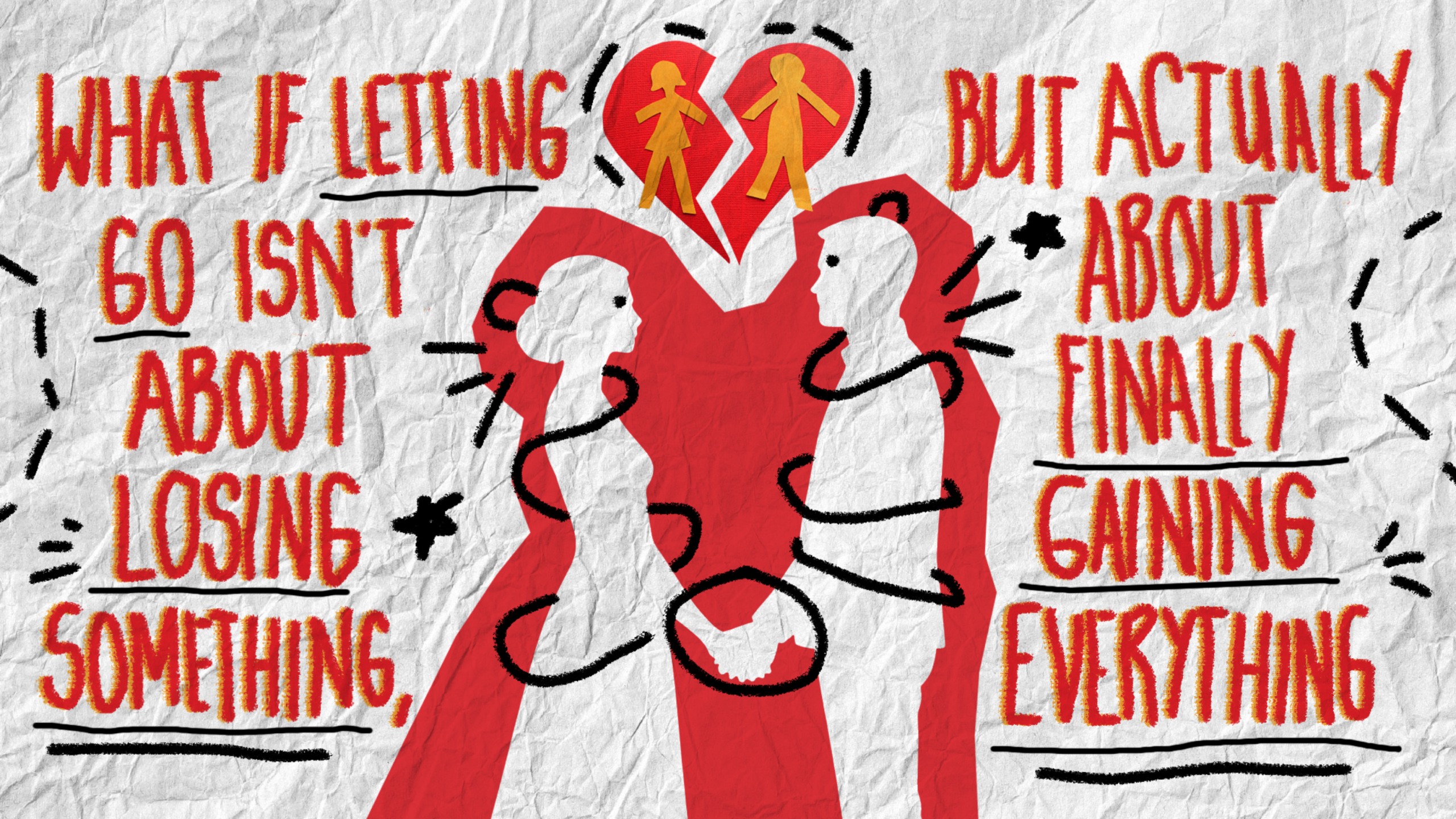
Often, the hesitation stems from a fear of the unknown, an ingrained need for control, or even a misguided sense of loyalty to past experiences. We equate letting go with failure—believing it means giving up. But what if embracing this ‘failure’ is actually the key to unlocking true peace, renewed energy, and a life unburdened? What if letting go isn’t about losing something, but actually about finally gaining everything?
Humanizing the process
Entertainment media frequently depicts these struggles. From television shows to films and books, these adaptations often capture the deeply human experience of pain, emotional turmoil, and heartbreak that accompanies the act of letting go—whether it be of people we love, dreams we once yearned for, or passions that brought us joy.
An example of this can be seen in the film All Roads Lead to Cubao (2025), where a young couple navigates the complexities of their breakup. As they walk through the streets of Cubao, they reflect on their shared memories and of their relationship. The film captures the process of letting each other go, emphasizing the importance of personal growth and character development. Throughout their journey, viewers of the film are reminded that letting go is not just an end, but also a necessary step toward new beginnings and self-discovery.
Another example of how the process of letting go was portrayed in the media is in the season finale of Brooklyn Nine-Nine’s Eighth Season (2021), titled ‘The Last Day pt. 2’. In this episode, Jake Peralta, one of the main characters, makes the heartfelt decision to officially resign from his dream job as a detective in order to become a stay-at-home dad and support his wife, Amy Santiago-Peralta. This decision was revealed during the climax of the series, as the characters prepare for one last Halloween heist.
With Jake’s decision to step away from the career he has always cherished, it showcased the complexities of personal sacrifice and the importance of prioritizing family. Throughout the series, fans have witnessed Jake’s passion for his work and how his character has matured over time, making this shift all the more impactful.
These narratives serve as powerful reminders that letting go—though painful—is an integral part of the human experience. Whether fictional or rooted in life, they resonate because they echo our own quiet battles with change and loss.
Science behind letting go
Letting go is not just an art — it is also a science.
Neuroscience tells us that emotional attachments are encoded in the brain like well-worn footpaths, making them difficult to navigate. This neural encoding means that the more we dwell on certain memories or feelings, the stronger the connections become, reinforcing our attachment to them. The brain’s reward system, particularly the release of neurotransmitters like dopamine, further complicates this process, as it associates these attachments with feelings of pleasure and comfort.
Neuroscientists explain that the more we think about something, the deeper it etches itself into our brain, creating a cycle that can be hard to break. This is why our minds often find it so difficult to release what we once held dear. The emotional weight of these attachments can lead to a phenomenon known as “emotional inertia,” where the effort required to change our emotional state feels insurmountable.
In addition to neuroscience, Jean Piaget’s Cognitive Theory provides valuable insights into this process. Piaget outlines four stages of cognitive development: Sensorimotor, Preoperational, Concrete Operational, and Formal Operational. From his theory, it is expected that as individuals progress through these stages, their ability to process and understand complex emotions and experiences evolves.
At the Concrete Operational stage, children start to understand loss as permanent. By the formal operational stage, adolescents and adults acquire the ability to think in an abstract manner and can therefore see that giving things up is not only a must, but the beginning of a change. That is, detachment is not only a developmental milestone, but also a neurological challenge. Knowing this does not erase the difficulty—but it does affirm that the struggle is human, not weakness. It’s like being caught in an emotional maze, understanding how the maze was built doesn’t just explain why we’re stuck; it also gives us clues to find the way out.
The heartbreak of holding on
Beyond fiction and theories, real stories believe that letting go can reshape our lives.
Take Nicole, 20, for instance. She grappled with a friendship with someone who was her complete opposite: an avoidant to her anxious attachment style, an obscure communicator to her overexplainer nature, and more of an introvert to her extrovert personality. But despite these personal contradictions, they had one common denominator: mental illnesses.
Evaluating their six years of friendship, Nicole could only describe it in one word: draining. As she put it, “Even with our differences, I loved and tried to understand her as much as I could. But I guess opposites don’t always attract; they clash.”
With such differing traits, they had to come up with one solution to protect their inner peace: letting go of their longtime friendship. This was something Nicole did not anticipate. “Even when there’s a lot of times that I badly want to give up on life, I always think about my future with her, how we’ll travel to different countries while brutally rating the matcha in town,” she added.
She also mentioned that she’s the type of person who hates the concept of letting go and painful goodbyes in general. In her own words, “Ayoko ng may umaalis, ayokong naiiwan ako.” And in honesty, don’t we all feel that sadness when the goodbye comes from someone we thought we’d share the future with?
But even if it was so hard to let the friendship go, she said it was indeed for the better. Her story lets us look through the lens of the heartache of saying goodbye to a bond she envisioned lasting a lifetime. It reminds us that attempting to force a connection that’s already a dead end won’t lead to escape from the emotional maze. Instead, it only traps us further, prolonging the drain and the hurt and that sometimes, letting go isn’t a failure but a necessary step towards inner peace for everyone involved.
This also resonates with Acela, a 19-year-old freshman who recently switched college programs. The reason? It’s worth the peace of mind.
From her initial college program, a Bachelor of Science in Accountancy (BSA), to a Bachelor of Science in Business Administration (BSBA) with a major in Financial Management & Accounting, Acela mentioned that she felt both sad and relieved about her decision to switch programs.
In her own words, “Sad kasi syempre naging dream ko naman maging CPA holder then fixated na ‘ko dun pag-start ko ng college pero noong na-realize ko na di ko talaga siya kaya and need ko siya i-let go, somehow sad. Happy kasi feel ko magiging less stressful na ang college life ko.”
For Acela, her initial program wasn’t a calling, but a compromise. Driven by intense family pressure and the allure of career stability and financial opportunity, she pursued a course her parents had chosen for her. Her focus was solely on the anticipated salary. But beneath the surface, a crucial element was missing: genuine desire.
“Hindi ko nai-imagine yung sarili ko na nagw-work sa harap ng computer, nagb-balance ng mga balance sheet saying ‘this is what I want’.” As she admitted, she could never truly visualize herself being happy as pursuing it for the rest of her life.
When asked if her program shift was worth it, she agreed that it was, since she was able to take a proper rest rather than being stressed out over the yearly Qualifying Exam (QE) in her previous program.
Acela’s situation highlights a reality for many students today. Now that we are battling not just academic responsibilities and pressure, we all value and yearn for rest and peace of mind, even if it requires making big moves, such as shifting programs and letting go of what truly doesn’t serve you and something you couldn’t see a future with.
Closed doors lead to new beginnings
When one door closes, another always opens.
When we close the door on certain chapters of our lives, we create space for new adventures and growth. Like clearing out a cluttered room full of worn-out clothing, old photographs, and cherished memories, letting go makes room for fresh experiences and unexpected possibilities to enter our lives. Every closed door is an invitation to discover new aspects of ourselves, and in moments of transition, we often find hidden strengths, untapped talents, and dreams we never knew we carried within us.
Letting go teaches us that holding on too tightly to the past prevents us from fully embracing the present. When we release our grip on what once was, we open our hands to receive what is meant to be. This act of surrender not only lets us grasp personal growth but also allows us to cultivate resilience and adaptability in the face of change, even if the change can be scary. By embracing the unknown, we can embark on journeys that lead us to our true selves and the life we are meant to live.
Thus, the act of letting go is not a sign of weakness; rather, it is a courageous step towards self-discovery and the pursuit of new opportunities that await us.