Now Reading: Resisting historical distortion with a talking ‘Hito’
-
01
Resisting historical distortion with a talking ‘Hito’

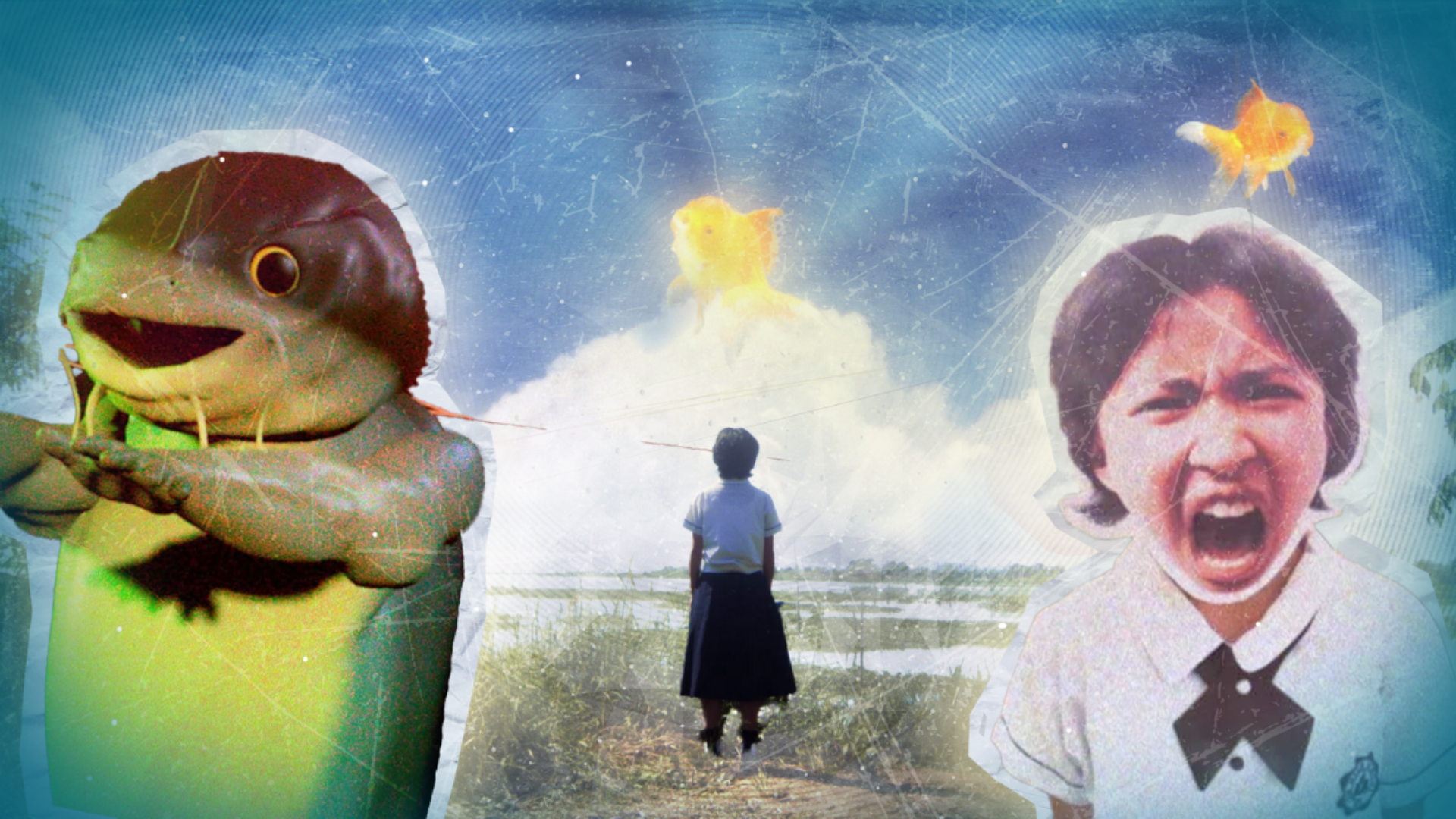
Hito by Stephen Lopez:1081 UP Cebu Martial Law Film Exhibit
“What if may mundong naging totoo lahat ng gusto nila?”
In the 2023 sci-fi short film Hito, director Stephen Lopez imagines a world completely wrought by the despotic whims and deception of the Marcoses. Through sequences of military curfew alarms to nuclear factories and windmills towering over, it transports us across different dimensions of absurdity, one that warns what absurd trap the country might fall into when a dark period of its history is denied and distorted.
As part of University of the Philippines Cebu’s 1081 Exhibit, a weeklong event leading to the commemoration of Martial Law, Hito was featured in a special screening at Lawak Sinehan with a talkback session with Lopez, who spoke via Zoom to discuss the concept, challenges, and core message of the 22-minute short.
Set against a highly militarized dystopia, the film follows Jani, a 14-year-old girl who finds comradeship in Kiefer, a Bisaya-speaking catfish with whom she breaks free from the oppressive, distorted worlds they’re forced into. When asked why he chose the fish “hito”, which in Japanese happens to translate to “human”, Lopez answered, “Naghahanap lang kasi ako ng funny-looking na isda […] Iyon ‘yung unang idea na pumasok, and we built a story from that.”
Born out of a silly thought to create a film with a talking fish, the concept eventually took shape as he drew influences on how his household lived during the Marcos regime. “My grandfather was a government employee, a speechwriter for Marcos Sr.,” he revealed. “Tapos, my parents were activists during that time. Nakakatawa ‘no?”
While most films that depict the grim realities of Martial Law are done through the feature-length or documentary medium, Hito took the experimental road with the short film format. With its satirically-charged script and fast-paced, disarmingly bizarre segments that mirror an era of historical dissonance, he gets the message across through an unconventional, alternative lens: “If I use the standard na storytelling ng ‘yung typical ‘Martial Law’ film, parang ‘di na ma-engganyo ang mga younger audience to know what Martial Law is.”
Martial Law History through ‘semiotic ghosts’
The burial of Marcos Sr. at the Libingan ng mga Bayani in 2016, a time when whether a dictator is a hero or not happened to be still up for debate, bared how fragile the nation’s collective memory is. In basic education, lessons in history often fail to sink deep into memory because learning has been reduced to rote memorization of textbook-keyworded events, names, and dates. Historical truths then risk being slept on — distorted, buried, and forgotten — so much so that they can pave the way for a dictator’s son to seize the highest seat of power in the country and preach false legacies of what they call the “Golden Age of the Philippines”.
Lopez, when asked about the layer of dimensions in the film, brought up the concept of “semiotic ghosts” in remembering Martial Law. These ghosts could refer to elements in history that are repressed or intentionally buried in mainstream discourse yet could still subconsciously haunt and influence the present political climate. “Itong mga nuclear reactors, itong mga windmills nila ni Marcos ‘no, nagiging symbols sila for something and sometimes they start to manifest themselves in our reality in a weird way,” he said, taking influences from real-life accounts from his mother. “Parang gusto kong i-take into perspective, ‘yung how it feels to live at that time.”
He also spoke of the differing accounts from people who have also lived through the regime. “During that time, kasi walang internet, so ‘di mo alam ‘yung nangyayari kasi wala ka namang smartphone,” he added. “So everything was so confusing for them. I want to make sense of that confusion.”
Even with attempts at reframing history surrounding Marcos, done even more blatantly during the 2022 presidential campaign, the truths of Martial Law, the abuses, atrocities, and oppression that continue to plague the country at present, refuse to be erased from the narrative. Cultural workers, artists, and filmmakers find new ways to thrust Martial Law history to the surface.
“Lahat ng Martial Law elements sa film ay intentional,” Lopez said on integrating the historical symbolisms on screen. “Kunwari yung Calauit Safari — I mean nagsimula sa stupid catfish idea ‘no pero naalala ko bigla Calauit Safari so pinasok ko ‘yung kwento ni Hito doon.”
The Calauit Safari Park in Palawan was once a game reserve that forcibly evicted and displaced 254 families from the Tagbanua indigenous group from their ancestral land in 1976. It was cleared at the request of then First Lady Imelda Marcos to make room for the Grévy’s zebras, giraffes, and other animals shipped from Kenya.
“Ang iba, mukha ni Marcos, nuclear reactors, windmills, at everything else was intentional,” added Lopez.
Shot in the midst of a global pandemic, when everyone retreated to online spaces, Hito echoes the overlapping dissonance between two eras: one when information was suppressed and tightly controlled by the government during Marcos Sr.’s dictatorship, and another when historical accounts are distorted in information-saturated platforms, exploited by his son to wash clean the blood shed during the tyrannical rule.
“Parang what if may mundong gawing totoo lahat ng gusto nila?” Lopez posed a question. “Tignan natin, is it a perfect world or is it the same as our world at ayun ang kinalabasan?”
If history is remembered without critical insight and inquiry, the events in Martial Law may simply be rewritten by those in power in ways that, as seen today, be either shamelessly blatant or deceivingly subtle. Through the integration of elements symbolic of the authoritarian regime, the film asks us to reckon the way we have been learning the country’s pasts.
Lopez on MTRCB and censorship
Film censorship was one of the ways the Marcos regime suppressed democracy. At present, alternative films or works produced independently, suffer from new patterns of censorship. JL Burgos’ FAMAS-winning Alipato at Muog, for one, was banned from screenings in commercial establishments after initially receiving an “X” rating by the MTRCB (Movie and Television Review and Classification Board) for allegations of “subversiveness”.
When asked if it experienced similar sort of challenges, Lopez believes that the medium of the film, as a short, spared it from censorship attempts. “They don’t block the screenings that much like feature-length films or docus. Never kaming na-censor,” he said. “They (MTRCB) don’t watch too much short films.”
Apart from Alipato at Muog, other feature-length films barred from screenings include Food Delivery: Fresh from the West Philippine Sea and Lost Sabungeros, both exposing critical issues in the country.
“Parang MTRCB is a crapshoot e’. Sometimes they watch, sometimes they don’t, sometimes they give random arbitrations,” he added.
Signed by Marcos Sr., Presidential Decree 1986 formally established the MTRCB, granting the board the authority to bar a film from being shown to the public on various grounds. Throughout the years, since the country was under Martial Law, film censorship has been used as a tool of power and control. Films critical of government systems could easily be banned from the public eye, blurring documents of lived realities, where truths become distorted until denied.
Confronting history then must be done so critically and in entirety, dealt with both in its grief and glory and in its complexities and contradictions. Only then can we truly learn historical truths and preserve them, may it be in films like Hito, or in university screenings like the 1081 Film Exhibit, or in other ways that daringly refuse to let truths be forgotten.