





Now Reading: This National Campus Press Freedom Day, student publications are still denied the freedom to fly
-
01
This National Campus Press Freedom Day, student publications are still denied the freedom to fly
This National Campus Press Freedom Day, student publications are still denied the freedom to fly

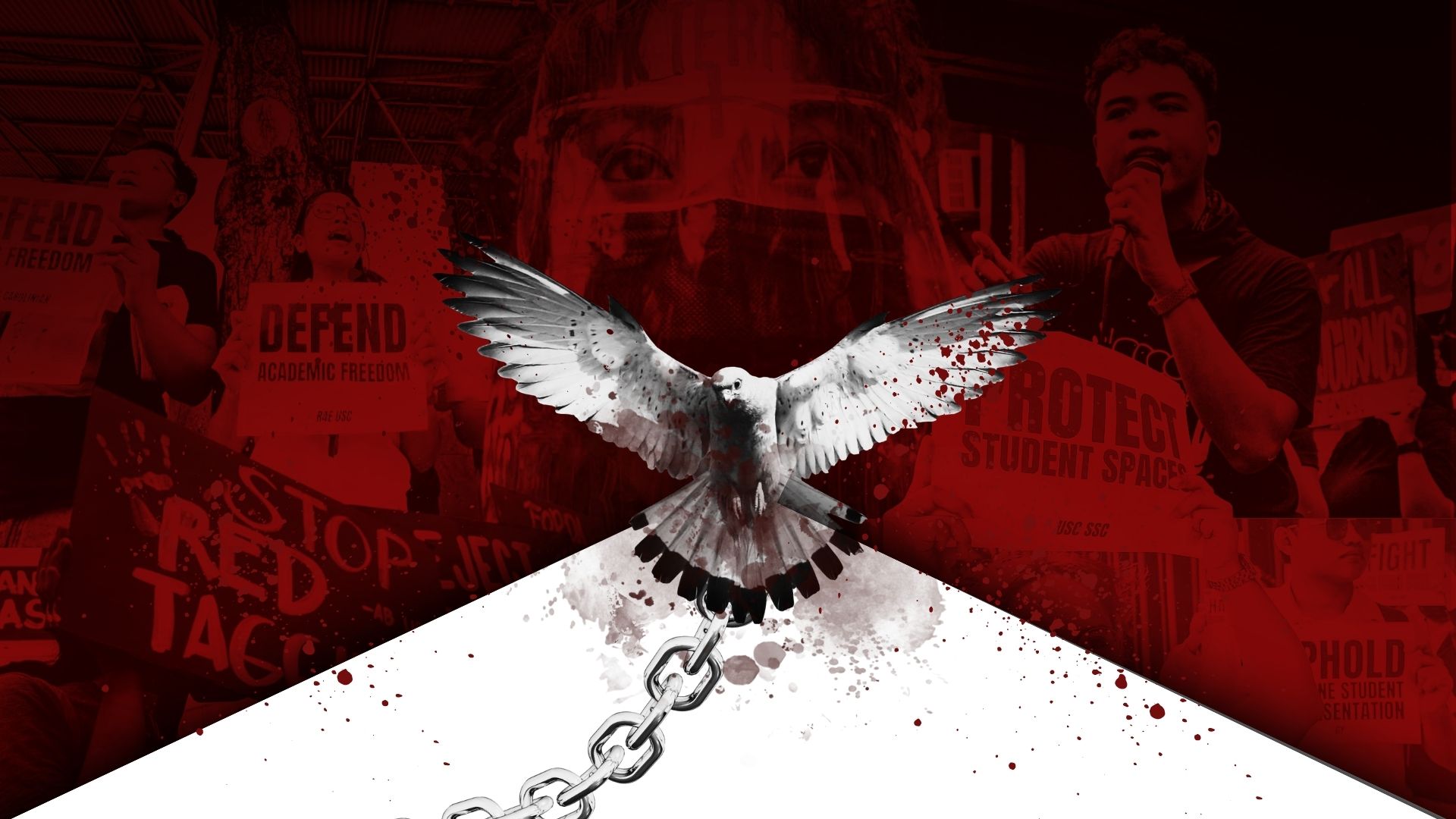
Maria Miguelle Aquino, Mayzelle Amerie Rafiñan, and Nesrine Saaduddin
There is nothing more tragic than a bird losing its wings.
Born to soar, born to seek, born to chase the truth. Across the horizon of liberation, one glides without restraint, their chirping stories of reality echoing all throughout, their flapping wings of voices drifting with the wind. Yet, even in free flight, the fear of the guilty slowly cuts their wings, agonizingly pulling them down.
Just as a flightless bird is pinned to the ground, the student journalists and campus publications of the Philippines continue to struggle against the suffocating chains of violations that attack the very reason they fight to fly.
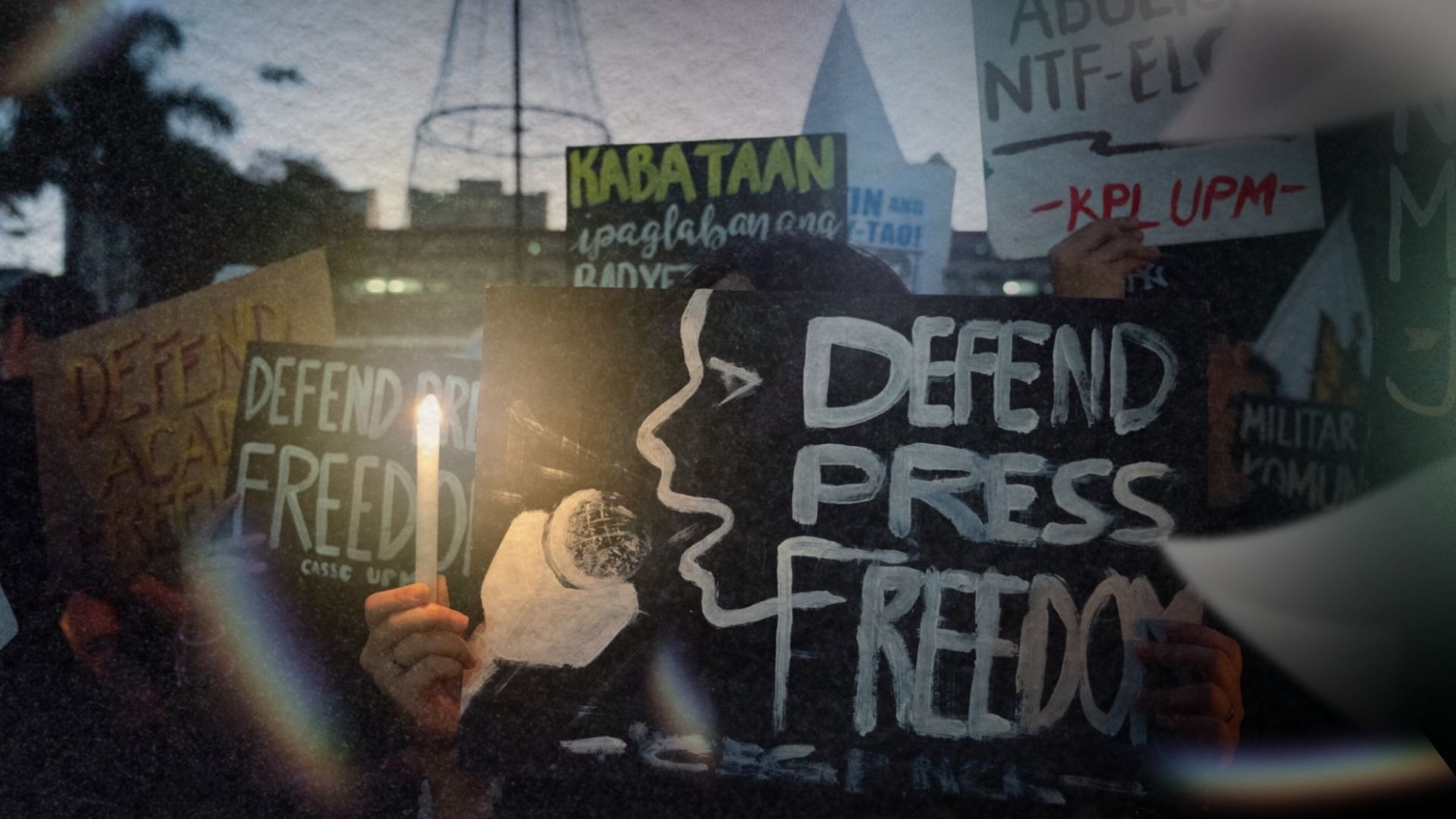
A fundamental component of democracy is press freedom, which guarantees that young journalists can also be the ones who hold public authorities responsible, challenge prevailing narratives, and shed light on stories that extend beyond the limiting barriers of the metal gates of their institutions. Every 25th of July, the National Campus Press Freedom Day established under Republic Act No. 11440 continues to ignite, amplify, and strengthen the dauntless voices of those who seek the gaze of veracity.
Nonetheless, the fear of the truth fuels the guilty to try to silence every one of these voices. The ink of the College Editors Guild of the Philippines (CEGP) blotted that 206 cases of press freedom violations from 2023 to 2024 have shredded its way towards school papers, including censorship, defunding, and administrative harassment.
In the same bloodied flight, the National Union of Journalists of the Philippines (NUJP) reported 159 incidents of red-tagging against watchdogs since 2016. These vile attacks include cases among publicly red-tagged journalists such as Atom Araullo, who fought against NTF-ELCAC spokesperson Lorraine Badoy and SMNI host Jeffrey Celiz, as well as the ceaseless harassment against Cong Corrales and his family, who were all falsely branded as communist members and tagged with false bounty claims. In 2023 alone, the CEGP carved a rise in digital surveillance and intimidation penetrating the wings of campus publications. These facts show that despite the protective barriers of legal documents, student journalists in the Philippines endure a glide with rusted chains on their ankles — working under pressure, writing under threat, and reporting under repression.
The ink persists. The chains tighten. The blood flows — until the lost wings of the birds that once soared for the sky take a fall to nowhere but the pits of the ground.
Grounded
Behind every staggering number lies a bloodied fate awaiting journalists who continuously report, write, and broadcast reality despite the pressure of intimidation.
“I recall a student publication that was forced to solicit money because they couldn’t access their own funds amounting to ₱300,000. I remember my editor’s face that tagged her and many other student editors as terrorists and enemies of the state,” Guinevere Latoza, 22, a journalism graduate from the University of the Philippines Diliman College of Mass Communication expressed the deflating ground that she and other journalists endure as they fight for the freedom of the pen and voice, in a report published on Philippine Center for Investigative Journalism (PCIJ) in 2024.
The Campus Press Freedom Bill, first proposed by Kabataan Partylist in 2011 remains trapped in the chilling corners of the Congress—leaving open wounds that Latoza traced: deprivation of funds, infiltration of administration, and branding of student journalists as the enemies of the nation. Until then, the drought of support for the liberation of the truth will forcibly poison the roots of the truth seekers. Student journalists will have to swallow their fear as they continuously glide their pen under the scrutinizing gaze of the critical, and unfair reality.
This is a hauntingly familiar story — one that can only be heard in whispers, private community groups, and late night discussions between young watchdogs who feel betrayed and voiceless. In institutions where critical thinking must be nurtured, they would rather drown out the voices that echo the truth than allow them to be heard.
Voiceless
Earlier this year, the pages of Primum at the University of Mindanao were effectively silenced by its administration. According to leaks and testimonies from the staff, the administration explicitly commanded them to remain “apolitical” after they published two critical pieces on their Facebook page — a February 18 article exposing the flaws of Sen. Robin Padilla’s remarks on youth mental health, and a February 20 literary commentary dissecting the local Duterte dynasty’s sexist rhetoric and presidential ambitions.
The weight of the bureaucracy descended quickly. The university management issued an official directive that the board must take all socio-political commentary down or face the immediate revocation of their academic scholarships and the termination of their publication. Caught in this systemic chokehold, the editor-in-chief chose to step down in a desperate bid to shield the rest of the editorial staff from the impending storm of institutional retaliation.
It is a compliance trap that echoes far beyond Davao, mirroring a systemic crisis across other institutions. Reports from The Flame reveal that at least six student media outlets at the University of Santo Tomas (UST) must constantly navigate an environment that defangs them. There, the sharp teeth of student watchdogs are systematically filed down by authorities who demand positive headlines — expecting these journalists to act as a domesticated public relations machinery rather than an actual media outlet that speaks on behalf of uncomfortable, bleeding truths.
For a truth that cannot be spoken eventually then leads the blind from the light.
Sightless
In January 2025, darkness descended upon Today’s Carolinian, the official student publication of the University of San Carlos (USC), after it was abruptly evicted from its campus office. Without prior notice, the editorial staff had their physical space of processing truth taken away from them, along with the institutional recognition and access to publication funds.
There is a reason why campus publications have been long regarded as the eyes of the student body. As much as they deliver urgent updates and announcements made by the school administration to inform, they bear witness to the students’ triumphs often overlooked, the struggles buried beneath the typicality of what it takes to be a student, and most importantly, the truths within the campus that demands to be seen. But once those eyes are forcibly kept shut, the publication is then plunged into dimming darkness, also engulfing the whole academic community together with them.
Farther than displacing a room meant for carrying the absolute truth, the move disrupted one of the university’s primary channels for independent student reporting, drawing criticism from campus journalists and press freedom advocates across the country.
Echoing the voice of student journalists nationwide, The Gateway, the official student publication of the Central Mindanao University–College of Arts and Sciences, through its solidarity statement as reported by Bulatlat, stressed that “Stripping Today’s Carolinian of essential space erodes its capacity to fulfill its mandate of fearless journalism and advocacy for student rights.”
When campus journalism is deprived of the means to give vision for the students to see, then they are left navigating with uncertain insights throughout their academic journey. For once an independent press takes its absence, the truth does not diminish to no existence, it lingers there as whole without being seen. And a student body robbed of its sight cannot long evade the dangers that threaten its existence.
Endangered
A study titled “From Schools to Societies: A Multiple Case Study on Campus Journalism Practices in State Universities and Colleges in Southern Philippines” concluded that campus publications do far more than produce newspapers. They function as democratic spaces where students develop their own critical thinking, construct public discourse, then learn how to hold institutions accountable. Even more, they serve as one of the earliest environments wherein media literacy and civic engagement are cultivated.
For campus journalism, it lies beyond confined cases of censorship and administrative interference is a further pattern that steadily belittles the spaces wherein student journalists can write and question without fear.
Every violation committed against campus press rights leaves more student journalists cornered within a hostile environment. They do not simply vanish overnight because the craft is demanding or because they are regarded as mere amateur journalists among those who work in mainstream platforms. Rather, it is the crushing weight of bearing the truth that gradually leads them to lay down their pens, dimming their courage in the process. And the burden extends far beyond the ink.
More Philippine studies on campus journalism consistently identified that it is shadowed by the fear of personal attacks, crippled by limited resources, and confined by institutional constraints, student journalists are left to navigate a landscape where speaking the truth often comes at a cost. And with every pen laid down, campus journalism loses another pair of eyes, another voice, and another defender — bringing it one step closer to becoming endangered. But what is a sky without those brave enough to fly through it?
Still a truth worth flying for
When the bird lost its wings, it poured down its blood that would shed its initial courage to take a leap. Though they may have fallen and remain grounded for a time, losing their senses at the same time, the instinct to fly has always outlived every cage built around it. The same goes for chasing the truth.
Behind the vibrant yet corroded celebration of the National Campus Press Freedom, a haunting and bloodied pen oozes with ink in filled school papers. This is the frontline of the battle for truth that the country desperately needs. The drought of liberation is what makes every campus journalist vulnerable to the shooting arrows of cruelties.
Publications may be defunded, editorial rooms may be emptied, articles may be taken down, and student journalists may be silenced by fear. Yet the pursuit of truth has never depended solely on what can only be given. It fiercely lives in every driven youth who chooses to ask questions that are deemed to be difficult, disturb the narratives of the comfortable, and write out the unappealing fact despite knowing the heavy cost.
For as long as untold truth continues to seek the sky, no lost wings can keep the flock from flying again.