











Now Reading: Guns don’t teach
-
01
Guns don’t teach

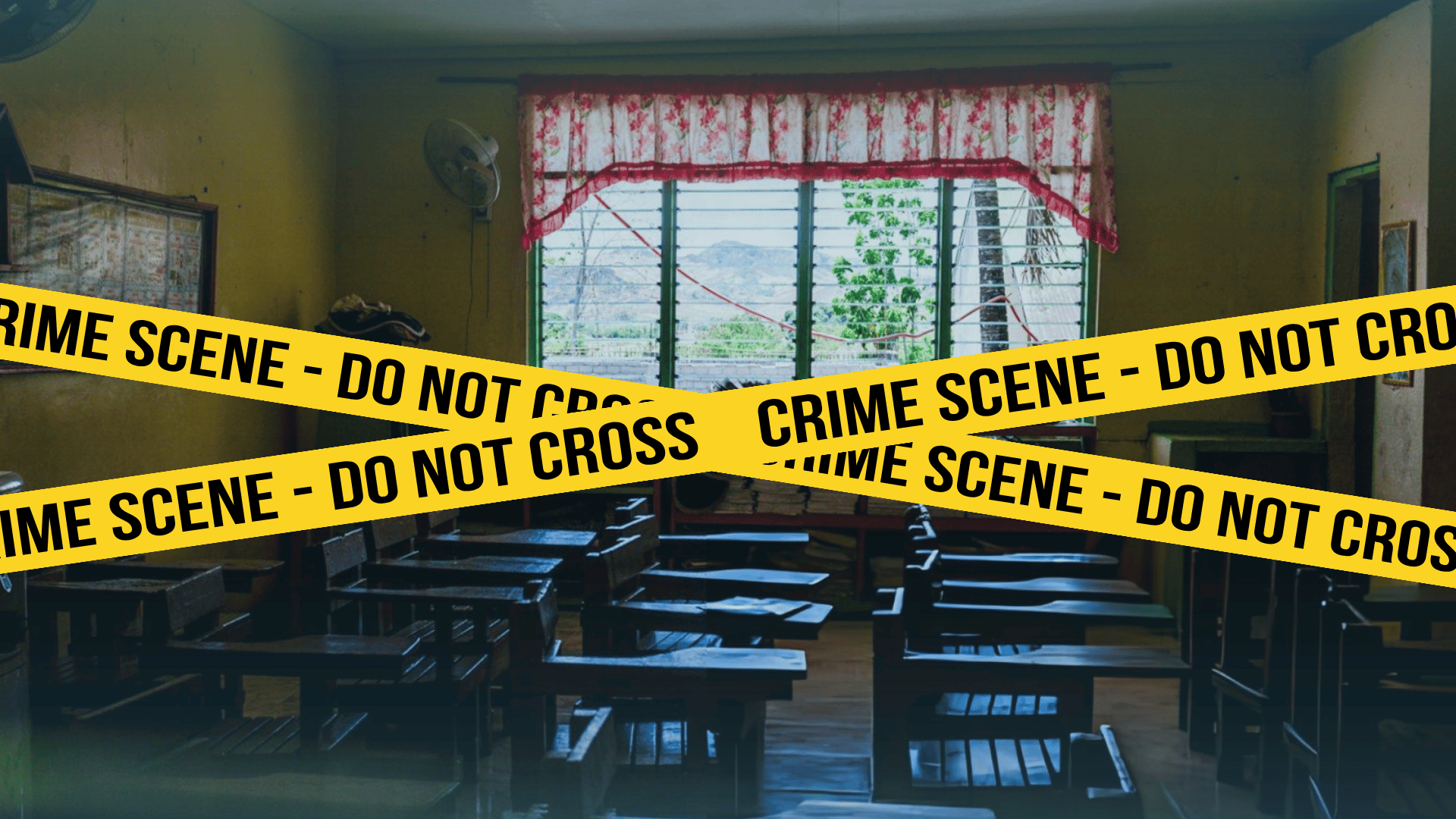
Nearly two months ago, school shootings became a national threat in the country. And yet, no signs of a silver lining appear for the safety of the younger generations. Until now, the issue of violence has yet to be resolved by the administration.
Last August 18, 2026 a devastating occurrence among the students of Ateneo de Zamboanga University (AdZU)—a brutal shooting—costing the lives of two students, including the shooter, and wounding nine individuals, leaving the victims to witness a surge of ruckus as school violence remains mounted against systematic negligence.
Ironically, the incident unfortunately materialized shortly after the university’s security team conducted simulation exercises to prepare for such incidents. Even so, preventive measures could have gone beyond just supplying adequate security; because a gun kills, while the thought pulls the trigger. Hence, school safety should mean keeping children away from the influence and access to firearms, and noticing distress immediately.
In response to the tragedy, the Department of Education (DepEd) has yet to shed light on the horrifying tendencies that continue to haunt the nation—an atrocious mark for the cries of justice dissolved under ignorance. This calls for accountability, rightfully, under the names of agencies like DepEd, which wish to “protect” the country.
Undeniably, none of this is supposed to be a reality a child should face when they go to school. Students are supposed to carry the hope to learn, not the mental dread of fear and crippling anxiety that one might be in sudden danger at any minute of the day.
In a prior incident, on June 22, 2026, the Tacloban school shooting incident left a trail of chaos in San Jose National High School after a gun attack occurred Monday morning. The aftermath left three students dead, caused a series of threats nationwide, and opened public discourse that immediately questioned who was to take the blame.
Tacloban was not a prequel to this story; it was a warning that youth violence has mutated into a cancer that the administration must contain by implementing proactive governance. But then again, the status quo says otherwise, as the AdZU tragedy proves a symptom in our country that barely anything has changed.
Earlier on, DepEd Secretary Sonny Angara enacted an agenda to hold school shooting drills that were implemented as protocols, only to be processed after reporting multiple innocent lives affected in the shooting in Tacloban. In spite of the simulation exercises aiming to protect, it only instills fear in students to the threat, rather than emphasizing the consequences orbiting such incidents.
Other than that, systematic setbacks concurrently fail to address the root causes of school violence; instead, the administration heedlessly blames video games to take the blame. It would be noteworthy that the depictions of these devastations amount to the same number of subsequent mass shootings occurring within the next 13 days on average—a vile brand for higher-ups to ensure desensitization to such catastrophes.
These responses from DepEd, like other agencies, are an epitome of how the government acts: reactive over proactive. To begin with, shootings would have been prevented beyond security if only children’s arms were prerequisitely kept away from firearms, and root causes should’ve been identified while video games were blamed, regardless of its spineless logic. Yet again, what can we expect from an administration if not shallow precautions?
Meanwhile, the Department of Social Welfare and Development (DSWD) is expected to cater to the holistic well-being of the youth. Then, its response to the rampant incidents of school violence is boosting child safety by appealing to media practitioners to monitor and prevent potential escalations of violent content from spreading online. However, a cure for the problem remains vague, as media is difficult to manage unless restrictions are implemented for specific ages.
Excessive media consumption is often the worst opportunity for the youth to be exposed to gruesome habits. Consequently, Nihilistic Violence Extremism (NVE) has reached multiple digital domains; whereas a simply chronically online child can become a victim of indirect indoctrination, glorifying human deprivation, and relentlessly radicalizing youth violence. In this event, children become desensitised to committing horrid crimes.
Without a clear solution coming from the administration, grievances become endless, and student deaths continuously turn into mere statistics without justice attained for their families. Proactiveness must appear in addressing the factors that cause the reason why young perpetrators exist, such as parental absenteeism, unmonitored digital usage, social pressure, and a lack of substantial education in morals and principles in their formative years.
Curiosity kills the cat: a phrase that depicts the challenge the youth of today experiences.
In this case, being curious meant harming others in this generation.
Devastations like the events of school shootings dwell on the depressing truth of how accessible gun usage and purchases are ubiquitous in the Philippines; deeply rooted in widely open black markets, and deliberately ignored by the government. Much worse, when children of adults working for the authorities are influenced by their parents, attaining access to such weaponry becomes an inevitable threat that compounds into bloodshed.
In reports from the Bureau of Customs (BOC), Commissioner Ariel Nepomuceno stated that the father of the alleged perpetrator was the district commander of the Port of Zamboanga Enforcement and Security Services, probing the suspect’s ceaseless accessibility to firearms.
This heinous fact emphasizes the hideous cycle of power-tripping in the instances of school cataclysms, evidently seen alongside the Tacloban incident as well—wherein one of the suspect’s aunts was a policewoman; the weapon used petrifyingly for violence belonged to her.
Concurrently, the Administration of Marcos Jr. has condoled upon the terror circumstances that happened such as the visit of Education Secretary Sonny Angara in AdZU. Even so, it is unquestionable that only being “saddened” by the situation is inadequate to their duty as public officials, and speaks loudly of their indifference to formulate a concrete plan to solve a bloody equation.
On the other hand, the Philippine National Police (PNP) administers the distribution of firearms and weaponry. Thus, it is only fair that the Firearms and Explosives Office (FEO) prohibits the personal use of guns and other weaponry.
As the legislative body in this issue, the Senate and House of Representatives shall be obligated to open discourse in strengthening the laws involved, such as the Republic Act No. 10591 or the Comprehensive Firearms and Ammunition Regulation Act, wherein firearm accessibility must strictly go beyond the reach of any citizen without legal notice to ensure public safety.
In line with educational attributes, DepEd should be prioritizing policies that assist mental health facilities in institutions, such as allotting a budget to address the scarcity of guidance counselling nationwide in order to strengthen the cognitive functions of students.
With the collaboration of DepEd and the Congress, Senate Bill No. 2390, or the Comprehensive School Safety Act, should be enlisted along with the mentioned prerequisite resolutions. Doing so signifies the urgency ofP implementing precautionary measures such as shooting drills and psychological education, rather than blindly blaming figures without prior investigation.
Nevertheless, the masses must not falter in the means of defeat. Hoping for a peaceful tomorrow is not yet impossible, as Filipinos are facing the conditions to decide how they prevent the cancer of violence from spreading rapidly in institutions built for the purpose of keeping children safe.
Change begins when adults supervise their children, monitoring their digital presence without the absence of their parents; when values are not left out for kids to discover, but taught to build discipline and character; and especially when adolescents do not have to grow up in a negligent environment.
“Acta non verba; deeds, not words.“
Public servants may have sent their sentiments and prayers for the victims of today’s tragedy, but it remains undeniable that serving the people goes beyond words; rather, persistently acting in pursuit of progress, as government officials are bound to comply with their duties to govern.
Certainly, guns do not teach. No child is born vicious, if not for the nature of society and the failing system that emboldens them to become an inhumane byproduct of hateful ideas.
Quintessentially, it is high time that children stop becoming unsolicited targets in schools—a result of the dereliction their supposed guardians ought to miserably impose. Violence will continue to prevail as a never-ending cycle, unless the pursuit of breaking the sole echo chambers that supply its lifeline surpass the negligence corrupting the system.