







Now Reading: Living beneath the downpour
-
01
Living beneath the downpour

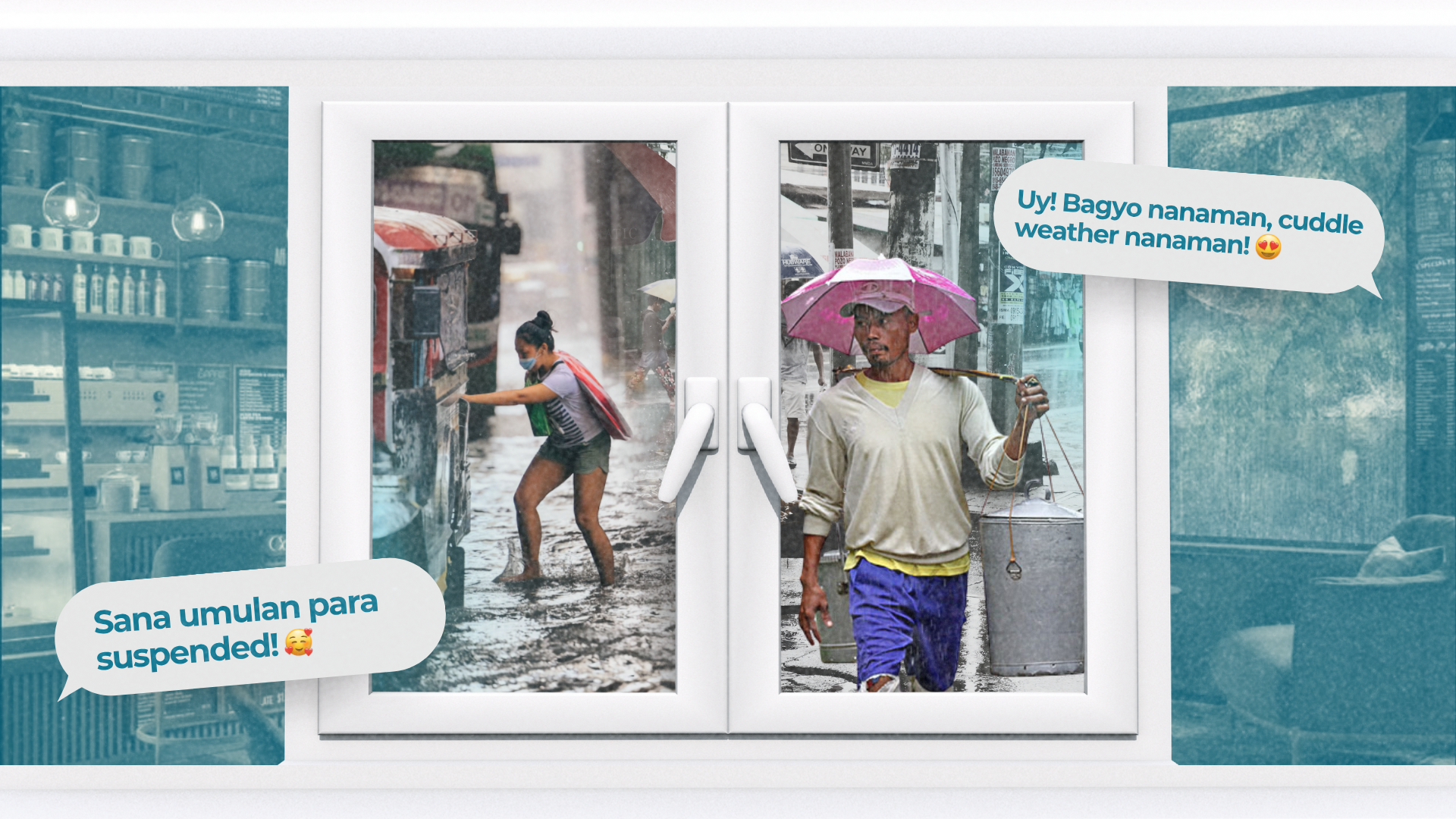
Rainy days have always comforted Filipino skin, tanned and sunburnt from months underneath the sun, quietly longing for the breath of cold wind and the soothing touch of water in the air. Mornings tend to move slower, as sleep settles a little longer and the sun takes its time to rise. Somewhere, a child craves a bowl of hot “sopas” or a coffee-dipped pandesal while eyes are fixed outside watching the rain fall.
In these moments, the world seems quieter, and a bit closer.
And as the world leans into this stillness, screens light up with snapshots of rainy windows, mugs of coffee, and that all-too-familiar line about it being cuddle weather. On the radio, that old tune floats faintly in the background — “Tuwing umuulan at kapiling ka…” And just like that, the downpour feels like tenderness itself, as if every breeze carries the warmth of an embrace.
But beyond high ceilings and fogged-up glass, who really gets to cuddle when it rains?
There are children running barefoot through flooded streets, while some have their uniforms clinging to their knees. Under a nearby shed, commuters huddle beneath barely functioning umbrellas, watching yet another jeepney pass, too full to stop. Across the road, others clasp their phones with batteries on their last flicker, waiting for multiple ride bookings that might never get accepted.
While some find comfort in the rain, others are left to confront it — because even under one sky, the rain never falls the same on everyone.
Weathering the wait
The rain does not always wait until you’re home. Sometimes, it meets you in the middle of the road; cold, unrelenting, and loud.
“Alas kwatro na ng umaga noong ako ay makarating sa Maynila,” recalls Daryl, who left Bulacan at 5 p.m. but was stranded for hours due to floods. “Matagal akong naghintay ng mag-aaccept ng booking ko sa lahat ng transportation app para makauwi sa dorm,” he added, having to rely on another ride after being stranded in the bus.
What should have been a two-hour trip stretched to eleven. And by the time the city lights greeted him, he was soaked, exhausted, and running on the last of his patience — not just from the weather, but from a system that fails to adjust when the skies turn.
Every storm forces commuters like Daryl to recalculate their day: packing umbrellas and biscuits, wearing slippers instead of shoes, and leaving hours earlier than usual in hopes of beating the downpour. But even the best preparations cannot always stand up to flooded roads and stalled traffic.
“Pakiramdam ko ako ay pagod na pagod… nababawasan ang sigla ng katawan ko at parang nakakawala ng gana sa pagtatrabaho,” he admits.
In this weather, it is not just the time that’s lost. It is rest, energy, safety, and, eventually, one’s sense of balance. What is often romanticized as cuddle weather for some, becomes a time of struggle for others.
Daryl was not the only one whose routine was derailed by the rain. JB, a student in Manila, had to postpone his trip home entirely.
“Kahapon pauwi ako mula dorm sa Manila noong Monday kasi kakatapos lang ng finals namin sa summer term, kaso bumubuhos ‘yong ulan and may baha na talaga around Manila… so naghintay ako hanggang bukas,” he narrated. Instead of braving waist-deep waters and stalled roads, JB waited an entire night before leaving the city.
“Tuesday na ako nakauwi… may gutter-deep na baha around Laong Laan and Lacson, passable na ‘yong España, so nag-commute na ako pa-Quiapo then [doon] ‘yong sakayan ko pa-Pasig,” he continued. But even then, the rain trailed him. “Inabutan na ako ng malakas na buhos ng ulan around Mandaluyong… dire-diretso na ‘yong ulan papuntang Pasig,”
The pause he took was not just about waiting out a storm, it was a strategy for survival in a system unprepared for the next downpour.
JB was fortunate, no floods blocked his path, and he made it home safely. But fortune should never be the foundation of mobility. Not when lives and livelihoods hinge on whether or not the city can stay dry enough to function.
When students have to delay their trip going home, when workers lose hours to reroutes, when sleep is cut short by the sound of storms rather than alarms — it becomes clear: the rain is not merely an inconvenience. It exposes every weak point in our urban planning, transportation system, and flood control.
For many, the forecast does not simply say “rain.” It means danger, disruption, and abrupt decisions no one should be forced to make just because of heavy rain.
In times like these, Daryl, a working professional, and JB, a student, may come from different walks of life but share the same plea — frustrations that echo across drenched streets.
“Gusto ko talaga baguhin ‘yong sistema ng flood control sa mga daan. [Hindi] milyon-milyon, kundi bilyon ang ginagastos para diyan, ngunit hindi naman napapakinabangan ng taong bayan,” JB pointed out, highlighting how these programs may be heavily funded, yet their impact remains barely felt by the public.
For commuters like Daryl and JB, drainage modernization, consistent maintenance, and real-time flood updates are not luxuries; they are essentials. They speak not just from frustration, but from lived experience shaped by long hours on the road, delayed routines, and constant risk. Because as Daryl puts it, the problem runs deeper than just bad weather:
“Ang problema sa baha ay dapat tinitingnan bilang bahagi ng transportasyon, hindi lang ng kalikasan.”
These problems lie not only in the unpredictability of nature but in the persistent gaps within our systems. And they will continue — unless infrastructure is reimagined, responsibilities are taken seriously, and solutions are built to last.
Drips over daily bread
Along those same roads that Daryl and JB have been conquering, there are people for whom the streets are more than just passageways; they are a second home. Street vendors line the sidewalks, pushing carts and balancing umbrellas, enduring the same pounding rain, yet with no destination but survival itself.
Just a few streets away, vendors like Kuya Noel of Kuya Noel’s Foodcart in Bataan push through the rain on wheels rather than footsteps, setting up shop not out of ease but out of sheer necessity.
Sharing the same fate as commuters, Kuya Noel endures the rain — but for him, it does not end with a delayed ride or long wait. The impact seeps deeper, reaching into the pockets that feed not just himself but his family. It is not just time and energy that are drained; it’s income, livelihood, and the everyday grind to make ends meet.
On rainy days, Kuya Noel says, sales drop noticeably. “Mahina,” he says. “Halos tatlong-kapat ang nawawala.” The numbers may sound simple, but to him, it means skipped meals, bills postponed, a week’s worth of rice washed away with the rain.
Still, he shows up — maneuvering his food cart across uneven roads, careful not to spill the hot oil sloshing inside. But accidents happen. He recalls one afternoon when the wheels hit a pothole. “May lamang mantika ’yong foodcart,” he explains. “Nasa tapat ako… biglang natapunan ako.”
Such woes go beyond the weight of a cart. They wear down comfort, well-being, and dignity — costs that never show up on receipts but are paid all the same, if not less.
Outside Metro Manila, countless vendors live out stories just like Kuya Noel’s, just in different streets, but same struggle.
In Calamba, Laguna, a “kakanin” vendor named Randy became a symbol of silent resilience when he was photographed braving chest-deep floodwaters during Typhoon Kristine — clutching pots of puto and sapin-sapin just to feed his family.
“Pinilit ko talagang magtinda… Ang nasa isip ko lang po, makauwi at ang iniwanan ko ay walang makakain,” he told GMA News.
Like Kuya Noel, Randy’s plight highlights a truth often lost in policy briefs and storm warnings: for street vendors, bad weather is not a break — it is a setback and a threat.
And yet, they keep showing up.
Despite their resilience, street vendors remain largely excluded from formal safety nets. According to the March 2022 Labour Force Survey of the Philippine Statistics Authority (PSA), there were 17 million workers in the informal economy, representing 36% of the total number of employed persons in the Philippines. These workers often lack job security, contracts, social insurance, or guaranteed relief during disasters.
DOLE’s TUPAD program — designed to give short-term employment to displaced and informal workers — offers some relief, but uptake remains limited and inconsistent. Critics argue the program should be expanded beyond emergency cleanup jobs to a public employment system that guarantees longer support during crises.
In the system we have today, street vendors work with little catch beneath the crash. No fallback, no rescue in sight, only flooded streets and the faint hope of earning just enough to survive the night, or perhaps the entire day.
Through all of these, the rain does not just pool on roads or flood sidewalks; it creeps into homes, into lives. And for some, it brings further than soaked feet or foregone profits.
Tide beneath the tins
Storms rage beyond your doorstep, but the greater tragedy is when the storm finds its way inside. For those living along riverbanks, near creeks, or in low-lying informal settlements, the rain does not come with lullabies — it comes with sirens.
“Pagbaha, ‘yan agad ang pumapasok sa isip ko.” Bel does not mince words. For over a decade, their home has stood beside the Tullahan River in Valenzuela, a place where heavy rain is synonymous with crisis.
“Kapag malakas at tuloy-tuloy ang buhos ng ulan… ilang oras lang, baha na ang kasunod.” And if the La Mesa Dam releases water on the same day? “Abot-tao na naman ang baha.”
For Bel and their family, rainy season means evacuation drills inside their home. “Binabantayan namin ang pagtaas ng tubig. Kung kinakailangan na, ililikas ang gamit.” They stack appliances, furniture, and clothes on any surface that stays dry. When the flood becomes inevitable, they retreat to the highest ground in their area. “Hangga’t maaari inuuna namin ilikas ang nanay ko na stroke, dahil ‘di naman kayang maglakad mag-isa,” Bel added.
Yet the suffering spills beyond dampened walls — Bel’s source of income is swept into the current too. “Pahirapan na naman sa pagpasok sa trabaho at paaralan, bilang isang empleyado at may pinapaaral… kung hirap makapasok, walang sasahurin, walang pambili ng pagkain.”
Meanwhile Jone, a resident of Quezon City, shares a different but equally telling experience. “Dati, wala namang balitang baha dito pero ngayon, meron na.” Their area used to be a safe zone — but nearby streets have begun to sag and surrender to the deluge. “[‘Yong] kalye na katabi namin ang lumulubog. Nakakabahala para sa mga taong andon.”
Though the flooding is often only ankle-deep in their home, its impact ripples. “Nahihinto ang trabaho at nahihirapan paglabas. Dahil malapit kami sa creek, mahirap lumabas lalo na kung wala kang kotse.” Jone also reflected on one incident that particularly unsettled them: “Sarado ang mga offices… malapit na ang enlistment ng courses sa university ko at kinakabahan ako na di umabot sa deadline.” The mundane morphs into the monumental; simple errands turn into obstacle courses.
While for Nana, a Pampanga local, flooding has become an annual fixture since 2023 — expected as surely as the season in a floodplain like their place. “Kapag naririnig na ‘yong ulan, topic na namin sa hapag ‘yong baha… baha lagi [ang] pinakapinaghihirapan namin… minsan umaabot pa higher than hita,” she remarked.
As with countless others, Nana and her family must navigate days when water does not flow, lights would not turn on, and meals hang in uncertainty. “Kapag nasa ganoong state kami, mahirap magbanyo like maligo, especially umihi, pero lalo naman ang pagdumi. Bukod pa riyan, pati paglalaba mahirap, kasi baka maubusan ng sabon, tapos nakaangat na washing machine namin at baka masira pa ng baha, tapos iisipin mo pa kung saan magpapatuyo.”
Nana shared that although there are variety stores nearby, when supplies run out — even there — they are forced to go all the way to the town proper in Apalit. However, wanting to stock up is one thing — being able to is another. “Pati sa main road abot hita na ‘yong taas… kahit motor nahihirapan na makaraos diyan sa baha sa harap. Ni bus nga wala na dumadaan, sobrang dalang ng mga namamasada.” To make matters worse, the road itself is severely damaged, making travel risky and prone to accidents. Fares are relatively higher also. She recounts how she once paid P100 for a 15-minute ride just to buy basic goods — inside the tricycle, where floodwater had drenched her up to her torso.
While logistics test the body, it is the emotional toll that exhausts the spirit. As Nana describes it, “Ang depressing, tbh (to be honest). Every year pa naman tumataas. Kaso kapag nakita mo naman sila ate saka papa na nasa same state… ikaw na lang magsheshare ng positive energy. ‘Oy, di na yan tataas,’ or, ‘lilipas din ‘yan.” Sometimes, optimism is the only thing they can afford.
In theory, help should arrive when disaster strikes. But in these communities, the line between “in need” and “deserving” is often drawn by visibility. “Para sa mga taong nanatili sa bahay kasi may 2nd, 3rd at 4th floor, kahit lampas tao na ang baha, walang tulong na nakukuha. Maliban kung pupunta siguro sa barangay,” says Bel. Nana echoes the sentiment: “Wala! Kahit relief goods, wala. If meron, super dalang at sobrang kaunti pa.”
A question many outsiders ask — “Why not relocate?” The answer, as Bel puts it, is hardly about choice. “Sa gantong situation, ilang beses na pumasok sa isip namin ‘yan, ngunit sa kawalan ng financial [means], walang magagawa kundi magtiis.” Even if they try to save up, the rising cost of living eats away at every peso earned.
And so they stay — under leaking roofs and beside surging streams. Still, in the words of Bel, “Hindi pa rin kami pwedeng mawalan ng pag-asa. Kaya ilalaban namin ‘to, hanggang makamit ang hinahangad na ginhawa ng buhay.”
Until then, these residents rise with the waters — and hope not to fall with them.
Knee-deep and nowhere near
We pleaded for an umbrella — sturdy, weather-worn, capable of saving a rain-weary nation. But year after year, people’s taxes conjured only a parasol: fragile, flimsy, neither built for storms nor charming in form, twirling uselessly in the wind.
Since assuming office in 2022, President Ferdinand Marcos Jr. has poured nearly half a trillion pesos into flood control efforts, boasting of around 9,800 completed projects and 5,700 ongoing ones. Drainage systems, river improvements, desilting works, and slope protections dot the country’s landscape like patches on a fraying raincoat. Flagship projects — like the Cagayan de Oro River Flood Risk Management Project and the Pampanga Bay adaptation program — aim to shield tens of thousands from the worst. Meanwhile, the Metro Manila Flood Management Project hustle to modernize decades-old pumping stations, even with a hefty $415 million World Bank loan in hand.
The numbers, nonetheless impressive, tell only half the story. Metro Manila still submerges, regularly and relentlessly. There is no real national flood master plan; instead, 18 river basins have isolated, outdated blueprints. One only needs to look at the 70% of the capital’s drainage choked with silt and plastic to understand that those interventions, while plenty on paper, falter in practice.
“No amount of engineering can completely control floods,” environmental geographer Timothy Cipriano reminds us. And yet, it seems the strategy has clung tightly to grey solutions, while green ones — like watershed rehabilitation and urban planning reform — remain in the margins.
Billions continue to be spent: ₱360 billion earmarked in the 2025 budget, ₱1.47 trillion over the past 15 years, and ₱360 million has been set aside for flood victims as of July this year. The climate lump sum in the 2025 “green budget” — ₱1 billion more than last year — sits without clear allocation, a hazy loophole amid already muddy waters.
Even lawmakers and public works officials admit the truth behind closed doors: that these projects offer “immediate relief,” not long-term solutions — that delays, outdated systems, and government inefficiencies leave many plans gathering dust while the tempest could only howl louder.
No matter how wide it tried to unfurl its canopy, droplets of despair would trickle through the punctures of hastily-stitched planning and half-kept promises.
A chug for the curled-up
In elevated sanctuaries, the pulse of drowning coastlines fails to breach the concrete. Has Filipino resilience filled the room so thickly — that they think we can outswim the torrents with nothing but a mindset shift?
It is easy to accept the “new normal” when your normal has not been uprooted. Empathy goes optional when privilege nests you in — and it disintegrates entirely when you pull the curtains shut, not because the clatter drums much, but because its consequences have grown too discomforting to bear witness to.
So while some sip the hush from ceramic cups, others grip plastic bags tighter as rain seeps into soles and sleeves. While a caption celebrates cuddle weather, a vendor wrings out her tarp and hopes the drizzle does not wash away what little she might earn today. Students, commuters — those who crouch underneath patchwork shelters — are not asking for clearer heavens, only for lighter burdens.
The sky may be shared — but the weight of the rain never is. Rain touches everyone, but only some stay dry.
In a nation where cloudburst can be felt as both comfort or calamity, justice might just begin with asking: who gets to stay warm… and who are still out there, trying to stay afloat?