








Now Reading: Bakla AT magaling
-
01
Bakla AT magaling

Anthea Florence Portacio
“Bakla siya pero magaling”
“Babae kasi eh.”
At first glance, these phrases appear harmless. The discrimination is never explicit. They don’t say upfront that women are inferior or that queer people are less worthy. Yet, because of the meanings we have attached to these words, they continue to reinforce the same prejudices we insist no longer exist.
We Filipinos take pride in telling ourselves celebratory stories. One of those we boast about is how the Filipino language has this rare “gender neutrality.” Unlike other languages, we rarely divide nouns into masculine and feminine. We do not have gendered pronouns like “he or she”; we simply use “siya.” The words “guro”, “doktor”, “pulis”, and “kapatid” show no trace of grammatical gender. So, at first glance, the Filipino language appears refreshingly progressive, where there is supposedly no room for the slightest bit of misogyny or gender-based discrimination.
However, while our language may be neutral on paper, its speakers and their connotations remain anything but.
Take for example the most familiar phrase that perhaps every Filipino woman has already heard: “Babae kasi eh.” It is thrown when a woman cries, struggles, or becomes emotional or expressive. Her behavior is justified away purely by her womanhood—as though being emotional is her natural flaw as a woman rather than a normal human experience. Now, when a man expresses the same kind of vulnerability, he is insulted with “Bakla ka ba?” In just three words, femininity becomes an insult to a man, and queerness becomes a failure to the more “superior” masculinity. The oppression of both women and queer people has never been separate because they stem from the same patriarchal belief that masculinity is the gold standard that everyone else falls short of.
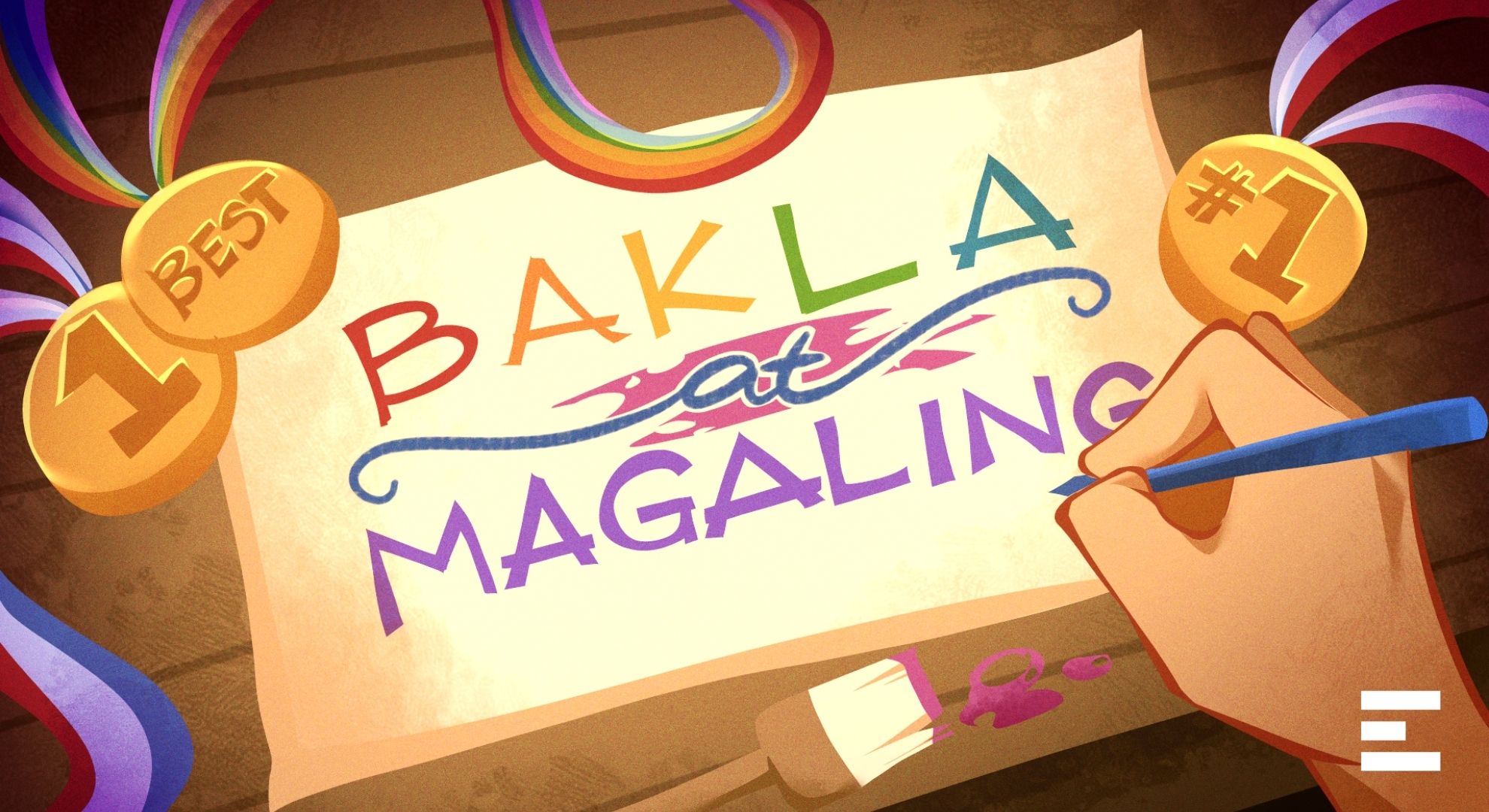
When a gay person excels, it is Filipinos’ pastime to say “Bakla siya pero magaling” or (vice versa) “Magaling siya pero bakla.” These are supposed to be compliments, but they reveal a prejudiced presumption—that excellence and queerness cannot co-exist. Apparently, as a gay person, you can only be one or the other—either bakla or magaling.
Beyond language, this prejudice extends into assumptions we thought were harmless. When we see two women in a romantic relationship, the first instinct is to ask “Sinong lalaki sa inyo?” As if heterosexual relationships are the default, and that somehow (if I get the logic right), there should still be a man in a woman-woman relationship. It is only curiosity, but we can see how even that is still confined to binaries we inherited from a long-standing understanding of gender based on patriarchy.
Ironically, despite celebrating ourselves as one of Southeast Asia’s most LGBTQ+-”friendly” countries, our vocabulary still exposes the limits of what we proudly call “acceptance.” Queer people are still confined to the two boxes of “bakla” and “tomboy”. And while we use terms like lesbian, transgender, and nonbinary, the discussions on them still largely rely on a foreign language. As a result, discourses on gender and sexuality can feel inaccessible to many Filipinos because the language used to discuss them feels foreign. This leaves many queer Filipinos with limited terms—that are unfamiliar to many—to identify themselves in their own language. And truly, to broaden such discussions, it is important to root their terms in Filipino.
That is why the solution lies in continuously developing our language. It is important to closely look at the prejudices disguised into our everyday expressions and, more importantly, to build institutions that reflect the same inclusivity that we often claim to value. However, beyond language, our acceptance should also be embedded in our laws. After all, for a country that prides itself as LGBTQ+-friendly, it has yet to pass a national SOGIESC Equality law.
There is every reason to celebrate the Filipino language. But there are even more reasons to interrogate it and ensure that it can become a language that is more inclusive for everyone who speaks it.
Because surely, pero is not the only conjunction that can exist between “bakla” and “magaling.”