








Now Reading: Pass the message, Mayor
-
01
Pass the message, Mayor

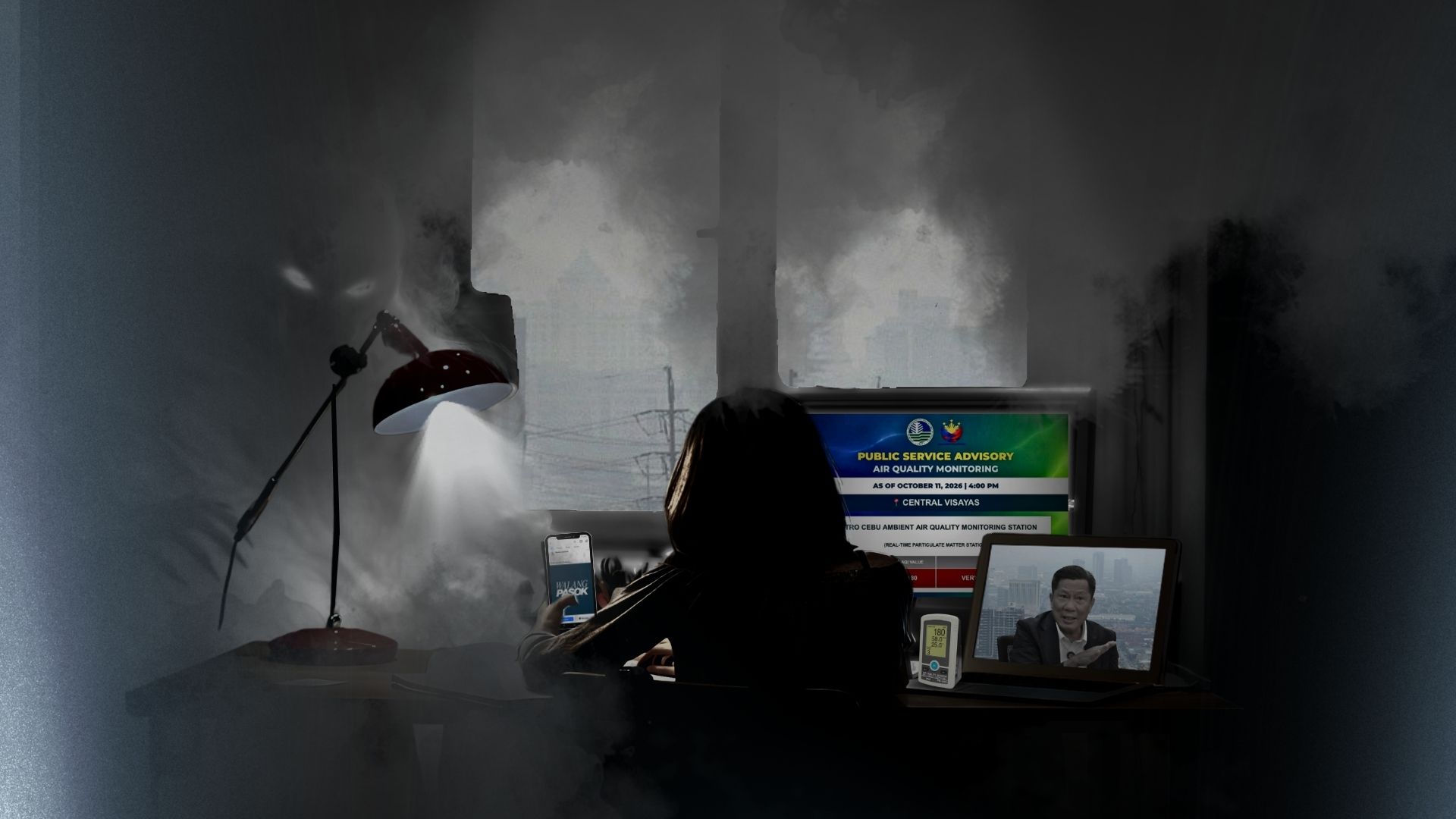
How to dodge a public health crisis in three easy steps: Drop the mandate at City Hall, pass the message to the schools, and leave young students to filter atmospheric acid with their lungs. After all, toxic air does not hold its breath while a principal drafts a memo.
Yet, for days, a suffocating gray veil has wrapped itself around Metro Cebu, erasing the skyline and turning the simple, instinctual act of breathing into a toxic hazard.
As the Air Quality Index (AQI) spiked past 150 into levels deemed “very unhealthy,” City Hall did not issue a rallying cry for public protection, but it issued a retreat, quietly stepping back precisely when firm, centralized authority was needed most.
Mayor Nestor Archival announced that deciding whether to suspend face-to-face classes is no longer an executive responsibility but a burden thrust onto individual school administrators unless pollution reaches a catastrophic AQI of 200. Paired with public statements casting doubt on official environmental reports and blaming distant Indonesian forest fires for our foul air, this sudden change is a breach of public trust. By washing its hands of routine emergency calls, City Hall has normalized an environment where public safety is treated as an administrative inconvenience rather than a fundamental civic right.
In the face of a toxic atmospheric crisis, city leadership passed the buck over executive courage, abandoning its most vulnerable citizens to navigate a public health emergency alone. Outsourcing the authority to suspend classes to individual school principals is a manifestation of a citywide environmental emergency turning into an anarchic, every-school-for-itself free-for-all.
Air pollution does not stop at campus gates, nor do school administrators possess atmospheric monitoring stations or epidemiologists on staff. Fine particulate matter (PM2.5) accumulated severely across the urban center, according to the data from the Environmental Management Bureau in Central Visayas (EMB-7), creating an invisible danger that penetrates deep into human lung tissue. Measuring a microscopic 2.5 micrometers or smaller, these lethal particles easily bypass nasal defenses to lodge inside lung alveoli and cross directly into the bloodstream, triggering severe acute asthma attacks, long-term cardiovascular damage, and respiratory distress. By forcing hundreds of principals to decipher complex atmospheric data in real time, City Hall creates a lottery of safety where a child’s protection depends entirely on the risk tolerance or bureaucratic efficiency of their specific school.
A child attending a private institution with a risk-averse board might be shielded, while a student in an overworked public school is left to sit in an open-air classroom inhaling airborne toxins.
Multiplying this failure of governance is the deliberate denial of local responsibility. While Mayor Archival publicly questioned whether local emissions were truly to blame, pointing his finger toward transboundary smoke across the ocean, EMB-7’s technical monitoring confirmed the ground reality: our smog is overwhelmingly driven by localized motor vehicle exhaust, industrial plants, and area-specific emissions trapped near the ground by low temperatures and still winds.
Blaming foreign winds while ignoring the tailpipes choking our own streets is not governance; it is a smokescreen. It is an intentional strategy designed to absolve city enforcement teams from clamping down on smoke-belching jeepneys, unregulated industrial stacks, and illegal open-garbage burning. The physical toll of this denial is already measurable: Department of Health (DOH-7) records indicate a dramatic 26.8% surge in regional respiratory consultations, with acute respiratory tract infections doubling as the haze hung over the metro. These are not abstract statistics; they represent emergency rooms filling with gasping children and frantic parents whose medical bills mount while City Hall debates meteorological origins.
A school-level autonomy grants institutions needed flexibility, allowing well-equipped campuses with filtered air-conditioning to remain open while poorer, unventilated schools close. They contend that a rigid, blanket municipal shutdown unnecessarily disrupts an already fragile academic calendar and deprives students of valuable instructional time.
And yet, this line of reasoning falls apart the moment a student steps outside their front door. A school’s clean indoor ventilation system offers zero protection to a child standing for an hour at a smog-choked jeepney stop or walking along congested arterial roads where toxic particulate levels peak. The hazard is not merely in the classroom; it is in the very air of the journey. Expecting academic flexibility to compensate for an unbreathable transit environment ignores the socioeconomic reality of thousands of commuter students who lack private, climate-controlled transport. For the average student who relies on open-air public transportation, the morning commute becomes an unavoidable toxic gauntlet, exposing them to peak pollutant concentrations long before they ever reach a classroom door.
Cebu City cannot permit its leadership to dissolve into thin air the moment our environment turns hostile. Abandoning central oversight while denying scientifically verified local emissions sets a dangerous path for how this city handles future public health disasters. If local government abdicates its protective role during a predictable atmospheric crisis, it invites institutional paralysis whenever the next disaster strikes.
A government that cannot guarantee clean air for its children must at least possess the courage to protect them from breathing it. Mayor Archival and municipal authorities must immediately reclaim centralized, data-driven trigger points for class suspensions while launching aggressive enforcement against local polluters. The city must deploy mobile air monitoring units, enforce strict roadside emission checks on public and private transportation, and establish mandatory municipal thresholds that automatically trigger online distance learning across all levels. When the sky turns gray and the air cuts sharp, Cebuanos do not need excuses wrapped in transboundary theories; we need decisive, unyielding leadership.
For a child’s lungs do not run on administrative timetables, and toxic air will not hold its breath while a principal drafts a memo. You can pass the message, Mayor, but when accountability vanishes into the haze, it is our children who are left choking on the consequences.