






Now Reading: 2025 NEWS WRAPPED: When shocks, scandals, and storms shook PH
-
01
2025 NEWS WRAPPED: When shocks, scandals, and storms shook PH


IF 2025 were a story, it would be a book packed with shocking plot twists — marked by chapters of political clashes, economic pressure, and a string of crises unfolding in each chapter.
These weren’t just stories that trended for a day, but a mirror to the real struggles of many Filipinos on a daily basis.
Here’s a look back at the top issues that shaped the country’s story over the past year.
Floods out of control
This year, the Philippines has been rocked by multiple controversies tied to the anomalous flood control projects, which started during President Ferdinand “Bongbong” Marcos Jr.’s State of the Nation Address last July 28, when he ordered an audit and list of flood control projects during the past three years.
What started as a call for transparency led to unraveling this year’s biggest corruption controversy yet.
- Who’s behind the flood scam?
Billions of pesos supposedly for projects to protect communities from flooding were instead used for projects that were poorly built, unfinished, and worse — never constructed at all. As investigations continue, engineers, contractors and even lawmakers were implicated on allegedly redoing budget insertions and dictated which firms would handle the projects in exchange for kickbacks.
Former Department of Public Works and Highways (DPWH) engineers Henry Alcantara and Brice Hernandez, along with contractors Sara and Curlee Discaya were among those implicated for assigning projects through budget insertions, then padding or leaving the projects unfinished.
Hernandez then tagged Senators Jinggoy Estrada and Joel Villanueva in the ghost projects, saying that they received kickbacks of up to 30% — however, both denied the allegations.
Former Ako Bicol Rep. Zaldy Co also stands as a central figure in the scheme for steering projects and manipulating bidding outcomes after Navotas City Rep. Toby Tiangco revealed that Co proposed billions for budget insertions this year.
In a statement, Batangas 1st District Rep. Leandro Leviste revealed that he holds former DPWH Undersecretary Maria Catalina Cabral’s files which named Congress members, executive branches, officials inside and outside DPWH, and even private interests. The file is yet to be released to the public, while legal proceedings and probes are still ongoing to hold the real masterminds accountable.
- DPWH’s massive reboot
Amid escalating political pressure and mounting controversy over flood-control infra projects, President Marcos accepted the resignation of the Department of Public Works and Highways’ former Secretary Manuel M. Bonoan and appointed Department of Transportation undersecretary Vince Dizon as the successor, tasking him with spearheading reforms within the agency.
Following the President’s directive, the newly appointed secretary ordered the courtesy resignation of all officials of the department, from the highest ranks to district engineers, to conduct a full organizational sweep of the Department.
This includes the undersecretary, assistant secretary, division head, regional director, up to the district engineer for the entire country, affecting more than 250 officials of the department.
To date, 100% of the department’s officials and staff have tendered their courtesy resignation as the ongoing flood control scandal takes center stage in the anti-corruption probe.
- Money, Money, Money
Children of the Philippines’ top flood control contractors have drawn criticism for flaunting lavish lifestyles online. Jammy Cruz, daughter of Sto. Cristo Construction owner Noel Cruz, posted videos showing luxury cars and designer items. Her family’s company secured up to 45 flood control project contracts worth an estimated P3.5 billion between 2022 and 2024.
Claudine Co, daughter of Hi-Tone Construction’s Christopher Co, shared videos of international trips and high-end fashion, including a Fendi jacket reportedly worth over P170,000. She is the niece of Ako Bicol Representative Zaldy Co, co-founder of Sunwest Incorporated. Co and her boyfriend, Lemuel Lubiano, brother of Centerways Construction president Lawrence Lubiano, purchased a Mini Bichon reportedly worth P380,000.
Social media users criticized the posts for flaunting extreme wealth while ordinary Filipinos struggle. Cruz and Co have begun deleting their online footprint, but debate over privilege and accountability in government-linked projects continues.
- Ikulong na ‘yan, mga kurakot!
Students from universities across Metro Manila staged walkout protests to denounce alleged corruption tied to flood control projects, linking their actions to other protests like the “Trillion Peso March” and the mass rally dubbed “Baha sa Luneta.” Protesters said the walkouts were meant to amplify public anger over billions of pesos allegedly lost to ghost projects while communities continue to suffer from flooding.
Thousands of Filipinos called for accountability, transparency, and the prosecution of officials and contractors implicated in the scandal shouting “Ikulong na ‘yan, mga kurakot” as the continued presence of pork barrel–like allocations still persist in the government.
The walkouts were part of a broader, coordinated wave of protest involving youth groups, civil society organizations, religious leaders, and flood victims. The actions served as a public outcry to end corruption and hold those responsible for the alleged misuse of public funds to account. As public anger grows, anti-corruption calls have also spread to concerts, sports events, and other public gatherings to let the protesters’ anger to be seen.
- Top Usec hits rock bottom
Former DPWH undersecretary Maria Catalina “Cathy” Cabral’s was found on December 18, shortly after she was declared dead on December 19 at 12:01 a.m., along Kennon Road in Tuba, Benguet. Authorities confirmed she died from blunt traumatic injuries consistent with a fall. Toxicology reports showed she had taken an anti-depressant, and no signs of foul play were detected. Cabral had been at the center of allegations involving irregularities in flood control project budgets.
New dashcam footage shows Cabral sitting alone on a concrete barrier at 3:25 p.m. on December 18, supporting reports that she asked her driver to leave her alone to “think.” Anti-anxiety medication and bladed weapons recovered from her belongings suggested she may have been under severe stress. She was discovered unconscious near the Bued River around 8 p.m., roughly 20 to 30 meters below the highway.
Authorities are securing hotel records and her electronic devices while civil forfeiture cases on her assets may continue. The investigation into both her death and alleged corruption remains ongoing.
The Hague calls, Duterte answers
Former president Rodrigo Roa Duterte has been detained by the International Criminal Court (ICC) in The Hague as he faces charges of crimes against humanity over the deadly war on drugs during his time as the president in 2016.
Duterte was arrested and turned over to the court on March 12, and appeared before ICC judges just two days later. A hearing to confirm the charges was initially set for September but has been put on hold until now.
His lawyers challenged the court’s authority, claiming that Duterte is not medically fit to stand trial — this has been rejected by the judges after arguing that ICC still have jurisdiction despite the country being withdrawn from the Rome Statue in 2019 by Duterte. The judges also found out after a series of assessments that Duterte is fit to stand trial.
In October, the case took another turn after judges removed ICC Chief Prosecutor Karim Khan due to impartiality issues, reassigning the case to Deputy Prosecutor Mame Mandiaye Niang. Duterte remains in detention as further legal proceedings continue.
VP, funds, and the impeachment storm
The House of Representatives voted to impeach Vice President Sara Duterte from her position on February 5 — making her the first since EDSA Revolution to face possible removal from office.
Duterte’s impeachment is based on her alleged misuse of confidential and intelligence funds, with acknowledgement receipts listing fictitious names such as Mary Grace Piattos and Carlos Miguel Oishi. According to lawmakers, Duterte has released and spent P125 million within 11 days of taking office in 2022.
The complaint against the vice president also expanded to include allegations of corruption, betrayal of public trust, and her controversial remarks about an alleged plot against the president. Yet, Duterte has denied the claims and maintains that the charges are politically motivated while acknowledging the another round of impeachment complaints that could be filed once the one-year bar rule lapses on February 2026.
Political and legal process from Duterte’s impeachment has already seen significant developments as the Senate archived the articles of impeachment after the Supreme Court ruled parts of the case “unconstitutional.” Though the lower house has filed a motion for reconsideration, asking the Court to revisit its ruling.
P500 on the Christmas Table
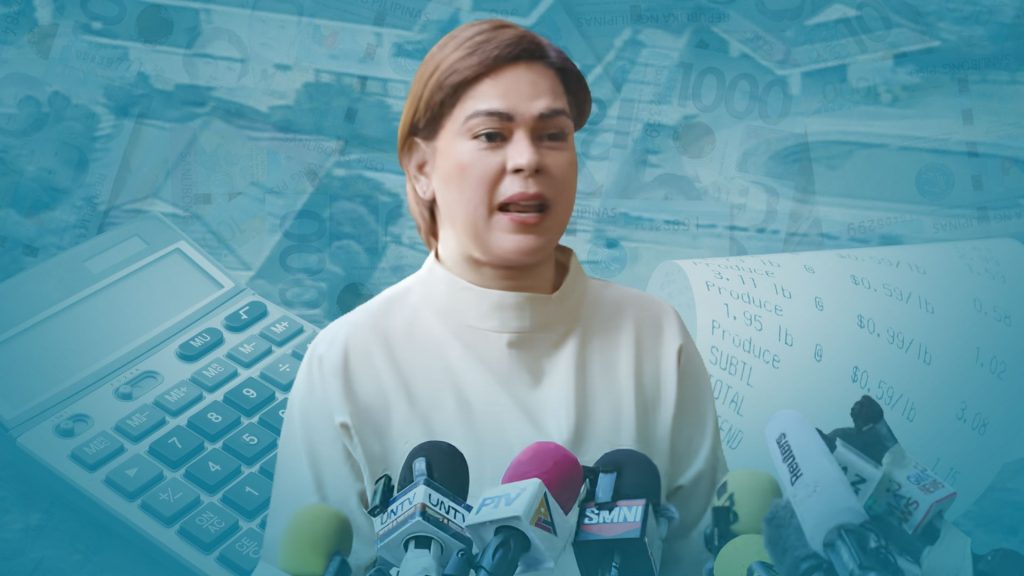
In December, the Department of Trade and Industry (DTI) drew public backlash after claiming that a P500 budget was enough to prepare for a basic Noche Buena, the traditional Christmas Eve meal. The proposal, pushed by DTI Secretary Cristina Roque, was framed as a practical guide for budget-strapped Filipino families amid inflation.
DTI’s suggested menu included modest portions of ham, spaghetti, macaroni salad, and fruit cocktail, while grocery tests showed it was technically possible, it was widely seen as unrealistic for a traditional celebration.
Lawmakers, labor groups, and netizens criticized the proposal as insensitive and disconnected from the daily struggles of Filipino families, arguing it reduced Christmas to bare survival rather than celebration.
Disaster-induced challenges
This year has also turned out far busier than usual due to calamity activities in the country — including typhoon and seismic activities. While Philippine Atmospheric, Geophysical and Astronomical Services Administration initially predicted a below-average season, storms have arrived earlier this year and more frequent than what is forecasted. By early October, 16 tropical cyclones had already entered the Philippine Area of Responsibility.
The most destructive storm so far was Super Typhoon Ragasa, locally named Nando, striking northern Luzon in September with extreme winds and flooding, causing 11 death tolls and heavy damage before moving to Taiwan.
In Cebu, the situation has even more severe after they were struck by a magnitude 6.9 earthquake on September 30, damaging homes, roads, and bridge, forcing citizens into evacuation centers. However, evacuation centers weren’t enough to accommodate everyone, leaving some to resort sleeping inside plastic bags.
Habemus Papam!
On April 21, Pope Francis passed away at the age of 88 leaving his 12 years of papacy behind. He had faced several health issues in his later years, including pneumonia and respiratory issues, but remained dedicated to his pastoral duties until then. The late pope had spent his final days at Vatican’s Casa Santa Marta where his death was officially announced.
Following his passing, Cardinals went to Rome for the papal conclave, where they vote in secrecy to choose the next pope. Among the 133 electors were three Filipino cardinals: Cardinals Luis Antonio Tagle, Jose Advincula, and Pablo Virgilio David.
On May 8, a white smoke finally rose from the Chapel, announcing the new pope, Cardinal Robert Francis Prevost, had been elected the 267th pope, taking the name Pope Leo XIV.
Lost in the shadows of Taal
In June, whistleblower Julie Patidongan, claimed that about 34 missing sabungeros were kidnapped, killed, and dumped in Taal Lake. He also accused e-sabong tycoon Charlie “Atong” Ang of being the mastermind and former actress Gretchen Barretto of being involved.
After Patidongan’s revelations, the Department of Justice, police, and Coast Guards began investigating the lake for evidence. They recovered human remains from the lake, though DNA tests have yet to match them to the victims.
In response, authorities has placed 15 police officers linked to the case under restrictive custody, and prosecutors have issued subpoenas to 60 individuals, including Ang, as authorities seek corroborating testimonies and “hard evidence” to strengthen Patidongan’s claims.
The lost sabungeros case has caught national attention, leading to the President vowing in his fourth State of the Nation Address to pursue the “big fishes” behind the disappearances.
Where every shade counts
Both the Marcos and Duterte blocs emerged, producing an evenly divided upper chamber, each securing five seats, a decisive break within the UniTeam coalition. Longtime supporter of the Duterte clan Bong Go topped the senatorial race; along with him in Duterte’s five are Dela Rosa, Marcoleta, Camille Villar, and Imee Marcos.
Two oppositions claim Top 5 spots as Bam Aquino makes his senate comeback, clinching the second spot after losing the 2019 senatorial race. Kiko Pangilingan, widely predicted to miss the Magic 12, landed fifth despite disinformation against him during the campaign season. The Marcos camp holds five seats: Tulfo, Lacson, Sotto, Cayetano, and Lapid.
Human-rights lawyer Chel Diokno and his party list, Akbayan Citizens’ Action, secured three slots in Congress with 2,779,621 votes—their strongest yet. Leila de Lima returns after seven years of arbitrary detention following Mamamayang Liberal Party-list’s victory of one congressional seat. Despite winning three seats, Duterte Youth party-list faced disqualification over eligibility and accreditation concerns.
A voter turnout of 81.65% marked the 2025 midterm elections with the highest turnout in the history of the midterm elections.
Welcome to “Family Feud”
In November, during the Iglesia Ni Cristo-led “Rally for Transparency” in Manila, Senator Imee Marcos publicly accused her brother, President Marcos, as well as the members of the first family of using illegal drugs.
The allegations surfaced following the worsening political tension in the country, including the anti-corruption protests and anomalies over flood infrastructure projects. Malacañang dismissed the claim, citing it as “baseless” and just an attempt at destabilization rather than a serious allegation.
So far, no evidence or credible documents have been produced to support Imee’s accusation. The Palace, however, released prior drug tests showing negative results and documents from authorities that the president was never included in the official drug watch list.
Meow you see me, meow you don’t
In December, Gen Z lawmaker Kiko Barzaga of Cavite’s 4th District became a subject of national attention after the House of Representatives voted to suspend him for 60 days without pay over “disorderly conduct.”
Known for his outspoken criticism of President Marcos and provocative social media posts, Barzaga faced ethics complaints allegedly lewd content, seditious remarks, and displays of wealth online. He is also known due to his “meow meow” persona, incorporating memes when posting criticisms.
The House Committee on Ethics, acting on complaints filed by Deputy Speaker Ronaldo Puno and members of Barzaga’s former party, found him guilty in a lopsided vote and ordered 24 of his posts deleted.
Barzaga accepted the suspension, but denied that he violated House rules, calling the punishment as politically motivated amid tensions triggered by the impeachment complaint he filed against Marcos and his calls for public protest.
K-12, reform or abolition?
The K–12 program has faced widespread criticism for failing to prepare students for employment while adding financial pressure on Filipino families. While the program was implemented to achieve progress in the education sector, many see it as a burden, urging its abolition instead.
President Marcos admitted the program did not provide clear job advantages and said the additional two years of schooling increased costs for parents. The administration has sought private-sector partnerships to address skills mismatch and align training programs with labor market needs.
Kabataan Partylist Rep. Raoul Manuel have called for the abolishment of the K–12 law, arguing repeated curriculum adjustments have failed to fix structural flaws.
Other organizations, including private education groups, urged reforms instead of abolition, warning that repealing the program could displace thousands of senior high school teachers and waste years of investments in facilities and training.
Saan aabot ang 20 pesos mo?
In early 2025, reports showed retailers sold imported rice for up to P65 per kilo, while average commercial rice prices reached P45 per kilo. On May 2, the government’s P20-per-kilo target distribution program, KADIWA ng Pangulo, led by the Department of Agriculture, currently has 162 centers nationwide as of July, as part of the government’s response to the declared food security emergency.
In 2022, then-presidential candidate Marcos pledged to lower rice prices to P20 per kilo, taking him years to partially accomplish the program since centers were yet to sell in all areas of the country — especially in the rural areas.
The initiative garnered criticism from analysts, farmers, and fisherfolk groups, who state that the P20 is not economically stable, considering the total costs of production factors would already be twice the suggested price. They emphasized that a lack of proper support for palay prices, input costs, and milling programs could threaten their livelihood and fair compensation as they continue to lower prices for consumers.
The Marcos Jr. administration promises to sustain its P20-per-kilo initiative until 2028, with no comment on specific plans yet.
Justice at last for Kian delos Santos
It took eight years for justice to be served for War on Drugs victim Kian delos Santos. He was just 17 when he was shot dead during a police drug operation in Caloocan City last August 16, 2017. The three officers, PO3 Arnel Oares, PO1 Jerwin Cruz, and PO1 Jeremias Pereda claimed that he fought back — which was coined as “nanlaban” during the duration of drug war.
In November 2018, the Caloocan Regional Trial Court convicted the three and imposed reclusion perpetua for 40 years imprisonment without parole. Kian’s remains were exhumed in 2022 for further forensic checks, and on December 22, 2025, the Supreme Court finally upheld the convictions on the ground that there was treachery and the officers were not performing act in line with their duty.