











Now Reading: 54 years later, humans return to deep space—and this might revive a new era of lunar exploration
-
01
54 years later, humans return to deep space—and this might revive a new era of lunar exploration
54 years later, humans return to deep space—and this might revive a new era of lunar exploration

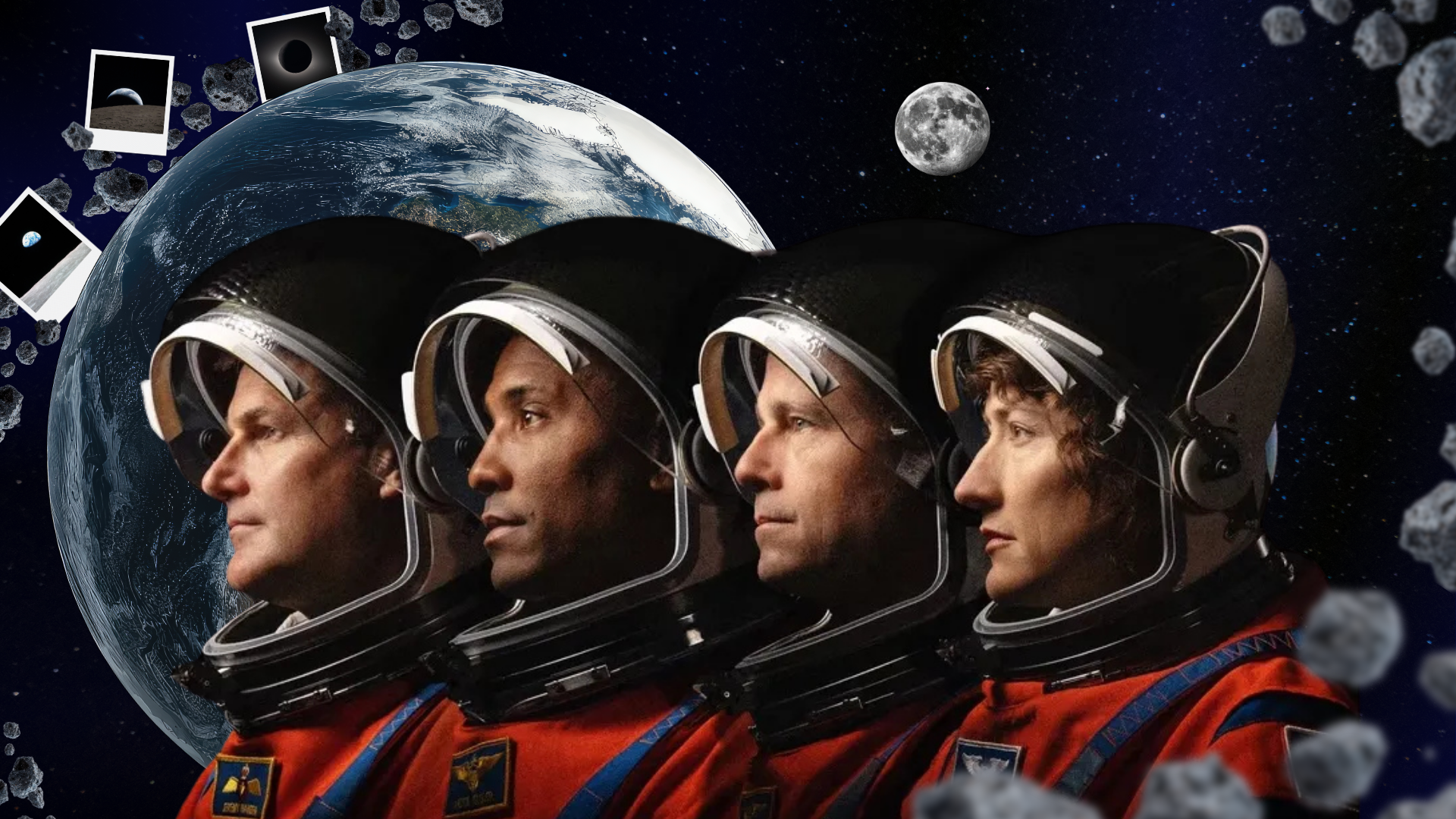
As the first crewed lunar mission since 1972, following Apollo 17, Artemis II marked a massive milestone as humans once again left low Earth orbit—but this time to pave the path for future lunar missions.
Set out to test the Orion spacecraft’s life-support systems with astronauts aboard, the National Aeronautics and Space Administration (NASA) designed the mission to gather critical data for future crewed lunar landings and to validate its performance for deep-space travel.
Let’s trace the 10-day path taken by the spacecraft in Philippine time:
April 2: Historic Ascent
The mission lifted off at 6:35 a.m. PHT from Kennedy Space Center’s Launch Complex 39B aboard the Space Launch System (SLS) rocket, carrying the four-person crew of NASA commander Reid Wiseman, pilot Victor Glover, and mission specialists Christina Hammock Koch and Jeremy Hansen.
Even before landing, the crew had already made several firsts: Christina Koch became the first woman to fly to the vicinity of the Moon, Victor Glover became the first person of color to fly a lunar mission, and Jeremy Hansen became the first non-American (Canadian) to leave low Earth orbit.
April 3: Hello, World
The second day included checking systems, troubleshooting the spacecraft’s toilet, and fixing a blinking light issue to ensure all systems were operational for the deep-space flight near the rocket’s upper stage.
Commander Wiseman also captured a photo of Earth from Orion, dubbed Hello, World—showing the planet in an inverted position, along with visible auroras, a faint patch of light as the Earth eclipses the sun, and city lights across multiple continents.
April 4-6: Trajectory Locked
The Artemis II crew executed the Trans-Lunar Injection burn, a rocket engine push to break free from Earth’s gravity, and began their multi-day cruise toward the Moon.
During this time, the crew also tested their Orion spacesuits and sent greetings to Earth ahead of their closest approach to the Moon on April 7.
April 7: The ‘40 minutes’ silence
In lunar history, Artemis II successfully flew past the Moon and reached a distance farther than anyone had ever traveled from Earth, 252,756 miles, leading to an expected 40-minute loss of communications with NASA.
There was no way to get a signal through the Moon, and during the same period, the astronauts saw the far side of the Moon, previously only visualized in grainy images from the Soviet Union’s 1959 Luna 3 mission.
Astronauts also captured a solar eclipse from their unique vantage point in space, together with new photos of Earthset and Earthrise.
Later that day, the crew also named two lunar craters: one was after the capsule the crew inside the Orion spacecraft were in which is called ‘Integrity’, and another crater was named ‘Carroll’ in honor of mission commander Reid Wiseman’s late wife, who was also dear to the other crew members.
April 8-10: On their way home
After the adrenaline high, the astronauts began their Earth-bound journey.
During these days, the crew did some final checks on their navigation systems and heat shield. They also secured everything in the cabin to prepare for a high speed re-entry to Earth’s atmosphere
April 11: Splashdown, mission complete
The Artemis II crew had come to the most dangerous part of their mission.
After some fine-tuning of their entry angle, which determined their trajectory path and where they will land, the Integrity capsule re-entered Earth’s atmosphere.
During their re-entry, there was an expected 6-minute blackout period where there were no communications with the crew. This was caused by intense heating that formed a shield-like structure, blocking all signals. The capsule also reached its peak descent speed in this period — about 25,000 mph
Finally, at around 8:08 a.m. PHT, after a series of successful parachute deployments, the crew made a safe splashdown in the Pacific Ocean near the coast of California, where they were recovered by the USS John P. Murtha, marking the end of their historic mission.
The 10-day crewed mission to the Moon and back did not just set new records, it redefined human capabilities and rekindled a new era of space exploration.
This is not the end, it is only just the beginning.