




Now Reading: Pares is everyone’s favorite product built by the working class
-
01
Pares is everyone’s favorite product built by the working class

It is high noon on Pedro Gil Street, and the concrete is radiating the heat shone over Manila’s historic Ermita district.
Along this 3.65-kilometer arterial road traversing the districts of Ermita, Malate, Paco, and Santa Ana, the daily grind is at its absolute peak. Jeepneys roar past, motorcycle taxis zip through traffic, and the midday sun beats down on hundreds of commuters and workers traversing to and fro the city.
And yet, even with the suffocating heat and noise, a different kind of intensity draws the attention of crowds towards the unmistakeable, heavy aroma of soy sauce, garlic, onions, and anisado clinging to the humid air.
Pedro Gil, to whomever lives and breathes the same fumes as one would, is a street of stark contrasts. Not far away would you find the University of the Philippines-Philippine General Hospital, a few private universities, ukay-ukays, dense informal settlements, the lot.
But during the brutal lunch rush, people would gather not in one, but in many street-side eateries–and one, which particularly caught my eye, was Mang Rich’s Kuya Pares paresan.
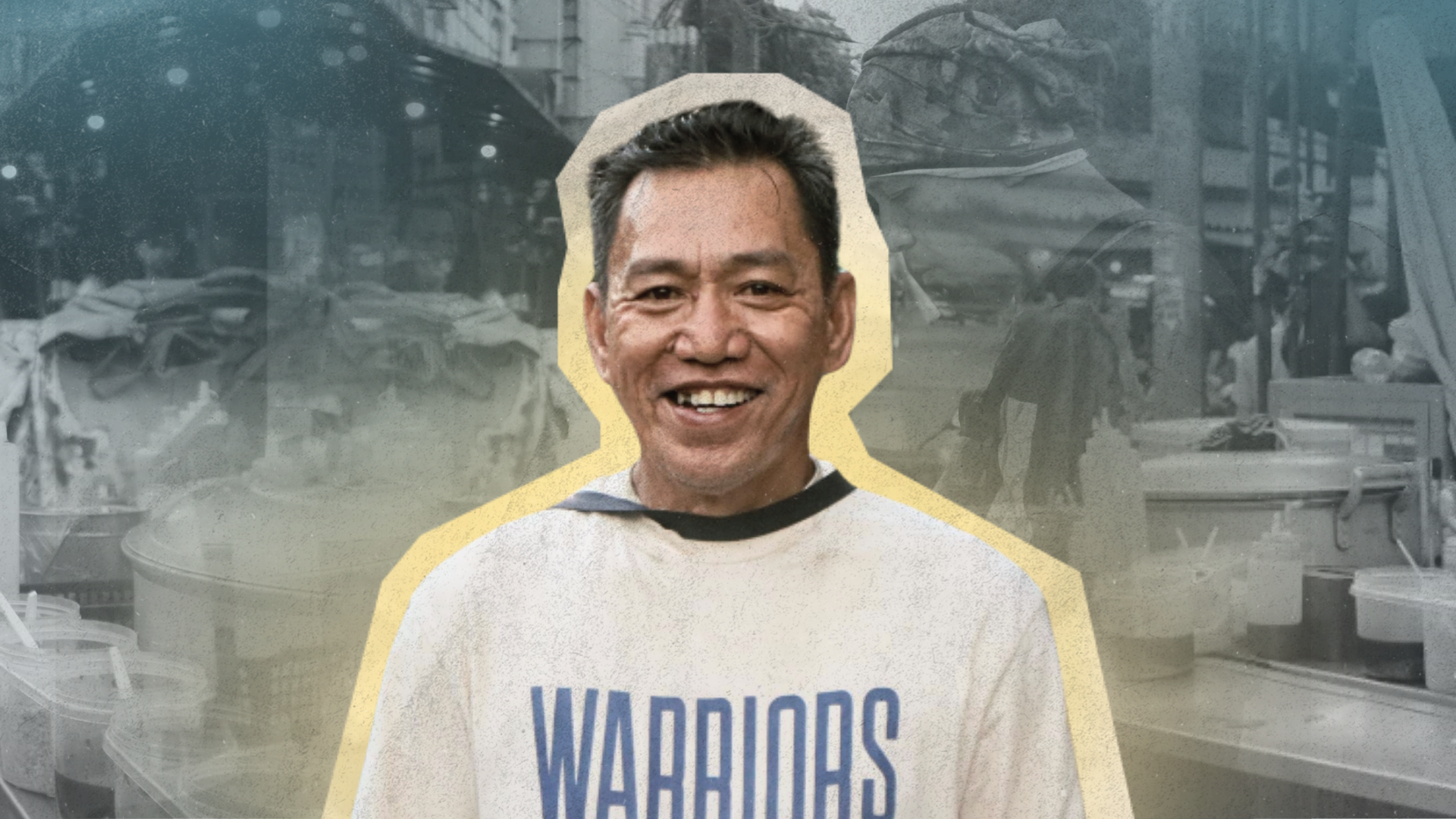
In this ecosystem stands 50-year-old Richmond Chavez. His moniker, which is proudly plastered over his cart, is what he wants himself to be known to the workers, delivery riders, commuters, and the broad community living in Ermita: ‘Kuya Pares’ – literally, older brother’s Pares.
For nearly 18 years, Chavez has served pares, a hearty, slow-braised stew served with rice. For one, it is the undisputed lifeblood of the Filipino working class; a cheap, caloric necessity.
In reality, however, Kuya Pares’ midday cart is the story of a booming micro-economy, a protest against system neglect, and a social anomaly where Manila’s rigid socioeconomic boundaries dissolve completely into the steam rising from the bowls.
Street economics
To the passerby, a food cart is a symbol of the informal economy – along with peddlers, street vendors, the lot. For policymakers, they can be dismissed as simply as an untaxed, unregulated nuisance that clogs Manila’s arterial roads.
Chavez, who had been formally educated, is acutely aware of the stigma in his line of work. Behind his welcoming demeanor is a fierce, highly articulated resentment towards the bureaucratic elite who deeply misunderstands his trade.
He is quick to dismantle the elitist misconception that street vendors are economic parasites. While the Philippine Statistics Authority (PSA) groups vendors into the “informal sector”–a demographic that makes up millions of the national workforce–Chavez argues that their contribution is exacted at the cash register, long before the food ever hits the bowl.
“Mayroon pa ngang nagsasabi na, hindi kami nakakatulong sa ekonomiya ng Pilipinas. No!” Chavez said.
(Some even said that we do not contribute to the Philippine economy. No!)
“Sa bawat binibili naming ingredients o anumang produkto na ihahain ko sa paresan, lahat ‘yan may VAT! Lahat ‘yan may tax! Lahat ‘yan may patong! Paano ang masasabing ang isang self-entrepreneur ay walang bahagi sa ekonomiya?”
(Every single ingredient or product that we use in our paresan has VAT! Everything is taxed! Everything has an added value! How can you say that a self-entrepreneur has no role in our economy?)
Chavez’s frustration is backed by the scale of the street food industry. The Food and Agriculture Organization (FAO) reports that urban households in developing Asian nations can spend anywhere from 15% to 50% of their food budgets on street food.
Furthermore, market analysts at Mordor Intelligence project the broader Philippine foodservice market to exceed USD 21 billion in the coming years.
Street vendors like Chavez are the unsung, heavily taxed foundation of this supply chain, purchasing commercial quantities of meat, rice, LPG, and produce daily, absorbing the shock of inflation so their customers don’t have to.
“Bilang isang empleyado ng gobyerno, hindi mo pwedeng maramdaman ‘yon dahil ikaw lang nakadepende sa trabahong meron ka. Wala kang pina-purchase araw-araw… Compare that to us na self-entrepreneur, na kami mismo ang gumagayak sa lahat ng ginagawa namin,” Chavez said.
“As a government employee, you can’t feel that way because you’re the only one dependent on the job you have. You don’t have to purchase anything every day… Compare that to us self-entrepreneurs, who deck ourselves out in everything we do.”
The dream of liberation
Even Chavez, who now seems to be the captain of his own life, used to be an employee. For years, he worked under a string of employers, overseas and locally, a grueling cycle of wage labor that offered little in the way of upward mobility.
It was not until the pandemic upended the global economy that Chavez made his move.
After the devastating lockdowns of 2022, Chavez looked at his meager savings and decided to buy his freedom.
“Sabi ko, sarilihin ko na ‘to,” he said. “At least I have ten to twelve thousand pesos… I will start na ako para sa sarili ko. Tapos na ako dun sa pangangamuhan. Ako na mismo.”
(I said, I’ll make this my own. At least I have ten to twelve thousand pesos… I’ll start now for myself. I’m done with the exploitation. It’s me now.)
With barely enough capital to buy a mid-range smartphone, Chavez built his own paresan. He hired his own prep cooks, managed his own inventory, and eventually expanded to a second location.
He chose this life–standing over boiling pots in the middle of a Pedro Gil summer–over the grueling life of becoming an Overseas Filipino Worker (OFW).
His ultimate motivation? To break the cycle of poverty for the next generation. “Ang talagang vision ko eh para sa mga anak ko,” he said. “Gusto ko talaga silang magkaroon ng edukasyon. Makapagtapos sa isang kolehiyo, at balang araw, yun naman ang gagamitin nilang career.”
(My real vision is for my children. I really want them to get an education. To graduate from college, and one day, that’s what they’ll use for their career.)
Accidental equalizer
Serving an average of 150 to 160 customers daily, Chavez’s cart is a lifeline for those who keep the city running. When asked who makes up his core clientele during this chaotic lunch hour, he lists the backbone of the urban workforce.
But now, that story is changing.
The working class established the paresan, but they are no longer its exclusive patrons. The undeniable comfort of the dish has drawn in crowds that span the entirety of the socioeconomic spectrum.
Chavez said that his clientele now routinely included OFWs, students, and people from companies.
At the paresan, the playing field is entirely leveled. There is no VIP seating on Pedro Gil. Everyone breathes the same exhaust, sweats in the same heat, waits in the same line, sits on the same plastic stools, and asks for the same chili oil.
The dish does not discriminate, demanding a quiet, mutual respect regardless of one’s tax bracket or social standing.
The pares must go on
The street food industry is notoriously unforgiving. Vulnerable to fluctuating meat prices, sudden torrential rains, strict city ordinances, and the severe physical toll of standing under the sun, many vendors fold within a few years. Yet, Chavez remains the sole survivor among the vendors who started alongside him on this stretch of Ermita in 2007.
When asked why he outlasted the rest, his answer strips away the complex economics and gets to the heart of the trade.
“Sabi nga ng ibang magpapares sa bukod-tangi, bakit ikaw lang ang natira? Kasi minahal ko ‘to eh,” he said. “Ginaganap ko yung parte na ‘yon na para ma-appreciate ang lasa ng mga customer at ginagalingan ko hangga’t maaari ang mga ingredients na maging maayos lahat at magiging satisfied ang bawat kakain sa akin.”
(As others who make pares say to the unique one, why are you the only one left? Because I love this. I fulfill that part so that customers can appreciate the taste, and I do my best with the ingredients to make everything proper and satisfy every customer who eats from me.)
While upscale restaurants increasingly attempt to gentrify the dish–topping it with Wagyu beef, truffle oil, and roasted bone marrow–Chavez insists that the traditional, unpretentious beef pares remains the truest unifier precisely because of its simplicity and accessibility.
“Beef pares kasi ito’y pangkalahatang pagkain,” Chavez said, pointing to the inclusive nature of the original recipe. “Pwedeng kumain ang Katoliko, ang Kristiyano, at ang Muslim. So mas pipiliin ko at mas kilala.”
(Beef pares is a general food. Catholics, Christians, and Muslims can all eat it. So I’ll choose it more, and it’s more well-known.)
But then again, in high noon, the class divides, gated communities, and political disenfranchisement still exists. Yet so, the cart of Kuya Pares on Pedro Gil stands as an endearment to the reality of the Filipino, a space completely united in class and radically inclusive of everyone.
And even though it is an enterprise built by the working class, taxed by a flawed system, it is open to absolutely everyone.
Richmond Chavez’s pares is a story that says no matter how vast the divide, Manila still gathers, exhausted and hungry, to eat from the same bowl.