




Now Reading: A scribe’s shackle
-
01
A scribe’s shackle

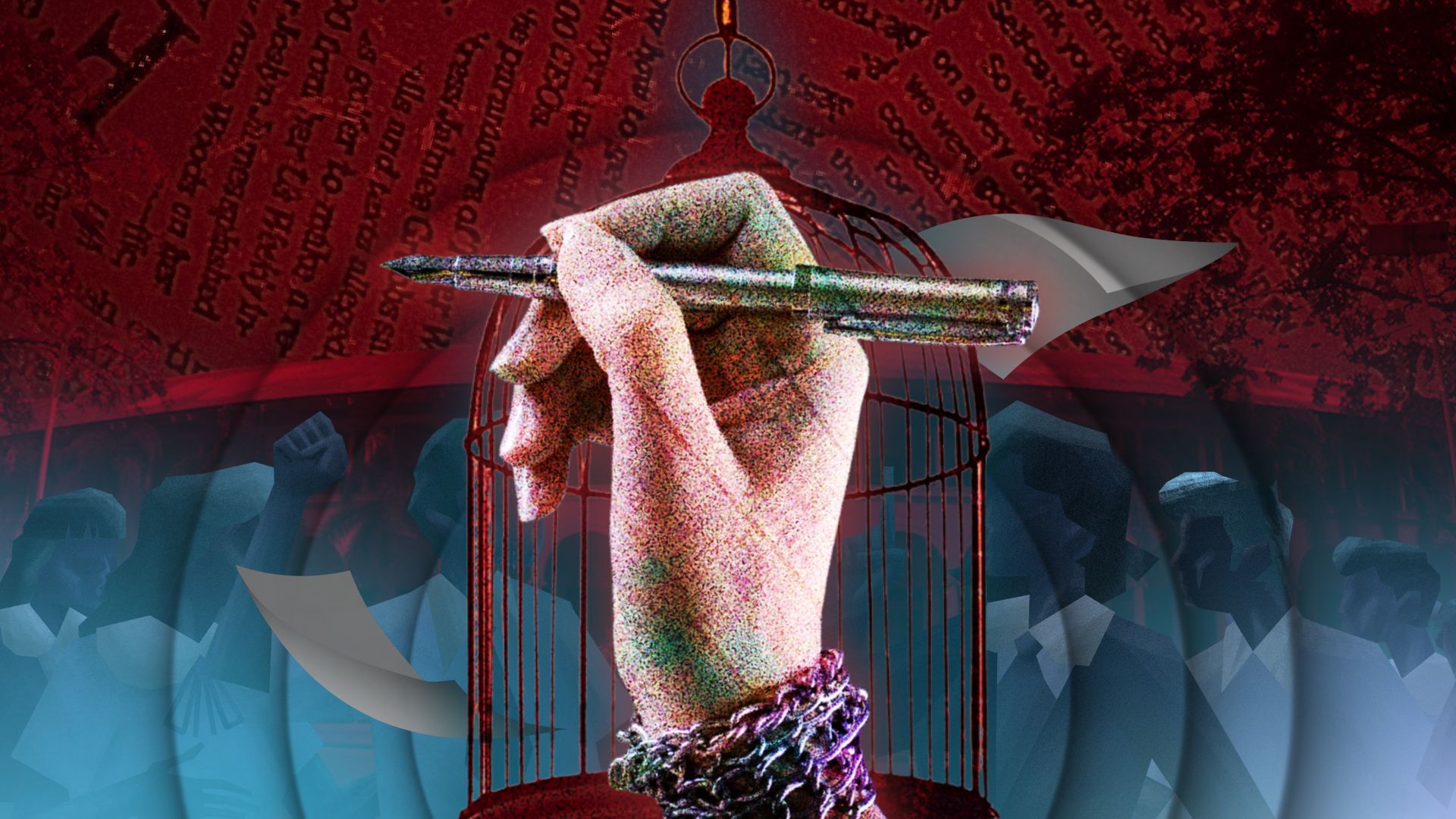
To remain quiet is to show support, and to repress criticism is to show solidarity. This is a narrow way of looking at constructive criticisms, especially when thrown at leaders. They expect comfort that comes along with their position. However, a striking irony exists when student leaders present themselves as the oppressors of truth against their fellow students. It is as if they are mirroring the treatment of the Philippine government to journalists, reduced to public relations and muffled by censorship.
In a Facebook post published last May 23 by the official student publication of West Visayas State University, Forum-Dimensions, the news update featured the reorganization of student government structures pushed by the University Student Council (USC) Constitutional Committee. This is through revisions of the constitution for the Main Campus. The provisions focused mainly on the shift to the presidential system, decentralization of power, and extension of term limits.
However, scribes were quick to react when a provision “regulation of fourth estate” (found in Article XII, Section 4) was included. The Fourth estate refers to the press and their role as an independent watchdog for truth and holding those in positions accountable. Therefore, the proposed constitution enables USC to regulate publications under its jurisdiction in cases when “public interest or safety so requires.” Ironically, under the same constitution, Article IV, Section 8, states that no policy shall be enforced that abridges freedom of expression and the student press.
Student councils are often regarded as the highest organization to lead school-wide events and activities, as well as to represent the school and its pool of students. However, representation does not equate to restrictions and regulations. It is not under the scope of the power of the student government to hold publications by the neck. It shouldn’t work like that. Additionally, this provision is a violation of the Campus Journalism Act of 1991 or RA 7079. Stipulated in Section 4, an established publication must determine its policies and funds independently, managed by the editorial board and staff.
By all means, these two entities are supposed to function independently, just like the branches of the government through the separation of powers. Otherwise, overlapping jurisdictions could create a conflict of interest and erode the purpose of a free press. Functioning independently also means it could act efficiently for checks and balances; stripping away its liberty blurs the line between power and manipulation.
The main duty of a free press is to serve the best interests of the public without fear of retaliation or restraint. Once boxed in restrictive policies, it cannot continue to benefit the people, but only those in power. It is as if shackles are put around the dove’s feet. Interventions like this are a big step back to how campus press was achieved back in the days.
What’s more alarming is the concern of public interest — who gets to decide if an article is “safe” to be published? When does it not tarnish the school name? When does it not criticize school administrators? When writers only frame the angle of stories to feature something desirable? This is an insult to the editorial freedom of campus journalists.
After receiving backlash, USC ConCom retracted and formally deleted the provision during its second reading on May 24. “Thank you for your active participation in the discourse of constitutional reform. We hear you, and we understand your sentiments,” said the ConCom Technical Working Group Secretary in a post.
While the provision was stripped from papers, it will always go down in history that the council once attempted to stifle the scribes. It should also serve as a lesson to student leaders that every resolution holds power and affects the dynamics of the student body. Likewise, it is a wakeup call for organizations and publications to not condone controlling narratives because if not corrected, they may ripple into their later life once in government offices, institutions, and the workplace. As young as now, we must train them to seek healthy discourse and democracy that also involves scrutiny and disagreement, not just praise and glorification.
Students must realize that truth-telling isn’t about giving comfort to those in power, but shaking their seats to stand and face the people. In the near future, these students will graduate, but their political habits, critical thinking, and rationality will remain. And it is important to instill in them that dissent isn’t something to be feared or neutralized, but taken as a point of improvement aimed at students’ welfare.
The school is an avenue to excel and serves as a training ground for future legislators, politicians, journalists, and citizens. We must maintain the integrity of these halls and respect the dignity of those who stand for and against it. After all, what schools allow today will reflect on what society will eventually permit and legislate in the future. Democracy starts in questioning the status quo, raising eyebrows on unnecessary provisions, nitpicking bills, and holding those in power (even at the school level) accountable. Democracy thrives where it allows itself to bloom, not slandered, repressed, or curtailed, but cultivated.