


Now Reading: When diskarte becomes the system
-
01
When diskarte becomes the system

Ariana Janeo
“Sa diskarte lang yan.”
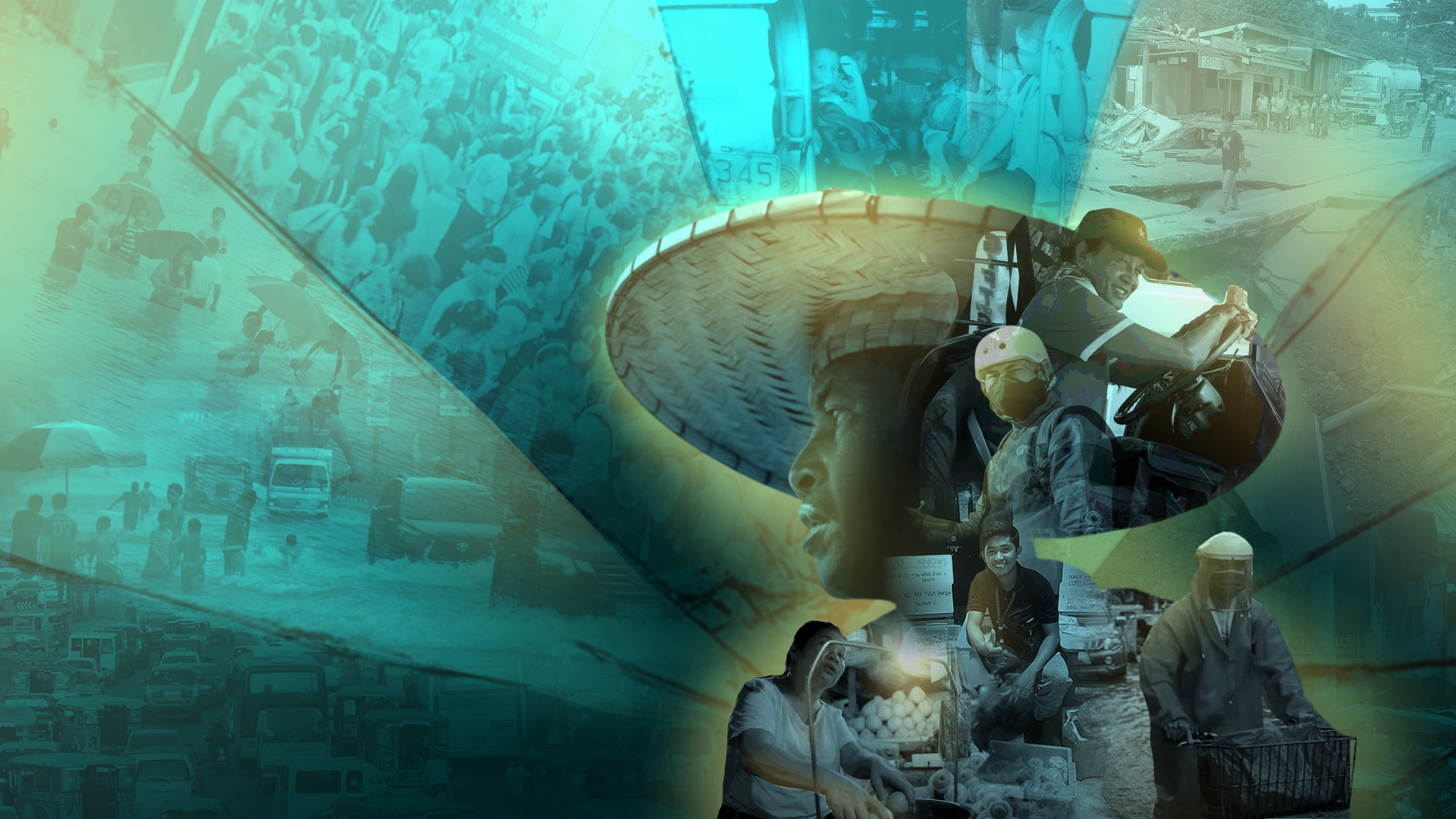
More often than not, this very phrase echoes to me from a relative, close colleague, or even from a stranger giving advice. There is this very distinct praise we reserve for every Filipino commuter who braves the waist-deep flood with a make-shift boat, a street vendor just wanting to make ends meet, or a hustling student working a part-time job for living expenses. We call it diskarte—the quintessential concept of being street-smart and resourceful in having creative solutions.
For generations, this very trait has been celebrated as a symbol of resilience. It reflects the way Filipinos react and cope up with whatever hurdle that may come along the way. But here’s the trap: because of this, we frame survival entities as an individual responsibility, letting the institutions forget about theirs.
While we continue to praise the strength of those who face unreliable transportation, low income, and tuition increases, among others, we fail to notice the reality that these struggles shouldn’t have existed in the first place. The problem is not that Filipinos rely on diskarte. The issue is that diskarte has become the expected solution to failures that the government should have resolved long before.
Moreover, nearly 40% of college enrollees result in dropouts due to financial hardships and systemic barriers in the system. As their opportunities become inaccessible, many of these young Filipinos are left with no choice but to enter the side hustle of taking multiple jobs or seeking other alternatives to make a living. Although these paths are often celebrated for being resilient, it only presents a troubling reality that for most of us, diskarte has never been just an option; for others, it is a necessity created by a system that struggles to give them the opportunity for their success.
The glorification of diskarte becomes even more dangerous when it transforms systemic problems into personal shortcomings. In a culture where success is often attributed to resourcefulness, those who continue to struggle are frequently told that they simply lack initiative. The unemployed 5.1% of Filipinos are advised to “find a way.” The 15.5% portion of the population living under the poverty line is told to “work harder.” The student who drops out is encouraged to “be practical.” And the shortage of 127,000 nurses is just a matter of “personal choice.” By reducing social issues to matters of individual effort, we create the illusion that opportunity is equally available to everyone when, in reality, many begin the race several steps behind.
Even more troubling is how diskarte has gradually expanded beyond resilience and into the realm of circumvention. It is also now commonly associated with those people who get to receive what they want by bending the rules, exploiting loopholes, and more commonly by using their connections to their advantage.
A clear example of this can be seen in the Land Transportation Office (LTO), where reports of “fixers” remain persistent despite repeated government warnings and anti-fixer campaigns. In many LTO branches, individuals offering “assistance” outside or near offices are still visible, promising faster license processing or easier appointment slots in exchange for additional fees. These intermediaries often bypass the standard queueing system that ordinary applicants must endure for hours or even multiple visits.
In such cases, what is essentially a violation of administrative rules is still sometimes called as diskarte, especially when it produces convenience or speed. In celebrating outcomes without questioning the systems being bypassed, we blur the line between genuine resourcefulness and opportunism. Now, we end up normalizing a culture where navigating around institutions becomes easier than improving them.
What is often commended for its adaptability is sometimes merely survival in disguise.
And perhaps, the greatest consequence of diskarte is the shift of accountability. Every time citizens encounter a problem, institutions face less pressure to solve the problem faster.
Mahabang traffic? Maaga gigising.
Slow public service? Maghanap ng kakilala sa loob.
Stagnant income? Mag-freelance or side quest.
It has always been us adjusting. Because for them, the Filipino adaptive personality is the perfect cushion for their failure. The burden of adjustment almost always falls on ordinary Filipinos. We modify our routines, lower our expectations, and search for workarounds. Meanwhile, those responsible for addressing these issues are given the luxury of inaction. After all, why bother to fix a problem when people have already learned how to live with it?
For instance, the Philippines has struggled for decades with unreliable mass transport, slow expansion of rail systems, and uneven implementation of modernization programs. While policies such as the Public Utility Vehicle Modernization Program aimed to improve transport, many small operators are left financially strained, and commuters continue to face long wait times, overcrowding, and inefficient routes. In response to this systemic gap, Filipinos have developed everyday survival strategies that reflect “diskarte” as a necessity rather than a choice.
Commuters wake up as early as 3–5 AM just to avoid congestion, combine multiple transport modes in a single trip, or enter informal transport livelihoods such as habal-habal operations. Meanwhile, those with greater financial means are able to bypass these difficulties entirely through private vehicles or ride-hailing services, showing how government shortcomings in public transport deepen inequality by forcing the majority to rely on diskarte as their survival, while the privileged are insulated from its consequences.
All these do not mean that diskarte is necessarily wrong. Taking it to advantage is. Resourcefulness is valuable, and being creative is still important. But our society must not live with workarounds forever. Diskarte was never meant to cover up the quality of education or efficient public service; it was only meant to help people navigate challenges and not be the solution to every one of them.
The irony is that the more Filipinos are praised for their ability to endure, the easier it becomes to ignore why they are forced to endure in the first place. After all, the true measure of progress is not how much hardship Filipinos can take or how creatively they can adapt to broken systems. It is how few obstacles they must overcome just to live with dignity.
Until that day comes, Filipinos will continue to find ways to move forward. The question is whether those responsible for clearing the path will ever do the same.