









Now Reading: PUP’s ‘first-come, first-served’ enrollment system is leaving PUPians behind
-
01
PUP’s ‘first-come, first-served’ enrollment system is leaving PUPians behind
PUP’s ‘first-come, first-served’ enrollment system is leaving PUPians behind

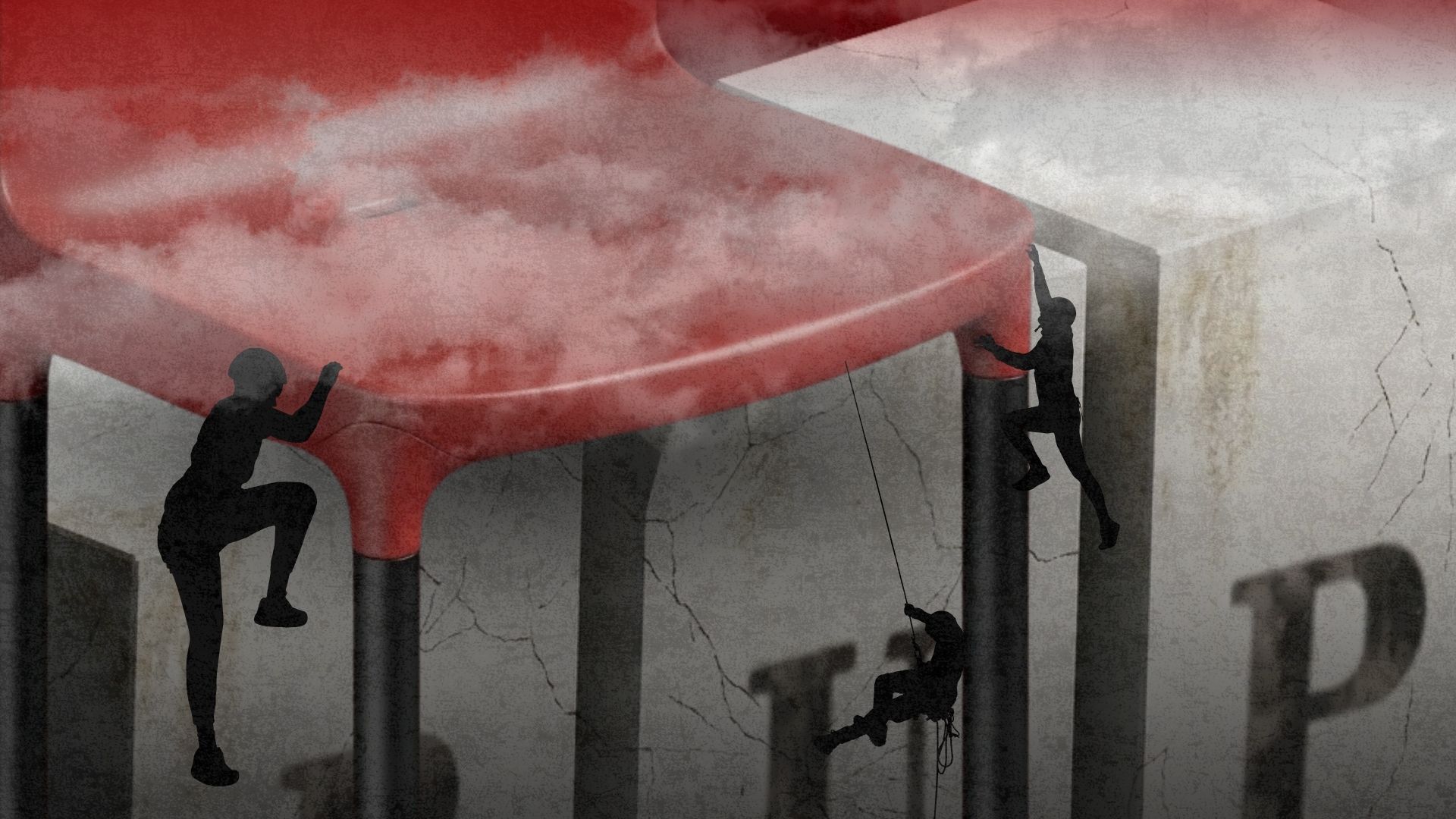
An alarm pierces through the dark at 3:00 AM. Elsewhere, the world lay asleep, but on Anonas Street, many eyes were open, resembling those of anxious owls. The concrete was cold, yet sleeping bags and makeshift cardboard mats sprawled around. Tucked into thin jackets, hundreds of hopeful students and exhausted parents lined the sidewalk. Some clutch folders packed with requirements tightly to their chests; others take turns napping while a companion watches the line.
Each shiver could be endured compared to the chill of losing one’s chance to a brighter future.
The iron gates finally opened, making many clutch their bags in anticipation. Just a few hours later, the line halts. Word trickles back down the queue: the quota for major programs has been reached; the remaining slots are gone.
Within moments, the semester’s worth of plans collapses. They had not just lost anything but their chance to get a better future—the enrollment to one of the country’s top state universities: the Polytechnic University of the Philippines (PUP).
Thousands of dreams, queued for a few
Having that title “Iskolar ng Bayan” invokes pride for most. It is the prized ideal many families envision for their children and one only a few can attain. It is the testament of their prowess as learners.
With each price hike and the weakening of the peso, the jump from senior high school to tertiary education becomes an uphill battle. According to reports by the Second Congressional Commission on Education (EDCOM II) and PIDS, only 17% of youth from the country’s lower-income households are enrolled in higher education compared to the wealthier 49%. While public universities and colleges are heavily subsidized and offer free tuition, the cost of living and miscellaneous fees (books, laboratory fees) still exist. A student may find themselves looking at a seemingly endless list of expenses and working part-time to make up for losses.
As a premier state university operating under the Free Higher Education law, PUP offers top-tier education without the crippling burden of tuition fees, serving as a ladder for low-income and working-class families. It is a gateway toward stable employment, economic mobility, and breaking the cycle of poverty limiting households for generations. Serving over 100,000 students across its 27 branches nationwide and renowned for producing highly sought-after graduates, the institution provides an exceptional return on ambition.
For students who cannot afford private institutions, a slot into PUP is rarely just one of many options; it is often their only viable path toward earning a college degree. Every slot represents a family’s hope and a student’s personal sacrifice. Meaning that when seats fill up, it is not merely a list closing—it is a crossroad in a young person’s life.
Too many students yet too few resources
The immediate bottleneck becomes clear the moment registration opens: the sheer volume of applicants outweighs the available space. In recent years, an estimated 170,000 aspiring students took the PUP College Entrance Test (PUPCET). Many submitted specifically for slots in the Sta. Mesa campus, amounting to a bulk of 82,282 applications received.
Imagine tens of thousands sweating bullets as they sat on the desk after they finished the exam. That was Tresa Mae Salazar’s reality. Arriving early for a 1:00 p.m. appointment at 10:00 a.m., she went through the gates of the Sta. Mesa campus with her friends who were also hoping to pass the PUPCET.
The test was not their only enemy, but also time and space.
Due to structural physical limitations, only 12,000- 20,000 applicants qualified to become freshmen, yielding around only a 10% acceptance rate. Under the sweltering heat, while determined, Tresa found herself seeing lines that stretched beyond the street. Getting inside was the challenge. Although the admission process itself was swift, they still got home after dark because of all the waiting. There were not enough waiting areas for students to rest.
Some even had to stand with their legs sore beneath the sun.
Tresa was fortunate to be among the few students with secured slots. Now, she will be attending as a first-year student in the Bachelor of Science in Management Accounting.
It is not just a 2026 event. In fact, back in 2025, another applicant—now a BS in Nutrition and Dietetics sophomore of PUP-Mabini main campus—faced the same problem. Pritz Niña “Niña” Montopar endured a prolonged overnight “vigil.” Though her schedule had been for 1:00 p.m., she arrived at midnight because she heard the camping would be worse. As expected, there had already been 150 students ahead of her for the afternoon shift.
She eventually got her slot. She would say that it really tested her patience and mental strength. Especially when there is no guarantee that she would even get a spot for her priority program.
Calling this intense competition the result of administrative negligence would be an oversimplification. There are still operational challenges. To illustrate, academic departments work with a limited number of classrooms, laboratories, and specialized facilities at any given hour of the day. Exceeding the room capacity can only go so far for any university and causes cramped, less productive learning.
Furthermore, existing faculty members already experience double their appropriate workloads. Some professors stand to teach a class already testing the limits of the assigned room. Attempting to absorb thousands of additional students without expanding physical spaces will sacrifice the quality of education, risk severe faculty burnout, and jeopardize the student-to-teacher ratios mandated by school accrediting bodies such as the Commission on Higher Education (CHED).
The university cannot expand instantly without resources.
Is it fair or is it frustrating?
To resolve these limitations, the university relies heavily on the First-Come, First-Served system for enrollment. Through the administration’s lens, this policy provides a standardized, objective framework capable of processing enrollees quickly under tight deadlines. By automating and streamlining the section-selection process, this aims to prevent backlogs, reduce delays, and eliminate subject biases in subject assignment during the registration period.
However, for students, this unveils the inequities that favor privilege over merit.
On one hand, physical queues favor those with financial resources. Students with more than enough allowances can travel early and stay for days before the submission just to hold a spot in line. Meanwhile, those living in more rural areas and distant provinces are placed at an immediate, severe disadvantage. Bus and jeepney fares have risen, straining already empty wallets. Not to mention, meal costs for those deciding to camp out are not cheap.
Even those who get admitted know that “free tuition” does not necessarily mean zero cost. The everyday expenses for attending college still exist.
“Even though tuition is free, there are still other expenses like transportation, dorm rent, food, photocopying documents, school supplies, and printing requirements,” Tresa pointed out. “Those may seem like small expenses, but they really add up, especially for students who are on a budget.”
Niña echoed this reality, noting that laboratory requirements quickly become out-of-pocket burdens: “Most of our money just goes toward expenses for laboratory classes.“
When access depends on transportation and proximity, enrollment ceases to be an equitable academic evaluation. Instead, it becomes a game of chance where the vulnerable students are left behind.
It goes beyond enrollment
While it is easier to put the blame on enrollment software and queue management as the primary source of frustration, the true root lies in the national budget allocations.
Being a state-funded institution, PUP relies on appropriations from the government through the General Appropriations Act, the yearly law that sets the national budget, to cover its own expenditures. What they need and what they are given is a disparity that highlights the massive funding gap.
For instance, in recent budget cycles, PUP leadership proposed an operational and capital budget requirement of ₱13.9 billion to support its expanding population, upgrade facilities, and build additional academic structures. However, the given budget failed to meet even 30% of the required budget, roughly amounting to ₱3.8 billion.
This shortfall caused everyday operations and long-term plans to fall down the drain. Once past the hurdle of enrollment, students are faced with the reality. Beneath the facade of being a top university, lay a campus hampered by aging facilities that either lack or are no longer usable.
“We have power outages at PUP every single day because we’re only running on a generator…” Niña explained. “It usually lasts an hour or more. Classes are interrupted and I can’t stay focused because of the unbearable heat inside the room.”
Crucial layout projects, such as the completion of multi-storey academic buildings designed to add dozens of new classrooms, are frequently delayed because of insufficient funding. This leads to strict limits on creating new regular faculty positions, hiring part-time instructors, and overextending existing full-time staff. Maintenance and operating funds cannot keep up with basic utility costs, laboratory equipment maintenance, and necessary IT server upgrades to quickly shoulder online registration.
The shortage of course lots is not an intentional restriction, but a direct outcome of a rigid “peso ceiling”– the financial cap that blocks expansions and more accommodations.
Searching for solutions
Resolving this means going beyond temporary administrative fixes to commit to long-term reforms. At the national level, there must be an effort to increase state funding for higher education schools, ensuring that state universities and colleges receive allocations aligned with their actual enrollment demands and structural needs.
Extra funding should go directly to building better facilities, faster internet, and decent pay to hire better professors.
State universities can continue refining their internal admission and registration protocols to cushion the impact of limited slots on vulnerable students. Implementing staggered, multi-tier enrollment schedules based on year level, academic performance, and socioeconomic background can smooth out server traffic and ensure that graduating students and high-end applicants receive priority access. Investing in scalable, cloud-based registration platforms and strengthening regional satellites can eliminate crashes during peak hours.
Relieving the burden concentrated on campuses means distributing student populations.
However, even the most innovative solutions might just be a band-aid fix if the overarching financial reality remains unchanged. The best-designed enrollment system cannot create nonexistent classrooms, nor can it pay for the electricity needed to power overcrowded lecture halls.
Real transformations require not just plans, but rather, a fundamental shift in priorities. The Philippine government must realign its budget allocation to prioritize public education, ensuring that state universities and colleges (SUCs) get what they really need. Free higher education must not just be a law on paper; it must be fully funded, functional, and accessible.
Investing in SUCs is not a charity case—it is a direct investment in the country’s future.
The meaning behind a slot
When thousands of young Filipinos line up before dawn, wrapped in jackets against the cold and clutching folders filled with dreams, the first-come, first-served system is not the real problem—it is merely the visible symptom of a much deeper crisis confronting Philippine public higher education.
The struggle for a seat at PUP is not simply a race against time. It is a reflection of a nation striving to fulfill its promise of accessible, quality education despite limited classrooms, overworked faculty, and insufficient government funding. As long as these structural challenges remain unresolved, every enrollment season will continue to leave thousands of deserving students wondering whether hard work alone is enough.
A slot at a state university has never been just another name on an enrollment list. It represents years of sacrifice from parents, sleepless nights of studying, and the hope of breaking the cycle of poverty through education. No Filipino student should have to measure their future by how early they can stand in line or how fast they can click a registration button.
“A higher budget for education (is needed). So many students can’t go to school because of the lack of funds…” Niña commented. “The intelligence, the skills— the potential of our youth are being wasted due to the lack of government support.”
For every gate that opens, another dream should not have to close. Every student deserves not just the chance to hope, but also the opportunity to learn.