


Now Reading: Scripted progress, unsung pain
-
01
Scripted progress, unsung pain

Bernadette Soriano, Stela Militante, and Ivan Howard Sumauang
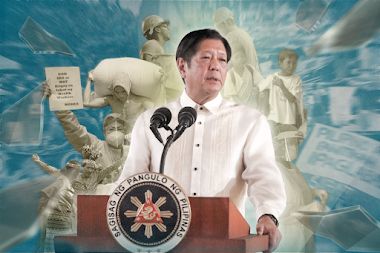
In a nation where problems seem to pour unendingly, the annual State of the Nation Address (SONA) is far more than a formality.
With inflation tightening its grip on Filipino households, transportation woes clogging daily commutes, and the education system buckling under widening gaps, the nation approaches July 28 with hearts suspended between belief and resignation — longing for bold change yet weighed down by years of unmet promises.
As President Ferdinand “Bongbong” Marcos Jr. speaks from the grand halls of Batasang Pambansa again, far beyond those walls, in crowded streets, remote villages, and humble homes lie millions of voices yearning to be heard and each one is worthy of being addressed.
This is where the People’s SONA begins. It is a counterpoint and a call — an annual reckoning that gives voice to the silenced and spotlights the issues the official narrative often sidelines. Economy, agriculture, labor — these aren’t just policy topics; they are lived realities, often wrapped in struggle and resilience.
This matters because the true measure of the nation is not found only in speeches or statistics, but in the hopes, struggles, and demands of everyday Filipinos. It is a powerful act of courage and truth — a gathering of those who refuse to be silenced.
Because the true state of the nation cannot be fully captured by charts or applause. It lies in the everyday hopes, fears, and demands of Filipinos who refuse to be reduced to footnotes. To listen to them is not just necessary; it is justice.
This feature brings their voices to the forefront. From the LGBTQIA+ community, the youth, and the labor force, we listen to three individuals who tell us what they expect from this year’s SONA, which promises they’ve seen delivered, and which demands still wait for more than just words.
Beyond inclusion, towards protection
When Yan talks about being gay in the Philippines, he doesn’t sound angry. He sounds honest.
At just 19, he’s already learned how to move carefully. He knows the difference between being seen and being safe.
“We are tolerated, not accepted,” he says. “Something we… are still longing for at this very moment.”
As President Marcos Jr. prepares for his next SONA, Yan isn’t hoping for another polished speech. He wants something firmer, something real. “He has certainly lacked… especially in the areas of the SOGIE Bill and the country’s disaster preparedness… with real and logical solutions, not empty promises.”
To date, the President has made some visible gestures toward inclusion.
In 2023, he hosted a Pride Reception at Malacañang and signed Executive Order No. 51, creating a Special Committee on LGBTQIA+ Affairs. He also publicly said the community deserves freedom from discrimination, and even shared that he had no objection to same-sex marriage — if Congress approved it.
But for Yan, symbolic gestures don’t replace legal protection. “The government surely hasn’t fulfilled its promises when every day, every gay person still suffers from this country’s lack of protection.” The SOGIE Equality Bill, which would penalize discrimination based on sexual orientation and gender identity, has been pending in Congress for over two decades. Despite the President’s progressive tone in some interviews, the bill hasn’t been certified as urgent, and it was left out entirely from his last year’s SONA.
Some local governments have passed anti-discrimination ordinances. But progress at the national level remains slow — caught in the push and pull of politics, tradition, and fear of controversy.
“The country’s reluctance keeps them blind to what truly matters, and what will be at stake if this continues to the next generation,” Yan expressed with conviction because for him, the SOGIE Bill isn’t just about LGBTQIA+ rights, it’s about basic fairness for everyone.
He continued, “It protects every person regardless of their sexual orientation and gender identity… not just those whom most of them condemn.” While he acknowledges that the President has a full plate, he believes real leadership means making room for everyone.
“It is his job to bring the country to greatness, and no one gets left behind. Is the president doing enough? No. Should he be doing enough? Yes,” with firmness, he uttered.
For Yan, progress is long overdue. Public statements aren’t enough. Pride receptions are not protection. What they want is to live without fear and with dignity.
As the SONA plays out on television screens and livestreams across the country, Yan — like so many others — will be watching. He won’t be listening to quotable lines or catchy slogans. He’ll be looking for something deeper: a proof that this year, change might finally include them. Because rainbow receptions are not enough. What they want is protection. And what they deserve is action.
Education, jobs, and a future worth staying for
By the time Nico — once a prominent force in his university’s student council — accepted his first freelance commission in the oversaturated and underpaid digital marketplace, he had already begun detaching from a hard lesson: that political faith and financial survival rarely cohabitate.
“Promise feels like privilege now,” he says, seated in a shared studio apartment on the periphery of Manila. “And belief? It’s a luxury I can’t afford when I’m one late payment away from losing bandwidth.” His tone doesn’t betray apathy — it signals something slower, more sedimented. A psychological reckoning, unfolding quietly among Filipino youth.
Belief in the system is not abandoned outright; it is worn down by unrelenting exposure to structural dysfunction, disguised as steady progress. To speak of youth expectations in 2025 is to trace a terrain of contradiction. This generation possesses instinctive, often hyper-attuned political literacy yet lives with emotional fatigue as its default mode. Fatigue not born of apathy, but from being persistently overlooked by the very systems designed to empower them.
These are individuals shaped by overlapping crises: A pandemic that fractured their formative years. An economy where even the cost of hope has inflated. A digital sphere saturated with misinformation. And a culture where mental distress is no longer an anomaly, but the baseline.
Campaign narratives still refer to the youth vote as “hopeful” and “transformative.” But for many, electoral participation is less a rite of passage than a form of desperation: not an embrace of democracy, but a final attempt at agency. Choosing to stay in the Philippines does not reflect passivity; it reflects a quiet form of resistance. Considering departure is not a betrayal. It is self-preservation.
Nico’s disillusionment is clearest when he speaks of education. One of the most painful betrayals, he says, is the state’s insistence that education reform is “solved.” The president’s favorite refrain — “libre na lahat” — has gained rhetorical traction. But it collapses under scrutiny.
Tuition fees in state universities are subsidized under the Universal Access to Quality Tertiary Education Act. Yet tuition is only one cost. Daily transportation, meals, internet access, housing, school materials remain unaffordable for many low-income students, particularly outside urban centers. What emerges is an economic paradox: the law primarily benefits those already relatively secure. The very students it claims to uplift are those most likely left behind.
Further complicating the narrative is the issue of authorship. While public perception credits President Ferdinand “Bongbong” Marcos Jr. as the bill’s architect, fact-checkers note it was principally authored by former Senator Ralph Recto. Marcos was neither sponsor nor co-author in the 2017 legislation. That inconvenient fact — airbrushed in campaign materials — remains buried beneath curated digital praise.
Then comes the K to 12 curriculum, another promise that wilted on contact with reality. Marketed as a leap toward global competitiveness, it envisioned a workforce-ready graduate by age 18. But a decade in, most employers still require college degrees. Senior High School graduates often land in precarious, low-wage jobs. Many are forced into college regardless, rendering the additional years functionally redundant.
What was intended as a leap forward has, instead, devolved into an institutional stutter. The reform has not eased burdens; it has intensified them: overloaded curricula, high-stakes assessments, surging dropout rates, and the silent epidemic of burnout. For students already balancing academic demands with economic precarity, the system offers no reprieve — it merely recalibrates the weight of exhaustion. What should have been scaffolding has turned scaffold: rigid, unyielding, and suspended over futures unsure of their footing.
The psychological costs of these failures are rarely acknowledged in legislative debates. Yet they surface with startling regularity in student narratives.
Nico describes his condition as “crisis paralysis” — a daily ritual of waking into stillness, where the body functions but the will does not follow. It is not quite depression, though it feels eerily adjacent; the weight he carries is less about internal despair than external stagnation. Increasingly, scholars are naming this: eco-anxiety of the self — a psychic condition in which personal burnout becomes indistinguishable from the slow erosion of public infrastructure. What falters in society is mirrored in the individual, until the line between exhaustion and existential commentary blurs.
This is not a failure of effort — nor of will. It is the predictable result of being conditioned to place faith in systems that reward neither merit nor perseverance. When institutions promise mobility but deliver erosion, disillusionment is not weakness; it is inevitable. What we witness is not laziness, but the psychological residue of promises perpetually deferred.
Government responses to youth mental health remain, for the most part, symbolic: reactive during campaign seasons, performative after tragedy, and conspicuously absent when no one is watching. There is no durable infrastructure for youth wellness — only fragmented gestures masquerading as care. In its absence, what takes root is not support, but silence… and the quiet, often painful cultivation of self-reliance disguised as discernment.
The youth are not disengaged. They are observing carefully. Interpreting. Dissecting the dissonance between what is promised and what is endured.
Employment — the supposed “next step”— offers little reprieve. Youth-targeted labor programs often feel like an extension of their educational disenchantment: extractive, temporary, underfunded. The freelance market is flooded. Corporate entry-level roles require experience but provide minimal upward mobility. Entrepreneurial pathways exist, but are mired in bureaucratic gridlock.
This generation has been trained to think creatively, problem-solve rapidly, and adapt to digital terrains that shift without warning. And yet, the labor system remains ill-equipped to receive them. “We were prepared for a future that refuses to absorb us,” Nico says. “It’s like they gave us wings… and then chained the sky.” What, then, do the youth ask of leadership? They do not seek spectacle. They seek reparation.
They expect leaders to finally understand that tuition-free does not mean cost-free — not when daily transportation, school materials, and unpaid internships bleed families dry. Reform, they insist, must go beyond curriculum redesign; it must begin with the redistribution of access itself. And listening? It cannot be reduced to a soundbite during consultations. It must be a sustained practice — a politics of presence, not performance. It is where democracy, if it is to mean anything at all, quietly begins.
They call for employment that extends beyond token internships and vanishing digital gigs — jobs with dignity, security, and a future. They want mental health recognized not as a passing trend or a campaign talking point, but as a standing national priority: one anchored in sustained policy, public funding, and a care infrastructure that does not wait for headlines to act.
Nico no longer identifies as a student leader. He now calls himself a “survivor of delayed promises.” But his weariness is not resignation. Beneath it is a clarity that feels radical.
“A leader who offers vision is commendable,” he says. “But a leader who repairs the very ground we’re told to walk on — that’s someone worth following.” This is not a fragile generation. The term “snowflake” does not survive serious scrutiny. These are individuals who are perceptive, emotionally literate, and system-aware.
They are not disillusioned; they are discerning. They are not passive; they are patient. They are learning, each day, to guard the quiet sanctuaries of their minds from the dissonance between what is said and what is shown. And when they vote, it is not a mere routine… it is rebellion.
They do not just hope; they have outgrown. They cast a future carved in stone — and they intend to call it home.
Between livelihood and living wage
In the northern town of Lal-lo, Cagayan, where fields stretch wide and signal bars are scarce, work starts before the sun rises — and often ends long after it sets. For the farmers, vendors, and drivers here, labor is not a choice; it is survival. But as they listen to presidential promises year after year, a familiar question lingers in the silence that follows: To whom is this progress really for?
Mang Lando, a rice farmer his whole life, sits by his irrigation pump, now half-broken from overuse and neglect. At 52, his back aches more than it used to, and his harvest barely breaks even.“ Marami ang sinasabi sa Maynila. Pero dito sa amin, ‘yong ayuda, ‘yong tulong, hindi umaabot,” he says. “‘Pag nagtanim ka, parang sugal. ‘Pag walang bagyo, may peste. ‘Pag may ani, bagsak ang presyo.”
He remembers President Marcos’s promises well: boosting local agriculture, modernizing equipment, cutting import dependency. But on the ground, imported rice still floods the market, dragging down prices. Machinery is still scarce. And subsidies — if they arrive at all — are too late, too little.
“Ang binhi, mahal. Ang abono, doble presyo. Pero ‘yong bilihan sa palay, ‘di gumagalaw,” Mang Lando says. “Saan banda ‘yong sinasabing tulong sa magsasaka?”
Meanwhile, down at a barangay market, Aling Vicky wipes her brow as she arranges eggplants and tomatoes under a tarpaulin that leaks when it rains. She’s been running a vegetable stall for over 20 years. And like many women in Lal-lo, she wears multiple hats: vendor, housekeeper, mother. “Wala kaming SSS, PhilHealth, kahit ‘yong maliit na ayuda, mahirap kunin kung wala kang koneksyon,” she says. “Sa dami ng sinabi sa SONA noon tungkol sa small businesses, parang hindi kami kasama doon.”
She heard about the loans for microenterprises, digitalization programs, and tax reforms. But for vendors like her, those are just words — inapplicable, inaccessible, and often filtered through so much red tape that they might as well not exist.
“Ang gusto lang namin, konting ginhawa. Hindi handout, kundi respeto sa trabaho namin.”
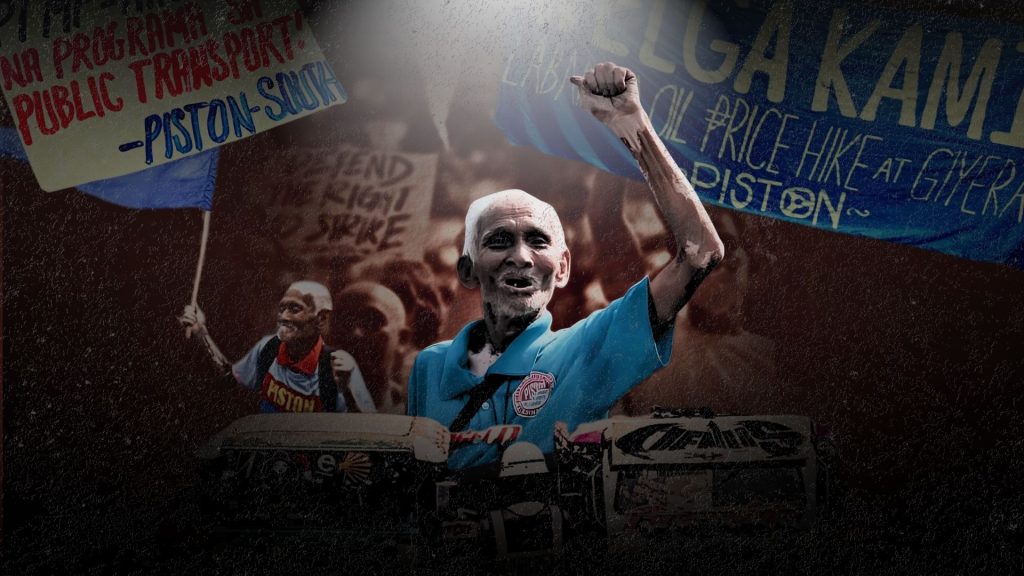
And then there’s Kuya Nestor, a jeepney driver who inherited the route from his father — a line connecting distant barangays in Lal-lo to the Poblacion. He used to take home enough to feed a family of five. Now, between rising fuel prices, spare part shortages, and dwindling passengers, most days barely break even.
“Puro modernization ang sinasabi ng gobyerno. Pero para sa’min, ang ibig sabihin no’n, utang,” he said.
He acknowledges the climate goals and road safety ideals behind the Public Utility Vehicle Modernization Program (PUVMP). But with no accessible bridge between intent and impact, many drivers in Lal-lo see it as a quiet eviction — displacing them from a livelihood handed down through generations. Despite different jobs, Mang Lando, Aling Vicky, and Kuya Nestor share one truth: they work every day, but still feel invisible. They aren’t asking for luxury — just dignity.
“Hindi kami tamad. Hindi kami nagrereklamo nang basta-basta,” Aling Vicky added. “Pero kung wala sa plano ng gobyerno ang taong katulad namin, saan pa kami kakapit?” What they want isn’t applause. It’s action.
What the people are really saying
Beneath the choreography of official speeches and applause, a quieter, more dissonant rhythm persists — one composed not of policy declarations or statistical crescendos, but of deferred needs, decentral narratives, and a public long trained to listen for what is not said.
Across the voices gathered in this piece — queer, young, working — there is no single demand that echoes uniformly. What emerges instead is a constellation of truths: differently weighted, unevenly distributed, but tightly bound by a shared disillusionment that is neither loud nor sudden. It is sedimented — layered over years of promises made eloquent in form and elusive in follow-through.
Disillusionment, in this context, is not rage but refinement, not a loss of faith, but the precision of it. The people do not arrive at the SONA hoping for miracles; they arrive with receipts.
Yan, does not clamor for tolerance. He parses it. He recognizes the performance of pride without the permanence of protection: executive gestures unaccompanied by legislative will, statements of solidarity that dissolve under congressional inaction. In his voice is the clarity of someone who has learned to differentiate being seen from being shielded. In his critique, visibility without viability is not progress — it is pageantry.
Nico, no longer occupies the posture of the activist on fire; he inhabits instead the quieter terrain of one who has made peace with the erosion of belief. Not because he is apathetic, but because he is attuned: to systems that speak in the idiom of uplift but operate in the machinery of extraction. His analysis is unhurried, deliberate, devastating in its composure — that to study, to graduate, to work, is to move through a state-sanctioned maze that rewards neither merit nor survival, but proximity to privilege and the performance of obedience.
And in Lal-lo, where labor is not romanticized but lived, where dignity is not a concept but a demand forged in mud and sun, Mang Lando, Aling Vicky, and Kuya Nestor outline not complaints, but equations. Inputs and outcomes. The calculus of what is planted versus what is taken. Their lives refute every neat formulation of “inclusive growth.” Their exhaustion is empirical.
Yet what binds these disparate testimonies is not merely fatigue; it is the structural intimacy with abandonment: the repeated experience of hearing one’s own hardship translated into a footnote, a slogan, or a misplaced applause line. The dissonance, then, is not incidental… It is engineered.
For the LGBTQIA+ community, promises of inclusion dissipate in the absence of urgency. The SOGIE Equality Bill remains not just undelivered, but undeclared essential — symptomatic of a state that will host receptions but not defend rights.
For the youth, tuition-free is revealed to be cost-burdened, and mental health is acknowledged only when the headlines demand it. Reform, when it arrives, is often rhetorical first, infrastructural never.
For the working class, especially those outside the visual range of Metro-centric policymaking, modernization is too often the state’s euphemism for displacement — innovation without transition, legislation without translation, help that arrives wrapped in debt.
And so the divide grows — not merely between sectors, but between what is said and what is sustained, between ambition and access, between presence in the text and presence in the plan.
This is the real substance of the People’s SONA: not resistance for spectacle, but reckoning as a method.
It asserts, without ornament or apology: That inclusion without institutional protection is a hollow virtue. That education declared “solved” while rendered inaccessible is not reform but betrayal. That labor celebrated in speeches but invisibilized in systems is not supported — it is siphoned.
Where the President speaks in metrics, the people reply in memory. Where the government proclaims targets, the public recalls timelines missed. Where leaders stage optimism, citizens counter with audit. Because to listen to the People’s SONA is to encounter not the absence of hope, but the refusal to outsource it.
If this administration wishes to reckon with the true state of the nation, it must first confront this fundamental truth: that transformation is not found in the choreography of applause, but in the anatomy of attention — where listening begins not with the loudest voice, but with the ones that have waited longest.
The people are not passive. They are practiced. And they are no longer content to be the periphery to their own future.