





Now Reading: A Seat in Every Story: The Monobloc Chair
-
01
A Seat in Every Story: The Monobloc Chair

Jullian Elemento
Filipino gatherings have almost always had the same exact scenarios. With tarpaulins stretched from gate to gate, folding tables bowing under trays of pancit, sweet Filipino-style spaghetti, and neat rows of lumpia, we have always been known for our deep-seated culture of big and festive gatherings.
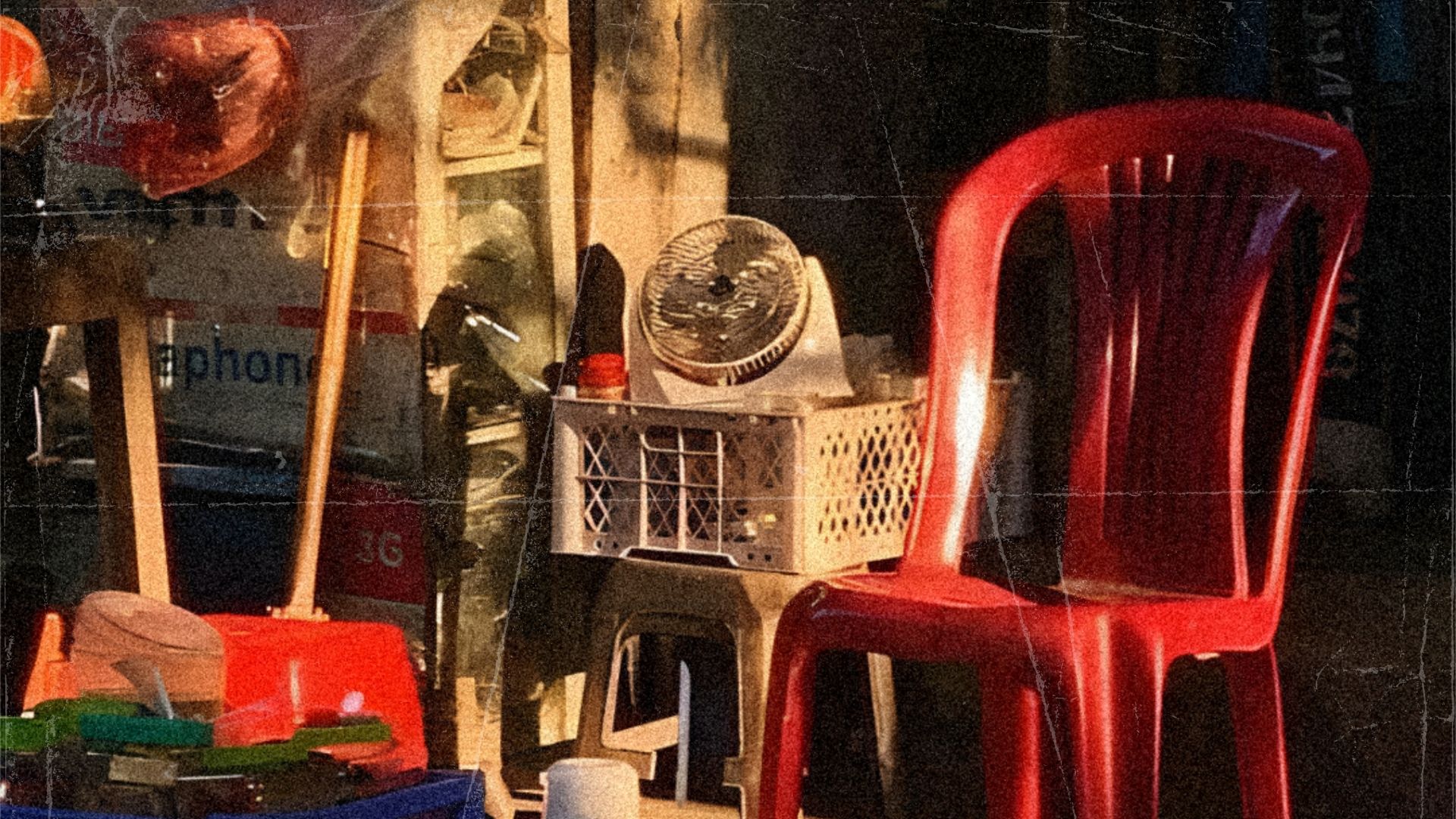
Just like the nostalgic sound of laughter that spills down the street at every celebration, there is something that has always been part of these gatherings. You will see it in every barkada hangout, birthday party, family reunion, and even funerals. These are the rows of identical plastic chairs facing a small improvised stage.
When someone calls out, “May upuan ka pa ba diyan?” and a neighbor disappears into a house, returning with another stack— light enough to carry with one arm, strong enough to hold a crowd of relatives, neighbors, and strangers who will feel like family by the end of the day.
Sonia, 70, a longtime resident of Sebaste, Antique, lowers herself carefully into one. “Palaging nandiyan ‘to,” she says with a quiet smile. “Parang kasama na namin sa lahat ng okasyon.”
The chairs do not decorate the gathering. They make it possible. They hold the weight of stories. They hold the weight of memory. They hold people together.
The science behind a Filipino mainstay
What Filipinos casually call a monobloc chair is, at its core, the result of modern chemical innovation. The material, polypropylene, was first successfully polymerized in 1951 by chemists Giulio Natta and Karl Ziegler, which later earned the Nobel Prize in Chemistry and shaped modern plastics manufacturing.
Polypropylene is a thermoplastic polymer: it can be melted, molded, and cooled repeatedly without losing its strength. It resists moisture, tolerates heat, and withstands chemical exposure. Light yet durable, it became ideal for mass-produced furniture that by the late twentieth century, it spread across the globe, and in the Philippines, it was the start of that chair becoming a silent witness of how conversations and celebrations intertwined people.
Built to last even more than one’s lifetime
Ever since a child was born, it has weathered through countless storms, welcomed the rain of accomplishments, and each time the planet would complete its full revolution around the sun. It basically just gave everyone a seat, withstanding the change and harshness of the climate.
Sunlight bleaches. Humidity lingers. Monsoon rains arrive suddenly, soaking wood and wearing down metal. But this chair’s material, polypropylene, endures.
Unlike wood, it does not drink in the damp air. Unlike metal, it does not surrender to rust. Perhaps it has already listened to billions of conversations and laughter, witnessed millions of smiles or even tears, and has already cradled thousands of Filipinos.
Stacked high against a concrete wall, they wait. And when the crowd grows fifty, five hundred, or even just the ordinary days where your aunties unexpectedly visited, these chairs are the first things we run to.
In a country of more than 42,000 barangays, where community events are frequent and often large, scalability is not luxury but a necessity. This scale is made possible through the monobloc chair, because hospitality in the Philippines is never small. The chair seems to just become the foundation of every story that unfolds and even until a person’s story would end.
Every seat tells a story
The monobloc chair holds toddlers with sticky hands and town officials in crisp shirts. It also serves as a support to grandparents with tired smiles, teenagers fidgeting, and infants perched on laps. During fiestas, neighbors sit shoulder to shoulder. At wakes, cousins and aunts share the same seats through long nights of whispered stories, soft crying, and quiet prayers.
It does not ask who you are. It does not care about rank or wealth. It does not put anyone above another. It just so show balances the room as it carries a kind of democracy that is felt in shared moments, loud augther, and memories made by everyone who has ever sat because the chair made them seated.
Why are seats actually taken
In 2025, Puerto Rican artist Bad Bunny released the album DeBÍ TiRAR MáS FOToS—I Should Have Taken More Photos. The cover shows two plastic chairs resting in an open landscape, just empty as it faces outward.
Long after the laughter has faded, the chairs are still there. They hold the weight of different people, their heartfelt smiles, echo of voices, smell of food made with love by every family member, and all the days it was always present.
These chairs do not notice who sits on them, because they hold everyone the same. But no one takes pictures and no one thinks about them. And yet, later, when you look back, you realize they were holding more than people as they were holding the moments that mattered.
They were there for birthdays and fiestas, for quiet afternoons, long nights, seemingly unending tears, gentle embraces, and hearty laughter. They were there when people came together, when people left, and when everything in between felt too small to notice. Always patient, steady, and just there.
Because when you offer someone a seat, it is like saying that they belong here. And in Filipino culture, this spirit of including others reflects kapwa, the shared identity and sense of togetherness.
Every chair holds everything possible there is. It creates space for conversations that stretch into the evening, for elders to reminisce, for children to squeal in delight, for a community to gather and feel like family. Even in the busiest room, even when everyone is rushing or talking at once, there is a bond and the chair keeps through the years.
Take a seat
Indeed, the monobloc chair has traveled far, seen more than enough, and has listened more than anyone ever could.
It holds birthdays and wakes, barangay meetings and Sunday lunches, stories that stretch late into the night, children’s laughter, auntie’s gentle scolding, grandparents’s proud smiles, and all memorable moments.
And when these moments become a memory, one by one, the chairs are stacked and carried back inside.
Like Sonia who resides somewhere in Antique, she rises from her seat as neighbors begin clearing the tables. Someone lifts the chair she had been sitting on and adds it to the familiar pile leaning against a wall.
Tomorrow it will wait again— silent, patient, ready. For the next gathering. For the next story. For the next time someone asks, “May upuan pa ba diyan?”
And anywhere in the country, as always, there will be one for you.