




Now Reading:
Behind EJ Obiena’s athletic greatness lies a Father’s Day story no one talks about
-
01
Behind EJ Obiena’s athletic greatness lies a Father’s Day story no one talks about
Behind EJ Obiena’s athletic greatness lies a Father’s Day story no one talks about

Raphael Lloren
Before EJ Obiena became an Olympian, he carried a dream that was never entirely his own.
That dream had a name and a history of its own. Emerson Obiena, EJ’s father and also a former national record holder in pole vault, never made it to the Olympics himself—an unfinished chapter that became a starting point of his son’s athletic career.
“Pole vaulting was my dad’s passion; it was his dream; it was never mine,” EJ said in a Rappler interview back in 2021.
But inheriting someone else’s dream was never as simple as picking up where his father left off, and carrying that weight came with its own quiet pressure.
“There’s a lot of influence coming from my dad, indirectly. He never pushed me to do it, but as a Filipino son… you subconsciously want your dad [to] be proud of you,” said pole vault world No. 13 Obiena.
For a long time, the dream felt borrowed rather than his own. It wasn’t until he had consciously chosen it for himself that the sport started to feel different—heavier, but also more personal.
That shift, from an inherited ambition to self-driven purpose, is what really defines his story.
Before the bar was his
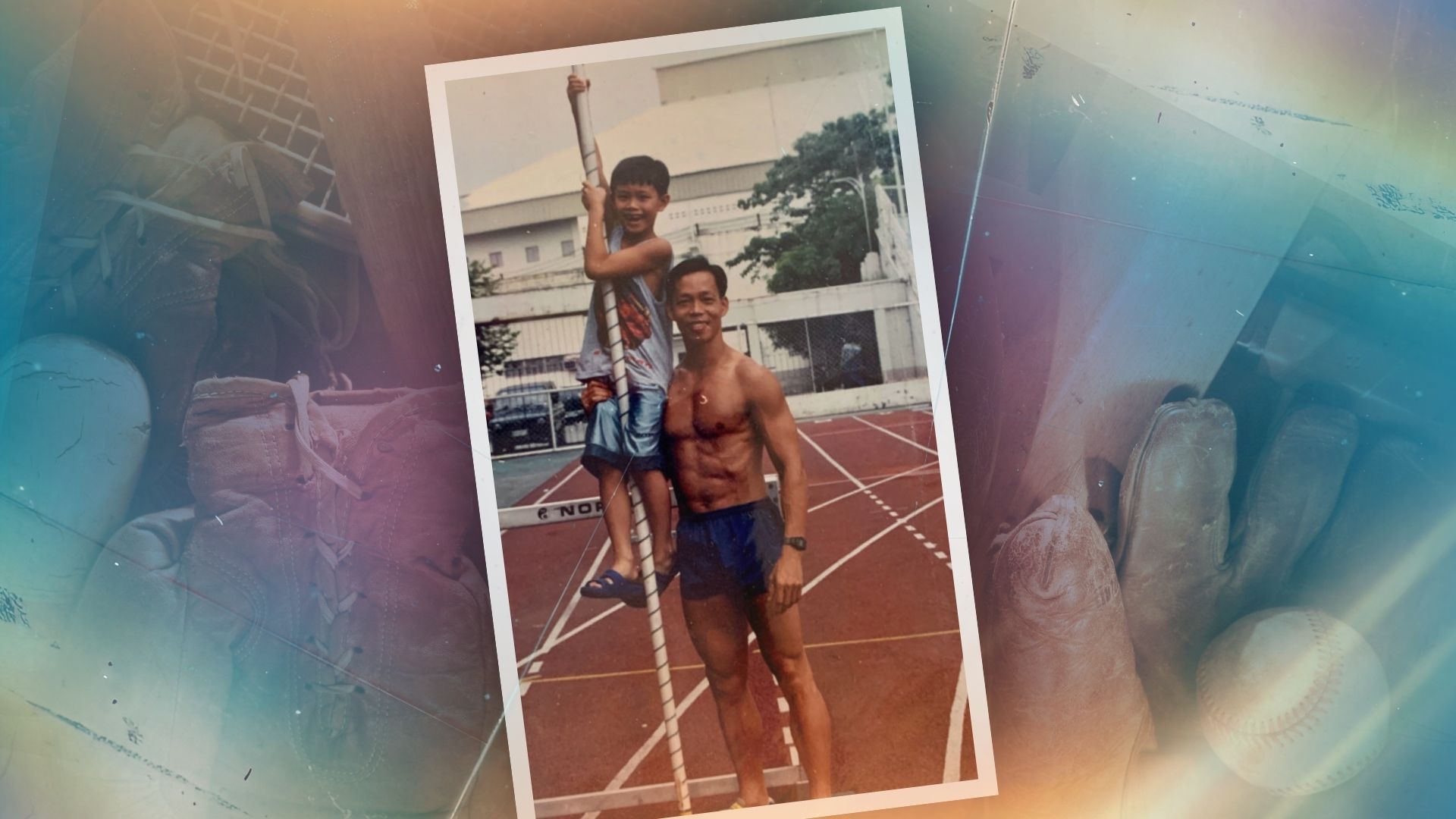
Long before podiums and personal bests, there was simply a six-year-old boy standing at the edge of a training oval in Manila, watching his father vault over a bar far beyond his height.
Too small for proper equipment, EJ refused to wait around for his body to catch up. He improvised with metal rods instead, and it was through makeshift training that he first learned how to handle a pole and move through its basic motions.
That detail matters more than it seems, because it flips the usual narrative. Instead of his father pushing him toward pole vaulting, it was EJ who pulled at his sleeve for a place on it.
His focus didn’t stay on pole vaulting right away, though. During his early high school years at Chiang Kai-shek College in Manila, EJ competed in the 100m and 400m hurdles, only returning to pole vaulting exclusively in his later secondary years—a decision that earned him a scholarship and led to a standout run with the University of Santo Tomas track team.
What the pole doesn’t show
In pole vaulting, height is what the crowd watches, but depth is what makes that height possible. It’s the steel embedded in the plant box, the run-up perfected over a thousand of unseen repetitions, the quiet mechanics beneath a single dramatic leap.
Emerson’s contribution to his son’s career has always lived in that unseen layer. Before there was multi-titled coach Vitaly Petrov and before there was Italy, there was simply a father and his eight-year-old son learning the fundamentals of a sport.
The early work was less about strategy than instinct. Emerson treated his young athletes like “clay,” something to be shaped slowly through play and repetition rather than rushed into elite-level drills. Technique mattered, but so did building confidence, and so did the discipline that only family can really instill.
Drawn from memory rather than manually, the teaching followed that same instinct. EJ learned the way his father once learned to compete, even though faster methods existed. It wasn’t the most efficient path, but it was the most honest one a father can offer.
Proof of that foundation surfaced soon after it was handed off. Just months after returning from a three-month stint training under Vitaly Petrov in Italy, an 18-year-old EJ broke the 22-year-old Philippine pole vault record, clearing 5.01 meters to surpass Edward Lasquete’s mark from the 1992 Barcelona Olympics.
“Now, he has always been happy about me jumping PRs over PR,” said EJ Obiena (Rappler, 2021).
Senior Obiena never measured his ambitions for his son in medals or world ranking, choosing instead to define success on far humbler terms.
His only real wish as a mentor had been for an athlete who could compete at a world-class level, calling the Olympics nothing more than a bonus on top of that. It was a quiet admission that revealed just how little he had asked of his son, compared to what his son would go on to give.
That restraint was tested most during the moments that threatened to end EJ’s career altogether—most notably when an ACL injury struck just a day before he was set to depart for the 2017 Kuala Lumpur Games, where it put both of the senior Obiena’s roles, coach and father, under the same unbearable pressure at once.
“Like other coaches, when the athletes get disappointed or frustrated or agitated, even if deep inside you know you felt like that, we cannot show it to them,” Emerson admitted in a Rappler interview. “Because I cannot show it to my son.”
The bar between two roles
Being both a father and a mentor, and watching those identities collapse into one another, became the defining struggle of their father-son relationship, something both of them have openly wrestled with in public.
“It’s difficult to put a divider—being a father and being a coach, it would really overlap. Hindi tayo robots eh,” the senior Obiena admitted in a talk with Rappler Media.
That tension surfaced again after the Paris Olympics, when EJ finished fourth, just short of a medal.
The margin was painfully thin. He tied with bronze medalist Emmanuel Karalis at 5.900 meters but lost on a tiebreaker. One missed jump, at 5.95 meters, was all that stood between him and ending the Philippines’ 88-year drought in athletics.
“It’s painful. I missed a medal by one jump,” EJ said in a post-interview.
Little room was left for coaching in a moment like that. What if his son was simply a father, and that was the role Emerson stepped into instead?
“Kung kailangan niya na ilabas ‘yung sama ng loob niya, kung kailangan niyang iiyak eh ‘di iiyak niya,” Emerson said in an interview with GMA. “Ang ano ko lang, pagkatapos nun, tayo ulit and try again.”
A dream that outgrew them
A house stands long after the scaffolding is gone, and that was Emerson really built: not a pole vaulter but a foundation strong enough for his son to dream as high as he wanted.
The Olympic moment Emerson once dreamed of for himself became something that they wrote together.
Whatever heights EJ Obiena clears next will be his alone to claim. But the part of him that allows failure, grief, and getting back up again will always trace back to a man who handed his son a dream too big for himself.
“I’m very happy to be able to fulfill that on his behalf, and he’s part of this journey. He’s been part of my story of becoming an Olympian,” EJ, as he put it in an early Rappler interview.
Maybe that’s the real measure of the bar he clears. Not the height on the board, but a father’s quiet promise, finally at home.