



Now Reading: The Philippines is more than Tagalog, and it speaks in many voices
-
01
The Philippines is more than Tagalog, and it speaks in many voices
The Philippines is more than Tagalog, and it speaks in many voices

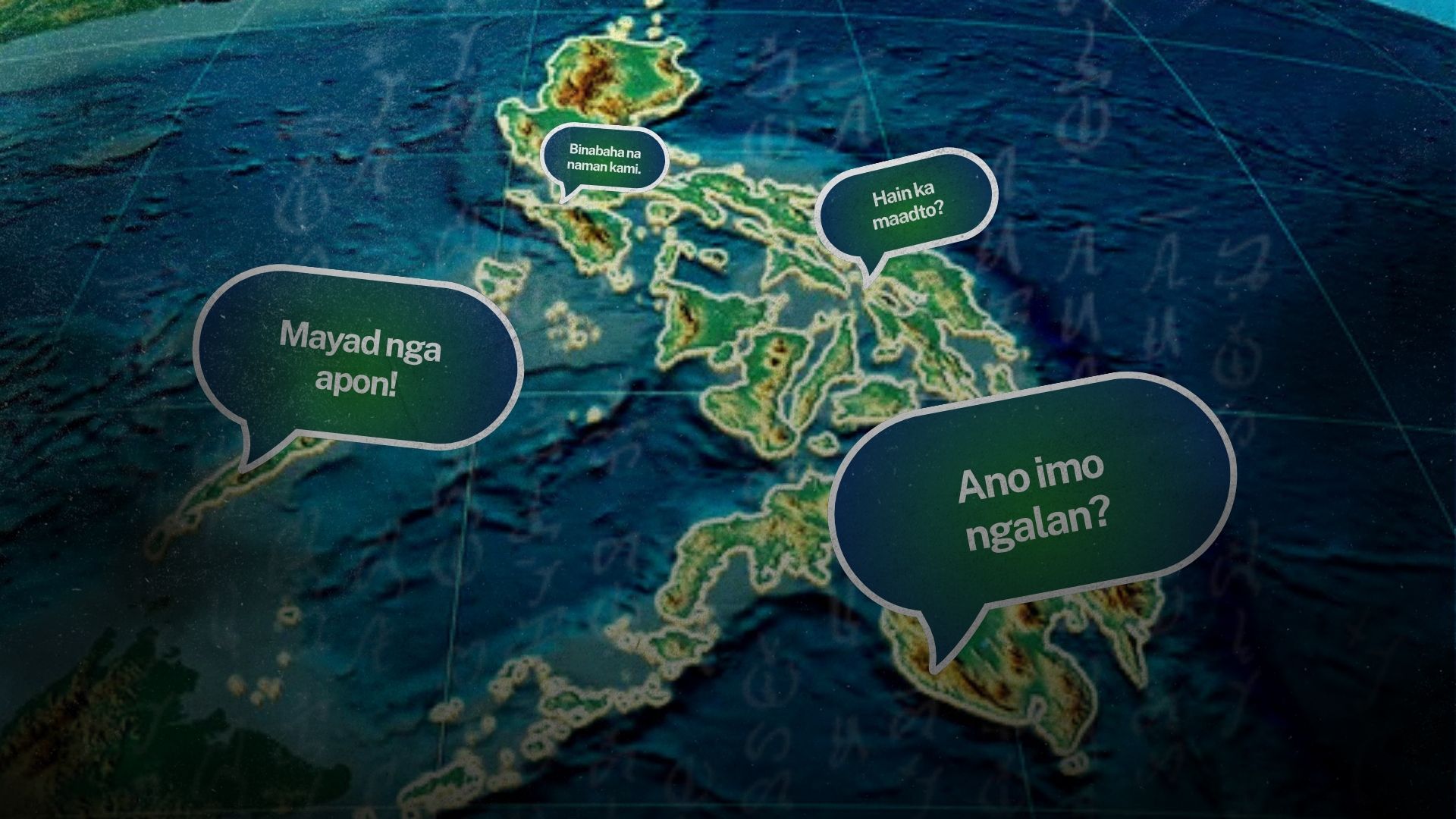
“Bili na kayo, suki!”
“Nalaka laeng ti sida ditoy, manang!”
“Tag-pila ning isda nimo, noy?”
Listen closely to a crowded palengke at sunrise, and you can hear people talking all at once: a fish vendor shouts prices in Tagalog, a woman asks for a discount in Ilocano, and a small radio on a wooden table plays the morning news in Bisaya.
It sounds like a noisy, confusing mix of voices, until a single common word passed down through generations and shared across different islands settles the bill, brings a smile, and proves that our local “dialects” are actually rich, full languages keeping us connected.
Across the islands of the Philippines, these different languages and dialects shape the daily lives of over 100 million people who are just trying to speak, connect, and understand each other every single day.
It raises a big question about the way Filipinos speak today: What really makes a speech a language instead of just a dialect? Why are there so many different tongues across our provinces? And how did we end up sharing so many identical words, even when we live seas and islands apart?
The fine thread between language and dialect
If you step off from a bus in Batangas, the familiar Tagalog of Manila begins to be different. Words end with a sharp, heavy ala eh, and local phrases bounce through the warm air, yet a visitor from the capital still follows every single instruction to the nearest kainan. That instant, effortless click of understanding is what experts at Ethnologue call a dialect—the same base language simply dressed in local clothes, accents, and everyday slang.
Historically, the word “dialect” traces back to the ancient Greek dialektos, which referred to regional speech variants of a single shared language. Today, modern science still uses this rule: if two people can understand each other despite using different regional expressions, they are merely speaking regional dialects of the same tongue.
Now board a ferry across the sea to Cebu. A vendor leans over the railing, hands over a cold drink, and offers a warm sentence in Bisaya. Suddenly, the familiar Tagalog roots disappear into entirely foreign rhythms, and without a translator or years of practice, the conversation grinds to a gentle halt. According to linguists at the Komisyon sa Wikang Filipino, that sudden wall of silence marks the true boundary of a language.
The concept of “language,” rooted in the Old French langage and Latin lingua (meaning tongue), represents an independent speech system. Linguists rely on Mutual Intelligibility Tests or Recorded Text Testing to draw this official line: when two speech patterns become so different that speakers no longer understand each other’s native sentences, they are officially recognized as separate languages rather than simple dialects.
Our regional tongues are not small variations or sub-categories of Tagalog. As research from the UP Department of Linguistics reveals, languages like Ilocano, Hiligaynon, and Waray carry their own distinct grammar engines and ancient vocabularies making them full, proud languages that stand completely on their own feet.
How the Filipino people speak at home
Linguists record around 170 living languages across the country, but how does that translate into everyday household life?
According to data from the 2020 Census of Population and Housing (2020 CPH) released by the Philippine Statistics Authority (PSA), a vast majority of the country’s 26.38 million households rely on a handful of major regional tongues for daily life.
While the 1987 Philippine Constitution designates Filipino (standardized Tagalog) as the national language and keeps both Filipino and English as official working languages, the true linguistic character of the country lives in its regional tongues.
Tagalog (39.9% or 10.52 Million Households)
As the basis for the national language, Tagalog is the most widely spoken home language in the country. Serving as the primary speech of Metro Manila, Bulacan, Nueva Ecija, Laguna, Cavite, and Batangas, its integration into the nationwide school curriculum and media has made it a universal second language across the archipelago.
Bisaya/Binisaya & Cebuano (22.5% combined or approximately 5.93 million households)
In official census tracking, Bisaya/Binisaya (16.0%) and Cebuano (6.5%) are cataloged based on household self-identification, but they represent the massive Visayan speech footprint across the south. Centered in Cebu, one of the country’s most progressive economic hubs, it expands heavily into Mindanao cities like Davao, Cagayan de Oro, Butuan, and General Santos.
Hiligaynon / Ilonggo (7.3% or 1.93 million households)
Famous for its soft, melodic intonation, Hiligaynon is the native speech of Western Visayas, spanning Iloilo, Negros Occidental, Capiz, Antique, and Aklan. Through historic trade and migration, it has also established deep roots in Mindanao, particularly in North and South Cotabato.
Ilocano (7.1% or 1.86 million households)
The dominant language of Northern Luzon, Ilocano reflects the seafaring and migratory heritage of the Ilocano people. Linguistically, it shares ancient ancestral ties with western Austronesian tongues like Malay and Indonesian, as well as Pacific languages like Hawaiian and Samoan.
Bikol / Bicol (3.9% or 1.03 million households)
Spoken across the six provinces of the Bicol Peninsula, Bicolano is notable for its rich internal diversity, boasting at least eight distinct geographic varieties. Among these is Bisakol, a unique linguistic bridge connecting Bicolano with neighboring Visayan languages.
Waray (2.6% or 698,745 households)
Vibrant and direct, Waray is the main language of Eastern Visayas, centered in Samar and Leyte. It is deeply intertwined with the historic resilience and cultural identity of the Waray people.
Kapampangan (2.4% or 639,687 households)
Primary in Central Luzon, Kapampangan (or Pampangueño) flourishes in Pampanga and parts of Tarlac and Bataan. It carries a rich literary tradition and a distinct vocabulary set separate from surrounding Tagalog areas.
Maguindanao, Pangasinan, & Beyond
Languages like Maguindanao (1.4%) and Pangasinan (1.3%) serve as vital regional anchors of its people—Pangasinan sharing close linguistic ties with mountain tongues like Ibaloi, and Maguindanao representing centuries of royal sultanate history in Mindanao.
Meanwhile, over 2.95 million households (11.2%) speak other distinct languages such as Boholano, Tausug, Maranao, Kinaray-a, Aklanon, Surigaonon, and Zamboagueño-Chavacano (a unique Spanish-based creole or a language that developed from the mixing of different languages).
Why do we share the same words?
Across thousands of miles of open ocean, a familiar word survives—lima.
In the Philippines, it means five. Variations of the same word can also be traced across the vast Austronesian world, from Southeast Asia to islands scattered across the Pacific. Even mata, the word for “eye” in several Philippine languages, carries echoes of a shared linguistic past.
These similarities are not merely coincidences. According to linguistic records from Britannica, Philippine languages belong to the Malayo-Polynesian branch of the Austronesian language family—a linguistic family whose reach stretches from Madagascar in the west to Hawaii and Easter Island in the east. Across this immense distance, languages that have long developed separately still carry traces of common Austronesian ancestors.
But shared ancestry is only one part of the story. Because for centuries, words also arrived by sea.
Long before Spanish colonizers reached Philippine shores, maritime networks had already connected the archipelago to neighboring societies in Southeast Asia and beyond. Trade and cultural exchange allowed languages to travel alongside spices, textiles, beliefs, and people. Some of these journeys can still be heard in everyday speech.
Words such as salamat and hukom, for instance, reflect linguistic influences that traveled through wider Southeast Asian networks, with Arabic and Persian vocabulary passing through Malay before finding their way into Philippine languages. Meanwhile, guro, meaning “teacher,” can be traced ultimately to the Sanskrit guru, revealing another layer in the long journey of words across cultures and languages.
Centuries of contact with Chinese communities also left their mark. Hokkien-speaking migrants and traders introduced words that eventually became part of Philippine vocabulary, particularly in Tagalog. Culinary and familial terms such as lumpia and kuya remain reminders that language, much like trade, rarely stays within a single shore.
Then came more than three centuries of Spanish colonial rule.
The Spanish language left widely shared traces across Philippine languages, particularly in words associated with religion, time, government, and everyday life. Mesa, silya, oras, and kutsara became part of ordinary conversations—words so deeply woven into local speech that their foreign origins can sometimes go unnoticed.
But, not all words arrived from distant shores—the Philippine archipelago itself was already a world connected by water.
Long before modern borders divided the country into regions, the sea served not simply as a boundary, but as a passage. Seafaring communities maintained networks of trade and exchange between islands, allowing people, goods, customs—and inevitably, words—to move from Luzon to the Visayas and Mindanao.
With every journey came the possibility of linguistic exchange. Words were borrowed, reshaped, and adapted by communities that encountered one another. Over generations, these interactions created overlaps between languages while allowing each one to develop its own distinct sound, grammar, and identity.
This is why hearing a familiar word in another language can feel almost uncanny.
Sometimes, it is a remnant of an ancient ancestor. Sometimes, it is evidence of a merchant crossing the sea, a migrant settling in a new community, or a colonizer imposing a language that locals eventually made their own. Sometimes, it is evidence of a shared history between communities long separated by distance.
The linguistic landscape of the Philippines, home to more than 170 languages, is far more than a collection of regional accents. It is a living record of movement—a form woven from ancient ancestry, migration, trade, colonization, and centuries of conversations across islands.
Our languages may have grown apart, taken on different names, and developed their own identities. But every now and then, a familiar lima, mata, or salamat reminds us that words, too, have histories.
The thread that binds us
As the morning sun climbs higher over the coast, the hum of the palengke begins to settle. The fish vendor counts his earnings, the shopper carries her basket home, and the radio fades into the background. They may navigate their days using different grammars, cadence, and rhythms, but when a word like salamat or pag-ibig passes between them, no translation is needed. The invisible boundaries melt away.
Our regional tongues are far more than hometown accents or sub-categories of a single national speech. They are full, living languages—carrying the weight of ancient navigators, centuries of trade, and the resilient spirit of distinct cultures.
Scattered across thousands of islands and separated by deep blue seas, we do not speak in mere dialects. We speak in an archipelago of voices—different in melody, yet forever bound by a shared human heartbeat.
As long as we keep speaking, our words will always find a way to bring us back to each other.