











Now Reading:
These new sites bring PH eagles home to Leyte
-
01
These new sites bring PH eagles home to Leyte

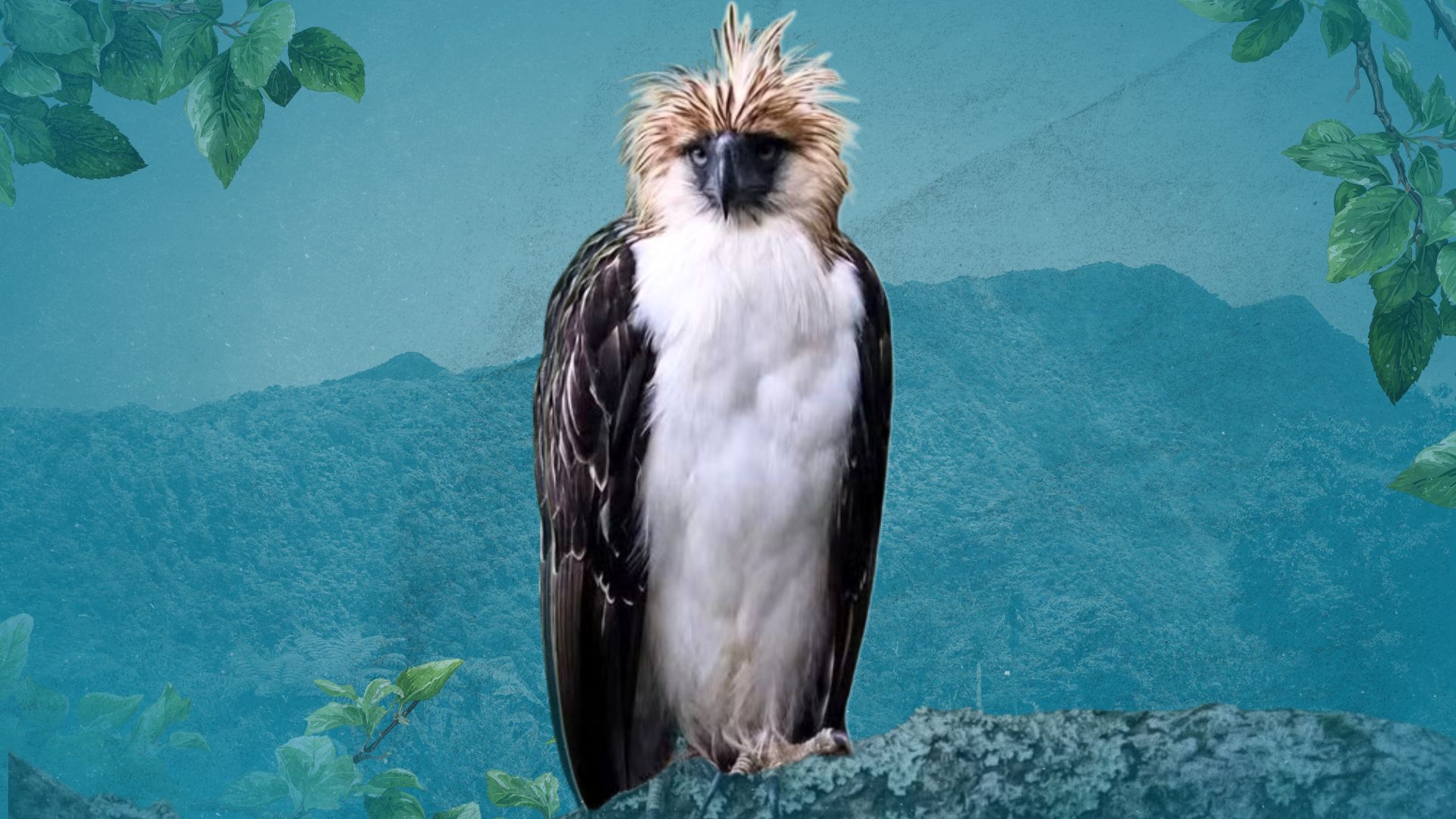
When people are asked where the Philippine Eagle lives, most would automatically point to the forests of Mindanao, but few would know that Leyte was actually once part of the majestic raptor’s natural range.
Long before decades of deforestation, encroachment, and natural disasters had reshaped the country’s landscape, Philippine eagles once soared over Leyte’s old-growth forests as apex predators, maintaining the ecosystem’s stability and balance. Today, after years of local disappearance, science is opening a path for the country’s avian giants to return.
A new study has identified approximately 10,320 hectares of “suitable” forest that could back future Philippine eagle reintroductions, offering a thorough scientific roadmap for restoring the species to its former home. Around 9,554 hectares of it were further classified as “most suitable,” being located more than 500 meters away from human settlements, which limits disturbance while providing the conditions needed for the territorial establishment of the eagles.
These release sites are within the Anonang-Lobi Mountain Range and Mt. Nacolod Key Biodiversity Areas.
Published in the Philippine Journal of Science, the study used Geographic Information Systems (GIS) and multi-criteria decision analysis to determine where the eagles would likely survive after release. Rather than simply locating large forest patches, researchers integrated ecological and human-related factors into spatial models, including forest cover, key biodiversity areas, elevation, terrain, roads, settlements, human disturbance, and potential power line hazards.
Methods also demonstrates how GIS can serve as a common platform for scientists, students, government agencies, and local communities working toward conservation. This illustrates the growing role of geospatial technologies in modern conservation.
The identified release sites consist largely of old-growth and secondary forests—habitats that could sustain abundant prey and provide the structural complexity needed by the eagles. Notably, portions of the Anonang-Lobi Range include areas near Barangay Kagbana, where the Waray and Mamanwa communities have an enduring history of protecting Philippine eagles.
Moreover, the study emphasizes that species recovery depends not only on scientific innovation but also on cross-sector partnerships. The Philippine Eagle Foundation highlighted the growing contribution of academic institutions to research that informs conservation action, while LGUs have expressed support for protecting the forests identified as future release sites. Officials from Javier, Leyte, whose forests were included among the suitable areas, recognized that conserving habitats for the eagles also safeguards watersheds, biodiversity, and carbon-rich forests.
These findings amplify the scientific foundation of the Philippine Eagle Reintroduction Program, a joint initiative involving the Department of Environment and Natural Resources, the Philippine Eagle Foundation, local government units (LGUs), universities, and conservation partners. Under the program, two Philippine Eagles were released in Leyte in 2024, followed by three more in 2025. These five birds represent only the first phase of a long-term effort to release a total of 16 eagles and establish at least six self-sustaining breeding pairs within the Anonang-Lobi Mountain Range.
The study also underscores into conversation a pressing conservation challenge: that although Philippine eagles remain in parts of Mindanao, their strong territorial behavior means that many of the remaining suitable forests are already occupied by breeding pairs, leaving little room for the population to expand into. Therefore, reintroducing eagles in Leyte, where they once existed, not only provides an opportunity to restore the species’ historical distribution but also the ecological role it once played.
Despite its promising findings, the researchers stressed that the mapped release sites are not the cherry-on-top step. Ground validation remains essential to verify habitat quality, identify localized threats, and evaluate nesting opportunities that cannot be fully captured through spatial datasets. Future studies integrating more detailed field surveys, mapping, and community assessments will further refine release planning. Even so, the research represents a significant milestone for one of the world’s rarest birds of prey.
Nevertheless, by combining advanced mapping technologies, ecological expertise, and collaborative conservation, scientists are helping ensure that Leyte’s forests may once again echo with the wingbeats of the majestic Philippine eagle that, unbeknownst to many, once truly belonged there.