






Now Reading: Why Marcos Sr. saw September 21 as his luckiest day and a doomsday for the country
-
01
Why Marcos Sr. saw September 21 as his luckiest day and a doomsday for the country
Why Marcos Sr. saw September 21 as his luckiest day and a doomsday for the country

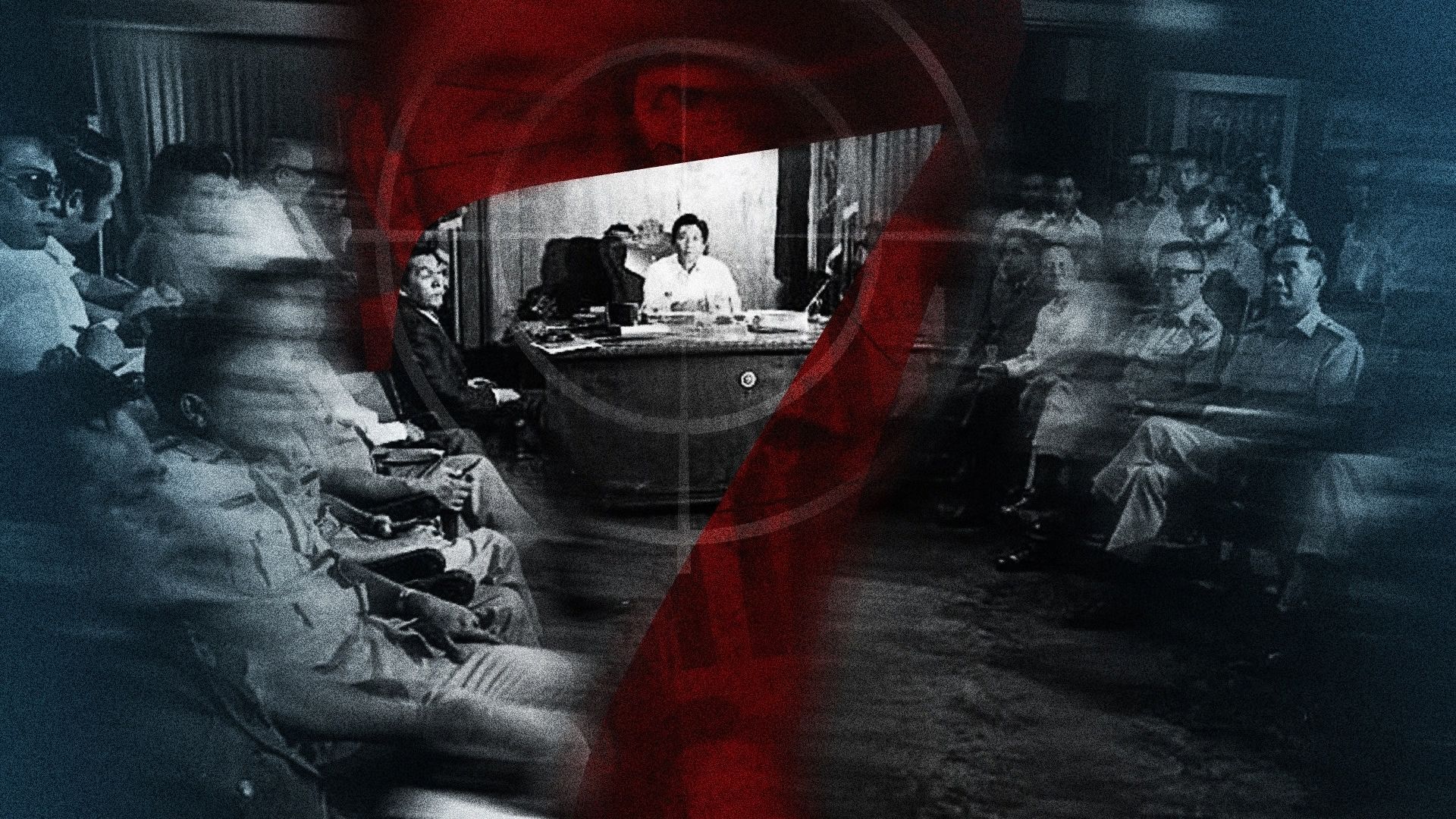
The 21st night of September, year 1972, was the pinnacle of 70s disco fever, oozing timeless dancefloor nostalgia—everywhere but the Philippines. Because September 21 was the beginning of the country’s darkest decade yet and a time of oppression and suppression.
September 21: The prologue of the Martial Law Era
Although martial law is not a foreign concept to Filipinos, Former President Ferdinand Marcos Sr.’s three-year-in-the-making declaration set precedents for some of the worst violations of human rights the Philippines has witnessed.
Beginning with the suspension of the Writ of Habeas Corpus, the Philippine Constabulary had vast freedom to arrest based on suspicion, which hastened the targeted arrest of activists and political rivals. In its wake, this increase in military power left 70,000 imprisoned and/or tortured, and 3,200 were allegedly killed. In 2019, only 131 of 786 “desaparecidos”, also known as victims of forced disappearances, have returned alive. The rest are either dead or nowhere to be found.
Worse, women bore the brunt of the administration’s most heinous crimes, enduring sexual abuse as a form of torture promoted by the state. This coincided with the tolerance of “bomba” films, which are erotic in nature, to avert people’s attention from “subversive” movies and Filipinos’ on-the-ground struggles.
The licensing and censorship of media networks likewise paralyzed free speech within the country, pushing journalists to continue in the form of alternative media called the “mosquito press.” Examples of such were “Ang Bayan,” “Balita ng Malayang Pilipinas,” and “Taliba ng Bayan,” all of which were compelled to operate underground, lest they be red-tagged or shut down altogether.
To top it all off, Marcos’ accumulation of power led to the collapse of both the Legislative and Judiciary branches with the birth of constitutional authoritarianism: a mechanism where the Executive could meticulously craft presidential decrees and executive orders, completely bypassing bicameral procedures, and exploit the law at will in the guise of “constitutional adherence.”
Thus, September 21 is far from the blissful disco escape popularized by the American band Earth, Wind, and Fire; instead, it has been indelibly marked by countless human rights violations, whose exact number of victims we still do not know today.
However, as we commemorate 54 years of Martial Law, we must not only treat hindsight introspectively—the “fortunate” 21 also carries a story of its own.
But what do lucky numbers and superstitions have to do with the Marcos lineage?
Seven for the Marcoses
Contrary to popular misconception, the Declaration of Martial Law was formally announced on September 23, 1972, though it was physically backdated to September 21, a number divisible by seven: auspicious in a way that screamed, “Marcos,” without question.
All constellations of events in the Marcoses’ lives revolve around the obsession with the lucky number “seven” of their patriarch, Ferdinand Marcos Sr., that will soon cause an unexpected doomsday for the Filipinos.
Former President Marcos Sr.’s yacht was given the hull number TP-777, a reference to the number of votes that won him the 1964 Liberal Convention against Emmanuel Pelaez. Notably, Cabinet Bill No. 7, which was passed by the then unicameral Congress, also formalized the 1986 Snap Elections out of public pressure and intent to maintain his political stronghold— ironically, they were also held on February 7 of that same year.
Primitivo Mijares, author of “The Conjugal Dictatorship of Ferdinand and Imelda Marcos,” divulged the former dictator’s “inner seven,” a group of close presidential allies who guided Marcos Sr.’s martial law rollout.
Prior to his presidency, there was an instance where “seven” appeared, though slightly far-fetched. In the case of The People of the Philippines vs. Mariano R. Marcos et al., it was General Register 47388 that acquitted Marcos Sr. and Quirino Lizardo of charges linked with the murder of Political Rival Julio Nalundasan, whose death was alleged by Calixto Aguinaldo to be at the hands of the Marcoses.
Fatefully, little did the Marcoses know that a number perfectly divisible would be equally, if not more, detrimental. In a twist of fate, the 21st likewise became their nightmare after the assassination of Former Senator Ninoy Aquino, one of Marcos Sr.’s staunchest critics and potential presidential rivals, in August of 1983 at the Manila International Airport (now Ninoy Aquino International Airport). It became the historic prelude to the 1986 EDSA People Power Revolution.
And like father, like son, some superstitions do run in the blood.
In 2015, President Ferdinand “Bong Bong” Marcos Jr. continued this numerological trend by being the seventh to file for his then-vice-presidential bid, commenting, “I guess the lucky seven for us Marcoses is still here. I think it’s a good omen.”
And though he lost to Former Vice President Maria Leonora “Leni” Robredo by a small margin in 2016, the “auspicious” number seven worked serendipitously six years later as he was the 7th presidential candidate on the 2022 ballot and later became the 17th president of the country.
With a string of dynastic political success tied to a single digit, seven becomes more than just a numerical representation—it attempts to vindicate numerologists, explain bizarrely patterned phenomena, and even mystify the actions of a kleptocrat.
Ironically, a fascist dictator’s obsession and reliance on numbers clearly displayed the administration’s true power and the lack thereof.
Seven is a universally “lucky” number
But the Marcoses’ superstition does not gatekeep the number seven’s peculiar luck. Across cultures and religions, seven is generally considered to be a sign of fortune.
For Confucianists, seven signifies “harmony,” where yin and yang are synchronized with the five elements of earth, water, fire, wood, and metal. In ancient China, seven-line poetry was also a trademark during the Three Kingdoms Period, popularized by Cáo Zhí’s Seven-Step Poem, which he wrote to reconcile with his brother.
For mathematicians, many of them deduced in a survey that seven was “appealing,” whether due to personal significance or a feeling of “friendliness and warmth.”
Similarly, seven being an odd number made it feel “more specific,” unlike even numbers such as “100,” which are usually used for rounding off. They likewise connect it to ancient Babylonian tablets, which also made use of the number system frequently despite their invention of the base-60 numeral system.
Biblically, seven is linked with “spiritual perfection,” notably harking back to the Story of Creation in Genesis when God rested on the seventh day. The number also appears multiple times in stories about forgiveness (“forgive 70 times seven times”), seven parables in the Gospel of Matthew, and the seven angels in the Book of Revelation. In contrast, six is often tagged as a representation of either the devil or mankind, one off from seven, as if showing how one’s power supersedes the other.
Truly, seven’s global reception as an auspicious number extends beyond political serendipity—its relevance in culture, society, and belief systems projects deeper significance and often prosperity. It’s just unfortunate that a number so lucky spelled misfortune for a decade of Filipinos under Marcos’ iron-fist rule: a tragedy no number can truly measure.