








Now Reading: Sinking to stagnation
-
01
Sinking to stagnation

Audly Lorenzo Aban
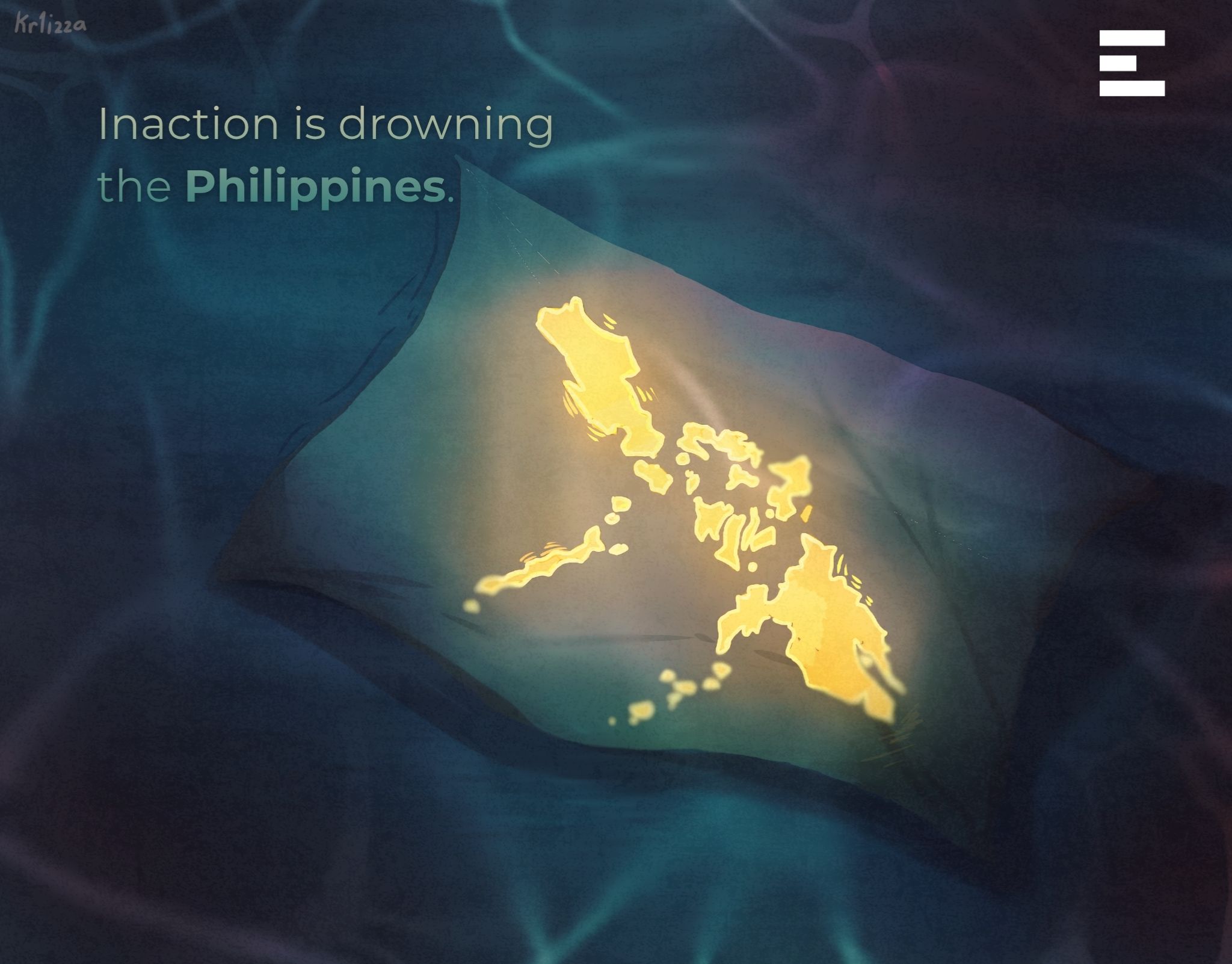
Faced with the wrath of countless typhoons, the Philippines has one foot on the ground and another buried beneath its underwater grave. If proper measures are still not put into motion, it’s only a matter of time before the country and its people completely drown under the ruins of their own making.
In a report from “State of the Nation”, a group of family members from Libacao, Aklan was shown lifting the coffin of their deceased loved one across a dense river, which took them more or less 10 hours to travel through. It was because the embalmer was unable to provide their essential services to the family, due to continuously progressing floodwaters that raised river levels and made traveling between communities exponentially difficult. This is only one of the imminent consequences dealt by impactful typhoons, which, even with the level of intensity that its persistent effects bring, continues to be overlooked and disregarded, which will inevitably worsen the problems at hand.
Like clockwork, the Philippines annually gets drenched in torrential floods and unrelenting rainfall. On average, around 20 tropical cyclones (TCs) enter the PAR every year, and about eight or nine of them move across the archipelago to yield landfall. This is alarmingly higher than most countries, signifying just how much danger Filipinos have to face every year. Whilst other countries commemorate events like Nutrition Month or Plastic Free July, the Philippines, on the other hand, is forced to begin this disastrous season with flooded streets and afflicted areas, since 70% of all typhoons develop from July through October.
In recent reports from the Philippine Atmospheric, Geophysical, and Astronomical Services Administration (PAGASA), supertyphoon Bavi, which first formed near the Western North Pacific Ocean, is expected to enter the Philippine Area of Responsibility (PAR) starting July 7, wherein it will be locally called ‘Inday’. The arrival of an intense tropical cyclone is no longer a new occurrence for Filipinos, but it serves as a vital warning that the typhoon season has once again begun. More importantly, it gives emphasis on what issues the country desperately needs to prioritize in order to ably protect itself from the harsh weather.
With the expected prevalence of these ravaging weather hazards, one can presume that the nation is wholly prepared to counter whatever risks come with typhoons and prevent any unwanted implications that may harm the countrymen. There’s also the idea that, because of its geographical location, the Philippines automatically becomes an easy target for typhoons, which is why adamant preparations are highly expected. Unfortunately, this is not the case. Even after decades of enduring the same grueling experience, it seems like Filipinos continue to keep their streak of lack of preparation alive and burning when it comes to disaster reduction.
Unlike earthquakes, which, up to this day, do not have accurate detection systems and often occur spontaneously, agencies are now highly capable of predicting the direction, magnitude, and possible route that typhoons come from and will cross through. Knowing this, Filipino communities rest assured that they will be warned about incoming tropical cyclones that could potentially enter the region. Still, identifying the hazard is utterly useless if there are no viable initiatives paired with it to ensure the people’s welfare and to cushion the disaster’s impending impact.
Across the nation’s history, there have been numerous cases where the effects of typhoons led to devastating complications, but to be frank, there is one precedent disaster that did not just lead to heavy rains and difficult weather, but it plummeted once-stable communities all around the country into rubble—the incident of Typhoon Yolanda. Known internationally as Haiyan, this groundbreaking typhoon hit the archipelago way back on November 8, 2013, where it sustained winds of up to 315 km/h and produced catastrophic storm surges that rippled all throughout the Philippines. Even after more than a decade, the resounding impact of Yolanda still lingers within the Filipinos’ collective memory, leaving marks of destruction both physically, to the affected victims, and figuratively, to the country’s past.
According to the United Nations Environment Programme (UNEP), Yolanda displaced 4 million citizens, affected around 14 million citizens, and led to about 6,000 deaths. Considering that this typhoon is regarded as the strongest and most destructive to ever strike the Philippines, the casualties have indeed piled into a massive sum. Yet again, Yolanda is only a single typhoon. Now, imagine dozens of these natural monstrosities consecutively bombarding the country every single year. Although this is an alarming revelation, what’s more disturbing is the fact that the country has already gotten used to this normalcy of typhoon disasters, and up until now, every Filipino can feel its destruction.
As typhoons enter PAR, its effects are not evidently felt yet, but when it reaches the landfall stage, the real battlefield arises. With strengthened rainfall and unending thunderstorms, the same, calm downpour of the rainy season that perhaps every Filipino has been well-acquainted with transforms into a bloodthirsty threat that engulfs communities and places serious risks on the foundational pillars that keep society afloat.
Just last year, the National Disaster Risk Reduction and Management Council (NDRRMC) reported that the impacted loss brought by tropical cyclones and the southwest monsoon (or habagat) rose to more than P9 billion, damaging more than 1,500 pieces of infrastructure countrywide. In this fragile economy, these constitute a massive loss, and not only are these losses hard to regain, but these will likewise take tons of effort and resources to rebuild and rehabilitate. Moreover, with crucial infrastructure being the preliminary frontliners that first crumble down, the lives of our countrymen become disrupted and stricken with danger.
In relation, typhoons also have direct detriments to the regular way of life of Filipinos. As a diverse blend of both rural and urban areas, communities in the Philippines have different means of encountering weather hazards. For those living in urbanized locations, the main problem would be the relentless flooding and damage of essential services. However, for low-lying communities, especially within areas that are prone to hazards, the issue ties deeply into their livelihoods, such as fishing and agriculture, which rely heavily on the surrounding environment.
Once these important resources get swept away by the typhoons, their lives are put at risk not only during times of calamity, but even during the aftermath, wherein they must endure the long-lasting impact it has to their families, their procurement of necessities, and their capability to sustain daily living. It also doesn’t help that the World Health Organization reports how people living near coastlines or cyclone-exposed areas have increased by 192 percent, exponentially increasing the potential morbidity and mortality rates worldwide. Rooftops aren’t the only ones that are torn down by the brutal weather; so are the futures of countless Filipinos who are closely tied to the lands being stripped of life whenever a typhoon comes strolling by.
At another perspective, typhoons also deliver cutthroat impediments to the nation’s economic state. The Asian Development Bank reports that after a low-damaging typhoon crisis, 1% of economic activity is decreased, whilst after more stronger typhoons, the reduction leads up to 3%. Though the numbers may seem to dwarf in comparison to much weightier statistics, any form of discrepancies with the Philippine economy must not be belittled. Every slight movement in our economic state can have disastrous effects once it trickles down into government agencies, local institutions, and even households.
The fact also remains that, due to the diversity of economic states and living experiences of Filipinos, the intensity of the typhoon’s impact also varies. For those with the proper resources and the means to ensure protection against such hazards, safety can easily be achieved. However, for the majority of Filipinos, who neither have the necessary assets nor the privilege to ask for such, their lives are placed into an unpredictable gambling game with typhoons, not knowing if they get to see the daylight the next day or if they will simply succumb to the disaster’s destruction. Though it feels frustrating to say so, it is unfortunately a reality for many of us, and even with years of fighting these battles, the nation seems to never learn.
Admittedly, the country does have various disaster risk reduction efforts in place, which are often spearheaded by the NDRRMC. Although proper warning systems are implemented, the actions succeeding the ‘sounding of the horn’ still lack proficiency. Using modern technologies, it’s already possible to identify which areas of the country are at most risk of typhoons. Even so, there are still numerous communities that get swallowed by disaster, and once they are spewed out, only debris and wreckage remain. There has never been a huge problem with determining where and when the typhoon will strike, but on the contrary, it’s the initiatives that must be applied to secure communities against them that are not monitored and implemented well.
The bigger irony, however, lies in the aftershocks of most disasters. When the hazard has already taken its course, or when communities have already crumbled into ruin, that’s the time when the heroes show up—donation drives, relief goods distribution, and rehabilitation campaigns. It’s a hard pill to swallow, but it’s the truth. Most of the time, proper protective measures become undermined and underestimated, with many focusing on the after rather than the before, when in fact it’s the latter that holds more importance.
Due to this deep-rooted sense of normalcy that Filipinos have adapted to typhoons and disasters, this has become the toxic mindset of many, but just as the saying goes, “Prevention is better than cure.” Though natural hazards are different from diseases, that mindset of early prevention and protection must still prevail, so that millions do not have to suffer against the dangers set by ravenous weather events.
In a recent briefing, the national government, through the Presidential Communications Office (PCO), emphasized the need for a ‘whole-of-government’ approach when it comes to handling the upcoming supertyphoon, pushing all government agencies to contribute to precautionary and prevention measures. Hopefully, this initiative is one that will lead to meaningful action, and not just remain as baseless statements. The government is the primary enforcer of regulations and initiatives that battle the typhoons’ impact, and as such, they must be able to implement more strengthened acts that serve to protect before the disaster and not wait until after the strike. By doing so, they can ensure that history doesn’t repeat itself once more.
The fact that our countrymen have become so disheveled by the typhoon’s lasting impediments to the point that simply traversing through areas to secure necessary services has become impossible is a frightening reality. Instead of mourning their loved one’s death, the family from Aklan had to push through the typhoon-exacerbated torrents simply to immortalize and commemorate the passed soul. For many, typhoons have become a mundane event in the Philippines, but it hits harder when we realize that its painful impact strikes through lives and sows disparities without rest nor repose.
The Philippines faces the typhoons’ wrath each year, and with it, the nation is gradually descending into a graveyard of its own demise. Nevertheless, once push comes to shove, the beginning of the typhoon season undeniably serves as a pulsating reminder of what actually needs to be done, by both the government and the countrymen, to ensure that our country doesn’t fall to its fate of sinking into stagnation.