









Now Reading: AI snakebite antivenom could save thousands — and it’s way cheaper than most think
-
01
AI snakebite antivenom could save thousands — and it’s way cheaper than most think
AI snakebite antivenom could save thousands — and it’s way cheaper than most think

Mark Aron Balbin
Who gets saved, and who gets left behind?
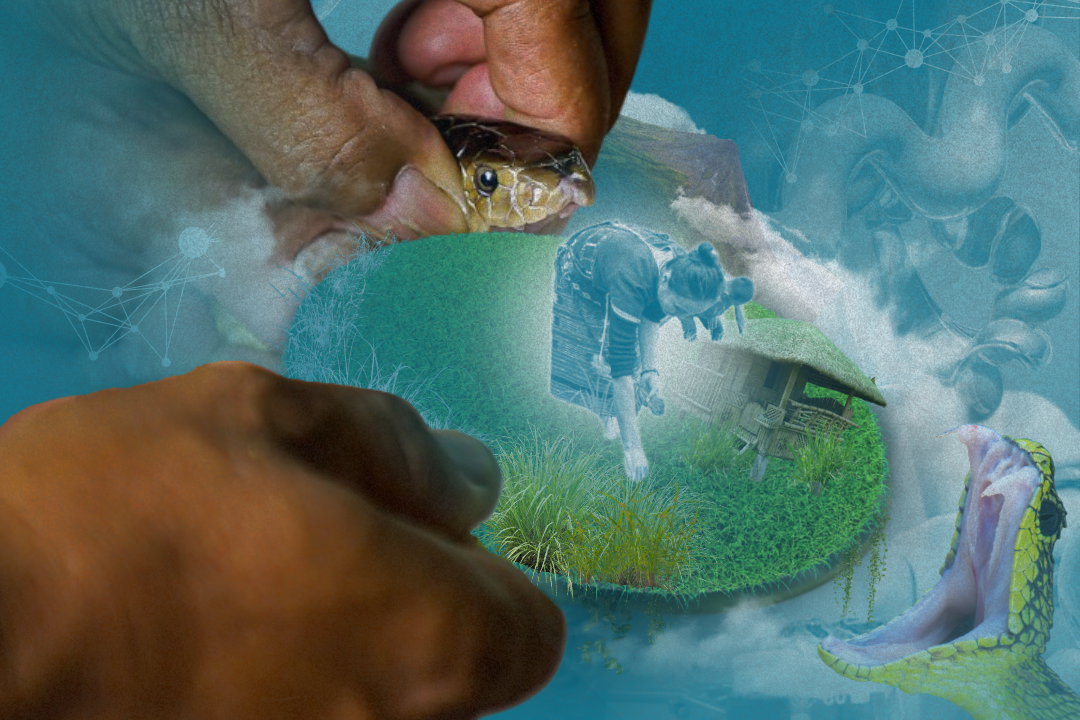
Snakebites remain one of the world’s most neglected health crises — despite being preventable, they continue to claim thousands of lives each year, especially in poor and rural communities.
But now, artificial intelligence may finally offer a breakthrough solution.
A team of scientists led by Timothy Patrick Jenkins from the Technical University of Denmark, alongside David Baker from the University of Washington, used AI to design proteins that can stop snake venom from ending a person’s life.
These proteins are created to attach to and block some of the deadliest toxins found in snake venom, particularly a group called “three-finger toxins.”
Toxins like 3FTx in snake venom attack the nervous system, causing paralysis in minutes.
Far worse, traditional antivenoms often struggle to neutralize it quickly.
To address this, scientists used artificial intelligence to design tiny lab-made proteins — called mini-binders — that can block these deadly toxins.
In lab tests, the AI-designed proteins helped mice survive high doses of venom, with up to 100% success in some cases.
What sets the old and new apart is their stability, affordability, and scalability.
Unlike current antivenoms, these proteins are heat-stable and easier to produce, which could make them more affordable and accessible for low-resource areas where snakebites are most common.
Snakebites kill over 80,000 people every year, mostly in rural communities where access to hospitals and effective treatment is limited.
What is even more concerning is that victims often include children and farm workers who cannot get help fast enough, leading to death or lifelong disability.
Forgotten lives in the countryside
In the Philippines, snakebites are a quiet yet deadly threat.
Every year, thousands are bitten, but many cases go unreported.
Those most affected are the poor — farmers, children walking home from school, and families living hours away from the nearest health center.
A single bite can lead not only to death but also disability, financial ruin, and long-term trauma.
According to local reports, many rural hospitals often run out of antivenom or don’t have any at all.
Victims are forced to rely on traditional remedies or wait for transport, which is often too late.
The Department of Health has acknowledged that access to treatment remains a major issue, especially in far-flung areas.
This is where AI-designed antivenoms could make a difference.
By creating proteins that are cheaper, more stable, and faster to produce, they offer a real chance to stop snakebite deaths in communities that are usually left behind.
For families who live in fear of venomous snakes with no reliable treatment nearby, this innovation could mean hope — and survival.
A beam of light
Today, antivenom treatments can cost more than a month’s salary in some countries, and they need to be refrigerated and administered by trained medical professionals.
In contrast, these AI-designed proteins could be made in large quantities, stored at room temperature, and possibly distributed to areas with limited access to healthcare.
Since they don’t rely on animals for production, they could also reduce the risks of allergic reactions sometimes caused by traditional antivenoms.
Even so, the current version of the AI-designed proteins only targets one type of toxin, not the full mix of harmful substances in real snake venom — as it is still in its early stages.
While human trials are still far off, the researchers hope that their study could lead to treatments that are more affordable and easier to access for low-income communities.
One bite at a time
For remote and low-income communities long forgotten in global health priorities, AI-designed antivenoms could finally bring accessible, affordable treatment within reach.
In places where one snakebite can steal a life, a livelihood, or a loved one — this innovation might just be the hope that they have been waiting for.