







Now Reading: Drone-incorporated rice planting process introduced to Laguna
-
01
Drone-incorporated rice planting process introduced to Laguna
Drone-incorporated rice planting process introduced to Laguna

The Philippines, a country heavily reliant on rice as a primary carbohydrate served at the dinner table, is reported by the International Rice Research Institute (IRRI) to have only 4.7 million hectares of land allotted as rice fields.
Highlighting the need for more ways of meeting the local demand of this agricultural gold, the Field Agricultural Extension Services-Office (FAES) of the Provincial Agriculturist-Laguna in collaboration with IRRI introduced drone-assisted rice planting—an efficient, innovative improvement to local agriculture practices.
Modernizing PH agriculture
FAES highlights that the introduction of these drones to the local agriculture community aims to speed up planting time, introduce more sustainable farming practices, and ensure more accurate fertilizer and seed placement.
Remaining a country most vulnerable to climate-driven agricultural losses, the newly integrated drones are said to help strengthen rice planting.
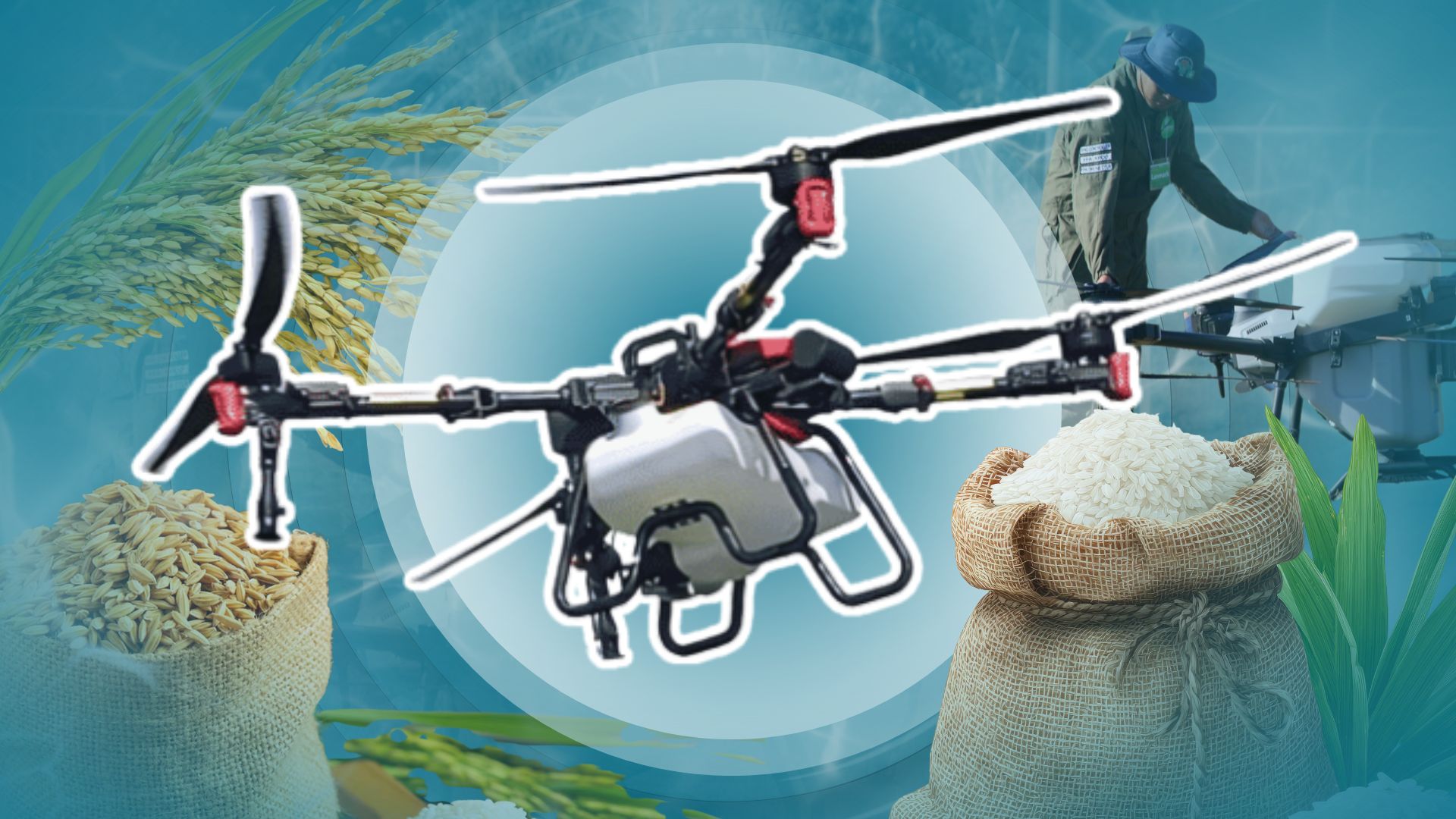
First introduced to the town of Los Baños, Laguna, the drones are said to be able to carry up to 50 kilograms of materials such as fertilizers, seeds, and pesticides.
In about 10 to 12 minutes, the drones, depending on their speed, altitude, and other conditions are capable of covering one hectare of land and perform a single task.
Technological manpower
Maximizing its energy, the drones can be charged through a generator in around 10 minutes.
To improve and ensure the quality of operations, these drones are said to have safety features, including a radar capable of sensing obstacles 10 meters away.
Additionally, it also includes Real-Time Kinematics (RTK) technology, which allows precise rice planting of up to one to two centimeters.
This new technology-driven method of planting rice could easily speed up the average time to plant rice seedlings compared to traditional mechanical machines such as the row machine, which is estimated to take a day to complete at least two hectares of land.
Individuals operating the drone are required to hold valid pilot licenses as well as additional certification in handling the pesticides used.
The drone-usage will strictly be implemented only for seed and pesticide application.
The future is rice
This drone application is not the first effort done by IRRI to the Philippine rice market.
Overcoming the rice shortage challenge of the country, IRRI claims to collaborate with several government agencies and research institutions in introducing and developing various rice varieties that are high-yielding and climate-resistant.
Standards introduced by the institute include rice varieties that are able to survive and thrive in irrigation, stress-prone, rainfed, and upland areas.
Furthermore, initiatives such as innovative farming practices, water-saving technologies, and smarter use of agricultural inputs, all with the goal of conserving and utilizing genetic diversity, are also implemented.