








Now Reading:
Marikina students bridge health monitoring, emergency response with AI-powered VitalBand
-
01
Marikina students bridge health monitoring, emergency response with AI-powered VitalBand
Marikina students bridge health monitoring, emergency response with AI-powered VitalBand

Deryn Theone Hipe and Diane Joy Galos
As typhoons flooded streets and earthquakes rattled countless communities across the Philippines, three students from Marikina Science High School saw an opportunity to turn innovation into preparedness.
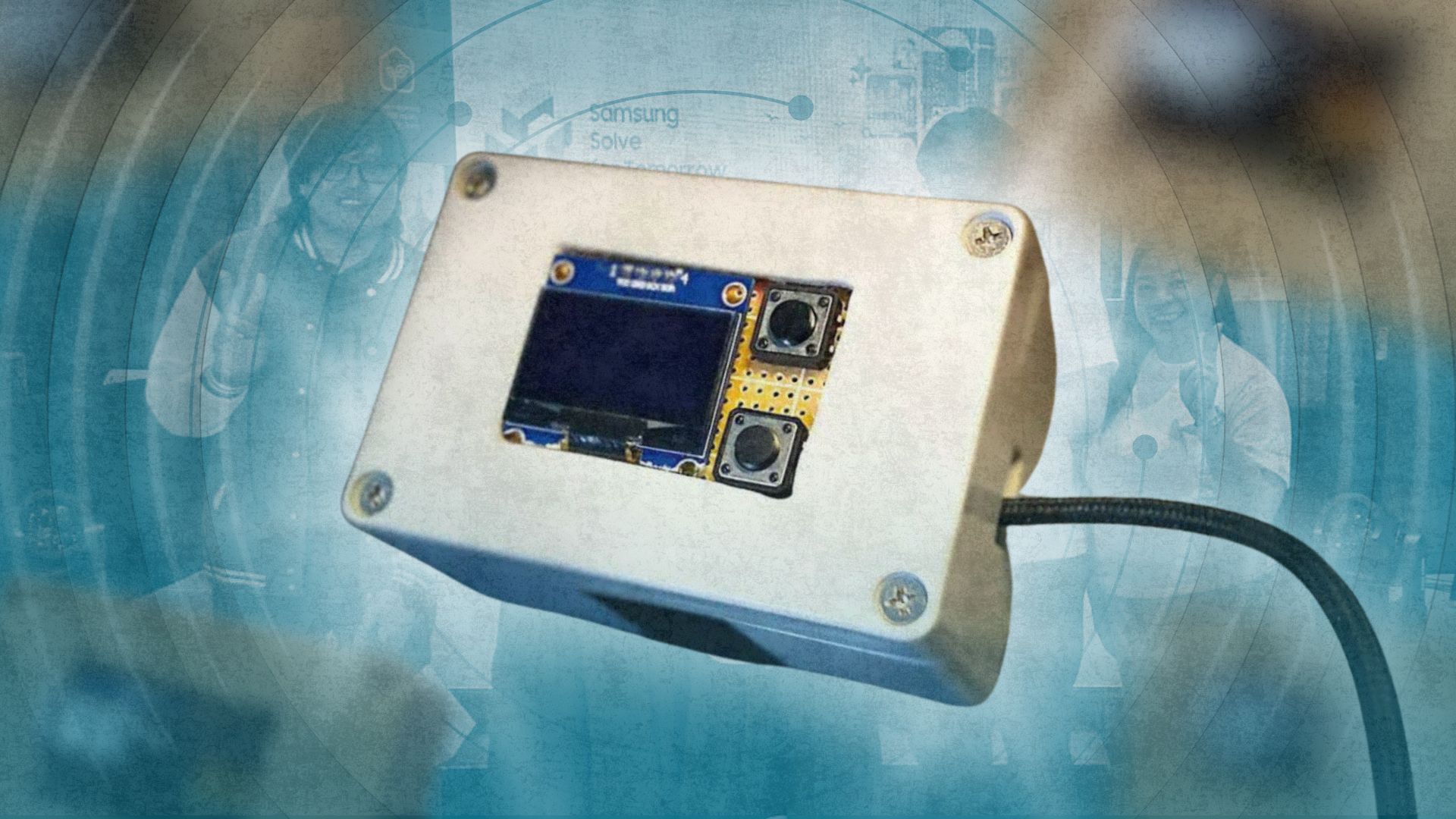
Their answer was VitalBand, a Galaxy AI-powered wristband developed by Julianne Vienna Tambaoan, Zoey Laylah Rivero, and Zyskh Gylyr Roca. Designed to combine vitals tracking with disaster readiness, the device seeks to help users access critical information in times of crises.
Recognizing its potential, the team brought VitalBand beyond their school grounds and into national competitions, where it gained recognition. The project emerged as a Top 10 finalist in Solve for Tomorrow 2025, an innovation competition hosted by Samsung that promotes environmental sustainability, social change, and AI-enabled solutions to community problems.
It later won the Entry-Level Best Display Board award at Brainiac: Clash of the Sci-Tech Champs, an inter-school quiz bowl and robotics competition hosted by Our Lady of Lourdes Hospital.
Where health data meets disaster readiness
VitalBand is a wearable system made to track vitals and send SMS emergency alerts with the help of Samsung’s Galaxy AI.
“Yung idea na nabigay namin sa Samsung is may iba’t iba siyang emergency buttons for different emergencies—yung fire, yung earthquake, yung flood, yung typhoon. Pag pinindot yung specific button, nag a-alert siya sa mga nearby responders,” Rivero shared.
(The idea we gave Samsung is that there are different emergency buttons for different emergencies—fires, earthquakes, floods, typhoons. When the specific button is pressed, it sends an alert to nearby responders.)
Unlike conventional fitness trackers that primarily monitor health data, VitalBand integrates vitals monitoring with disaster-response functions. Through dedicated emergency buttons and SMS-based alert systems, the device is designed to connect users with responders during emergencies, particularly in situations where Internet connectivity may be limited.
The invention was inspired by the team’s realization that students are often most vulnerable outside school grounds, especially while commuting. The increasing frequency of natural disasters in the country also highlighted the need for practical safety tools that could help communities during emergencies.
From this awareness, the students developed a prototype of the VitalBand, with an estimated production cost of around ₱3,500. Although it began as a research project, they hope future versions can become more affordable and accessible, especially for students and communities vulnerable to disasters.
From the ground up
Behind the recognition, however, was nearly a year of experimentation, technical setbacks, and continuous learning for the young researchers. The young innovators admitted that their biggest challenge was learning how to use and integrate different technological components into a single working device.
“We started from scratch and had no background in robotics, so understanding and combining all the technologies into one system was our biggest hurdle,” the team shared.
The researchers also encountered technical limitations, particularly with the GPS component, which required repeated testing and adjustments to improve its performance. They also identified the prototype’s bulky design as a challenge and hope to develop a thinner, more compact version in future iterations.
Beyond engineering problems, the students faced academic sacrifices as they had to miss classes and balance school requirements while building the prototype. The development of VitalBand took them nearly a year, beginning in the summer of Grade 9 and continuing until the end of Grade 10.
Despite their limited experience, the team sought guidance from experts to turn their concept into a reality. The students received technical support from the Department of Science and Technology, which introduced them to the fundamentals of building the device and refining their design. Samsung also played an important role in the project’s growth by providing a mentor who guided the team throughout the development process.
Towards a wider impact
Looking ahead, the researchers hope that VitalBand will continue evolving beyond the competition stage and into a practical solution for communities across the country.
“We want to collaborate with Samsung again for mentorship and technological support, distribute the product nationwide, and eventually bring it to the global market,” the team said.
The students acknowledged that producing the device at an affordable cost remains a challenge for their intended users. They believe that government assistance will be necessary to make the technology accessible to more Filipinos.
At present, the team said that plans for commercialization largely depend on financial support from government agencies. The researchers also revealed that they personally covered the expenses needed to produce the VitalBand prototype.
For the team members, the journey taught lessons that went far beyond science and technology.
“Participating in these competitions is a privilege because you learn so much about yourself and others while solving real-world problems,” said Tambaoan.
She added that the experience helped her develop confidence under pressure and strengthened her appreciation for research as a field that encourages curiosity and exploration.
For Rivero, the project cultivated a deeper understanding of the communities affected by the issues they sought to address.
“I learned to become more connected to the problems we researched and to stay passionate about finding solutions,” Rivero said.
The team also hopes that their journey will encourage more young Filipinos to pursue science and innovation despite uncertainty.
“Don’t be scared, even if you don’t know what you’re doing at first, and focus on learning and overcoming challenges instead of thinking they’re impossible,” said Roca.
Rivero encouraged aspiring innovators to remain committed to the purpose behind their work.
“Don’t forget why you started your research or why you came up with your idea, and keep going because you want to solve a problem,” she said.
Tambaoan hopes that VitalBand will inspire more students to seize opportunities and pay closer attention to the challenges faced by Filipinos.
“I hope more people are inspired to grab opportunities, learn more about themselves, and give greater value to the problems experienced by people in our country,” she said.
The researchers also believe that stronger government investment is needed to sustain student-led innovation in the Philippines.
“I hope the government shows more interest in the research being done by students because we didn’t really feel that support ourselves,” Tambaoan said.
She pointed out that the team had to shoulder many of the project’s expenses despite the broader responsibility of supporting scientific research. The students also called for better access to funding, resources, and research facilities for young innovators across the country.
Their experience with VitalBand shows not only the creativity and determination of the Filipino youth but also the challenges that many student researchers face in transforming promising ideas into technologies that can benefit society.
As VitalBand moves toward further development, its creators hope that stronger institutional and government support will help more young innovators turn ambitious ideas into life-saving solutions for the nation.