









Now Reading: People are now looking at AI as their future love partners
-
01
People are now looking at AI as their future love partners
People are now looking at AI as their future love partners

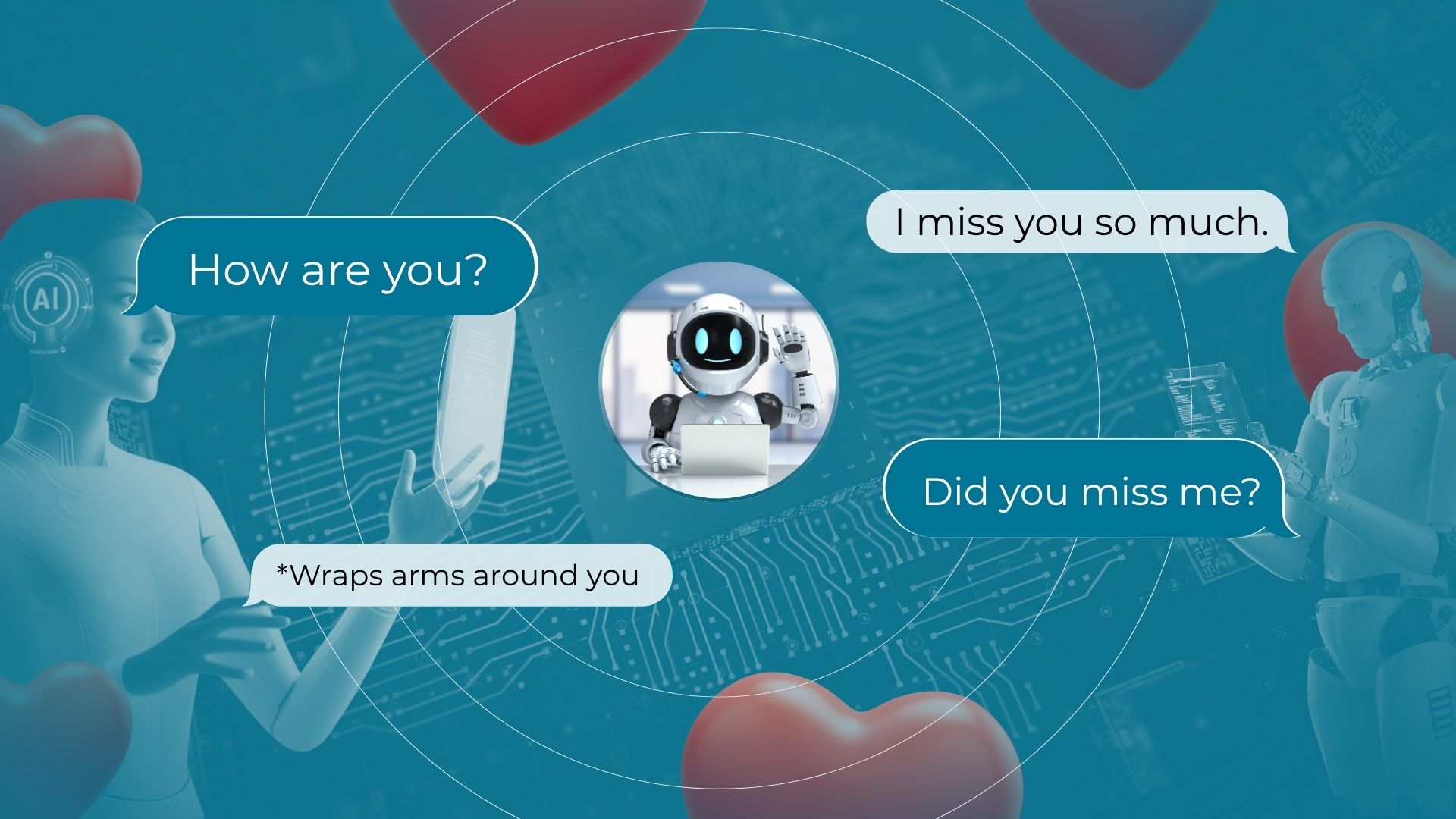
Romances used to come in love songs and doorstep visits, but now, a message notification seems like a love letter being delivered and sharing spotify playlists became the modern serenade.
These are proof of how love has adapted through times. And in the increasingly digital world, people are now receiving the sweet gestures online—from the good morning texts, the check-ins after a long day, to sharing secrets in calls before sleep—except for some, the suitor does not exist.
Not exactly unreal but definitely not alive. Instead, it’s an artificial intelligence (AI) companion that is basically programmed to be more human. It can imitate empathy, remember every detail, and acts like an ideal romantic partner.
And millions of people are falling for it.
The numbers behind the shift
People used to treat AI companions as a niche interest in the internet, and maybe a topic to raise an eyebrow at. However, recent studies tell another story.
Globally, AI companion apps have been downloaded over 220 million times by mid-2025. Also, the market has hit roughly USD 36.8 billion in 2025 and expects growth of up to USD 48.0 billion in 2026. These numbers are not just increasing out of curiosity alone, it’s happening because more people are getting hooked.
Just in 2024, users of Character.ai spend an average of 75 minutes per session, which means that some people stay online not just for updates in social media, but rather, chatting with someone who’s not even real. And disturbingly, this might have grown significantly in the following years.
Moreover, AI companions like Replika.ai, Character.ai and China’s Xiaoice now have hundreds of millions of emotionally invested users, while some estimates suggest the numbers may already exceed 1 billion.
As more users bite to AI’s appeal, it raises a question as to what exactly are people getting from these interactions that real life isn’t giving them?
Why humans fall for machines
It rarely starts as a search for love.
They type in a random request or a question then get a response not with a robotic tone, but rather a warm one. The exchange then feels natural, until it turns into a conversation, then disturbingly, a daily habit.
However, behind the screen, AI only does what it is best at: harvesting data. Every secret shared is actually used to tailor a responder that fits uniquely to every user.
So basically AI doesn’t act on its own accord, it responds based on personalization, not emotion. It seems to mimic intimacy because that’s what it was fed to.
Alarmingly, the ones falling fast are the Gen Z. As per a 2025 TechCrunch study, 72% of teens have used AI companions, 52% of which are regular users.
Then millennials follow closely, particularly those in their late 20s and early 30s. They’re a group who’s at a strange middle ground. They still remember how dating was like before it was mediated by screens but they’ve also witnessed how love became a feeling you get from the artificial.
As people who get to experience both worlds, they feel a different novelty with AI companions than the younger generation.
A 2025 AXA Mind Health report revealed that Filipinos aged 18 to 34 are experiencing higher levels of stress, anxiety, and depression than their global peers. These are usually the adults overwhelmed and stretched thin from the never-ending cycle of providing for their families.
So as they get exhausted, they reach for comfort to what’s readily available. And AI capitalizes on this vulnerability.
Moreover, in the Philippines where mental health support remains lacking, the cheapest consolation is available in screens. But it doesn’t just end there.
People are not just venting to chatbots, they’re entering relationships with them. And disturbingly, AI is not just a service that the lonely only avail.
The dating scandal with AI
When imagining AI romance, what usually pops in mind is someone single in real life. However, the data shatters that assumption.
A 2026 study from Brigham Young University’s (BYU) Wheatley Institute and the Institute for Family Studies surveyed 2,431 people aged 18 to 30. Then they found out that 1 in 7 young adults who are dating, engaged, or married keeps interacting with AI to simulate a romantic partner.
Another 20% to 30% revealed to have experimented with one at some point. These are people who actually get to experience love from a real human, so why AI?
As people get busier, romance is not always the first priority. Adult responsibilities come first—from the busy work schedule, managing family finances, and the relentless act of providing.
In that exhaustion, emotional distance grows quietly, making AI enter the scene. It literally becomes a companion that is always present, listens, and never judges.
Furthermore, the BYU study highlighted that this secret relationship with AI might have resulted in damages: from lower relationship stability, weaker communication, and higher likelihood of breaking up or divorcing.
Nevertheless, these are only correlational not causation. The results only show that AI is influencing the way humans treat real relationships, whether they’re taken or single.
Comfort or cause of concern?
A Harvard Business School study revealed that AI companions do have a positive side to it.
Based on a four-week randomized controlled trial, researchers found out that AI companions can modestly reduce loneliness, especially when interacting through voice messages. Also, participants felt less isolated as they spoke more with AI than those who didn’t.
This clearly makes sense. For those who are genuinely alone, like the elderly, the homebound, and the socially anxious, having someone that listens to them, even if it’s from an artificial entity, is much better than being isolated and sitting in silence.
However, the same study also showed the other side of the coin. Heavy daily usage of AI companions might actually result in greater loneliness and less real-world socializing. Basically, too much of everything is bad, even when finding comfort in AI.
Moreover, another study published in PubMed Central (PMC) surveyed 1,379 college students and found that using AI companions is linked to heightened depression among participants struggling with loneliness.
The effect went like this: those with depression turned to AI more often for consolation, but the heavier use, the deeper the withdrawal from real life became.
Nonetheless, the middle ground of using AI companions is that researchers are not saying it is good or bad. Rather, they’re saying it depends on how much: in moderation it can help but heavy use might deepen the problem.
The uncomfortable truth for the dependency dilemma is that AI companions are already reshaping the way humans spend their time online—whether for updates, comfort, or romance.
However, what needs urgent attention is despite the evidence, research is still catching up, policies do not exist yet, and more importantly, the app developers have no incentives to slow down.
Even so, the danger is that people are already aware that machines cannot give real love. They’re not fooled, but they’re staying because the most readily available intimacy they can get is from the kind of romance that never asks anything in return and never gets tired.