



Now Reading: This developer is weaving Baybayin back into the fabric through SYLLA
-
01
This developer is weaving Baybayin back into the fabric through SYLLA
This developer is weaving Baybayin back into the fabric through SYLLA

Before history was bound in books and archived through narratives, it lived in the hands and voices of the people who carried it.
Stories were passed from one generation to the next, names and words were etched into bamboo, and knowledge found its way into the rhythms of everyday life. Among these traces was Baybayin, an ancient writing system that once formed part of how Filipinos recorded and expressed their world.
Centuries later, that legacy is finding its way into a new medium, one that fits in the palm of a hand. Somewhere between heritage and technology, Baybayin is once again being given a space to speak.
Lost in translation
Heritage does not always disappear all at once. Sometimes, it frays quietly—the way a word is no longer spoken, a script is no longer understood, or a story has no one left to tell it.
The country is home to roughly 183-187 living languages, yet many face varying degrees of endangerment. The University of the Philippines-Diliman’s Katíg Collective maps endangered Philippine languages according to their current status, identifying 30 as threatened, four as shifting, wherein communities are gradually switching to another language; four as moribund, with languages no longer passed down to younger generations; five as nearly extinct, one is dormant, and two are already extinct.
Language loss is not merely the disappearance of words from everyday speech. It can also mean the gradual severing of communities from the stories, traditions, and identities carried by those words.
The same question of preservation extends beyond spoken languages and into the scripts that once gave them written form. For Baybayin, its survival in the present depends not only on remembering that it existed, but on finding ways for a new generation to encounter it.
Studies by the Komisyon sa Wikang Filipino have likewise identified as many as 40 regional or indigenous languages facing severe endangerment. With every language that falls silent, a distinct way of naming, remembering, and understanding the world risks disappearing with it.
And while languages struggle to survive in the spoken world, their written histories woven alongside them face a similar challenge.
Writing heritage anew
For Nikki “Nikz” Dela Cruz, a Master of Science in Information Technology graduate of the Polytechnic University of the Philippines (PUP), that challenge began with a personal encounter with Baybayin in 2016.
A history enthusiast, former college professor, software engineer, and founder of CliqAlly, a local web development company, Dela Cruz initially approached the script out of a desire to connect with a part of Filipino heritage. What followed, however, was a difficult search through inconsistent charts, varying stroke styles, and conflicting interpretations scattered across the internet.
It was as though Dela Cruz had found an old pattern but no instructions for how its threads were meant to cross.
Baybayin was finding new life online, but its growing visibility was not always accompanied by understanding. Words were often rendered correctly, with phonetic nuances reduced or overlooked. Even a familiar word such as masaya, for instance, is sometimes written as Ma-A-Sa-A-Ya-A instead of the more historically appropriate Ma-Sa-Ya.
“There is a certain performativeness around using Baybayin today—people want to use it for tattoos or personal projects, but many don’t have the resources to properly learn it first,” Dela Cruz reflected.
The problem, then, was not a lack of interest but rather a lack of accessible ways to learn.
For the history enthusiast, the answer was not to keep Baybayin as a relic sealed away from the present. It was to bring the thread back into people’s hands, to give them a way to understand the script before they use it, and to reconnect with the history woven into every word.
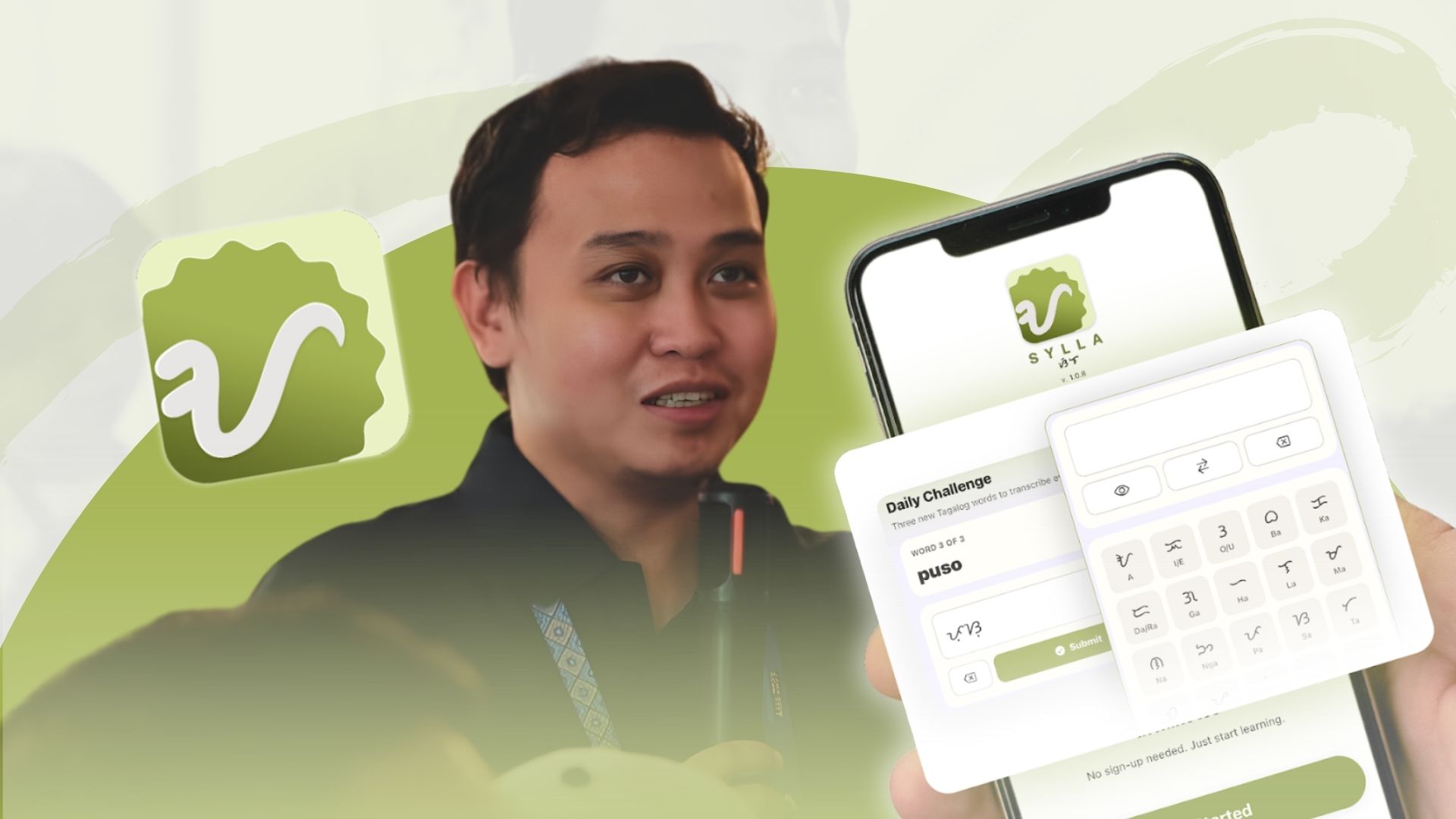
Drawing from his background in software engineering and User Interface/User Experience (UI/UX) design, he developed SYLLA, a free mobile application designed to make learning Baybayin more accessible while encouraging users to understand the script beyond its visual appeal.
“That’s also why I chose the tagline, ‘Learn Baybayin in minutes.’ People have shorter attention spans these days, and I understand that learning Baybayin is often more of a side interest or personal activity rather than something people study academically,” he added.
Instead of simply converting Latin characters into Baybayin, SYLLA guides users through 18 short lessons that introduce the script step by step. An interactive practice keyboard allows learners to apply what they have learned, while a stealth mode removes Latin labels to test their recall. A 15-second Daily Challenge further turns cultural learning into a habit that can be picked up in the spaces between everyday routines.
Its accessibility extends beyond the lesson themselves. SYLLA is completely free, without intrusive advertisements or mandatory subscriptions. Its operational costs, including server fees and cross-platform maintenance for iOS and Android, are funded entirely out of Dela Cruz’s pocket, supplemented only by optional user donations and future community workshops.
“I’ve always believed that learning Baybayin should be free and accessible, especially for Filipinos who want to reconnect with our ancient writing system,” the developer shared.
Keeping the threads within reach
For Dela Cruz, accessibility is not simply about making the app available. It is about lowering the barrier between curiosity and understanding—making sure that someone who wants to pick up the thread has a place to begin.
This commitment to accessibility caught the attention of prominent cultural advocate Howie Severino, who validated the platform at HistoEx 2026, a flagship pop-culture-style mini-convention by the National Historical Commission of the Philippines (NHCP). After testing it himself, Severino noted its technical accuracy, intuitive layout, and grasp of the script’s subtle nuances.
For something that began with the rediscovery of an old writing system, SYLLA ultimately asks a much larger question—what happens when Filipinos are given the chance to pick up the threads of history themselves?
Perhaps preservation should not always originate within archives or museums. Sometimes, it sprouts with someone learning how to write a word again, and choosing not to let it disappear—stitching the hands that hold the very threads that weave our lingua franca.