









Now Reading: Tested by NASA, Filipino students’ Double Gyroscope experiment reaches space
-
01
Tested by NASA, Filipino students’ Double Gyroscope experiment reaches space
Tested by NASA, Filipino students’ Double Gyroscope experiment reaches space

Jeo Angelo Ampis
While the Earth slept beneath gravity’s pull, young minds soared thousands of kilometers high, far beyond the halls of their school.
An experiment of third-year astrophysics students from the Rizal Technology University (RTU) called Double Gyroscope was successfully tested by the National Aeronautics and Space Administration (NASA) in the International Space Station (ISS) during the Asian Try Zero-G (ATZG) competition 2025.
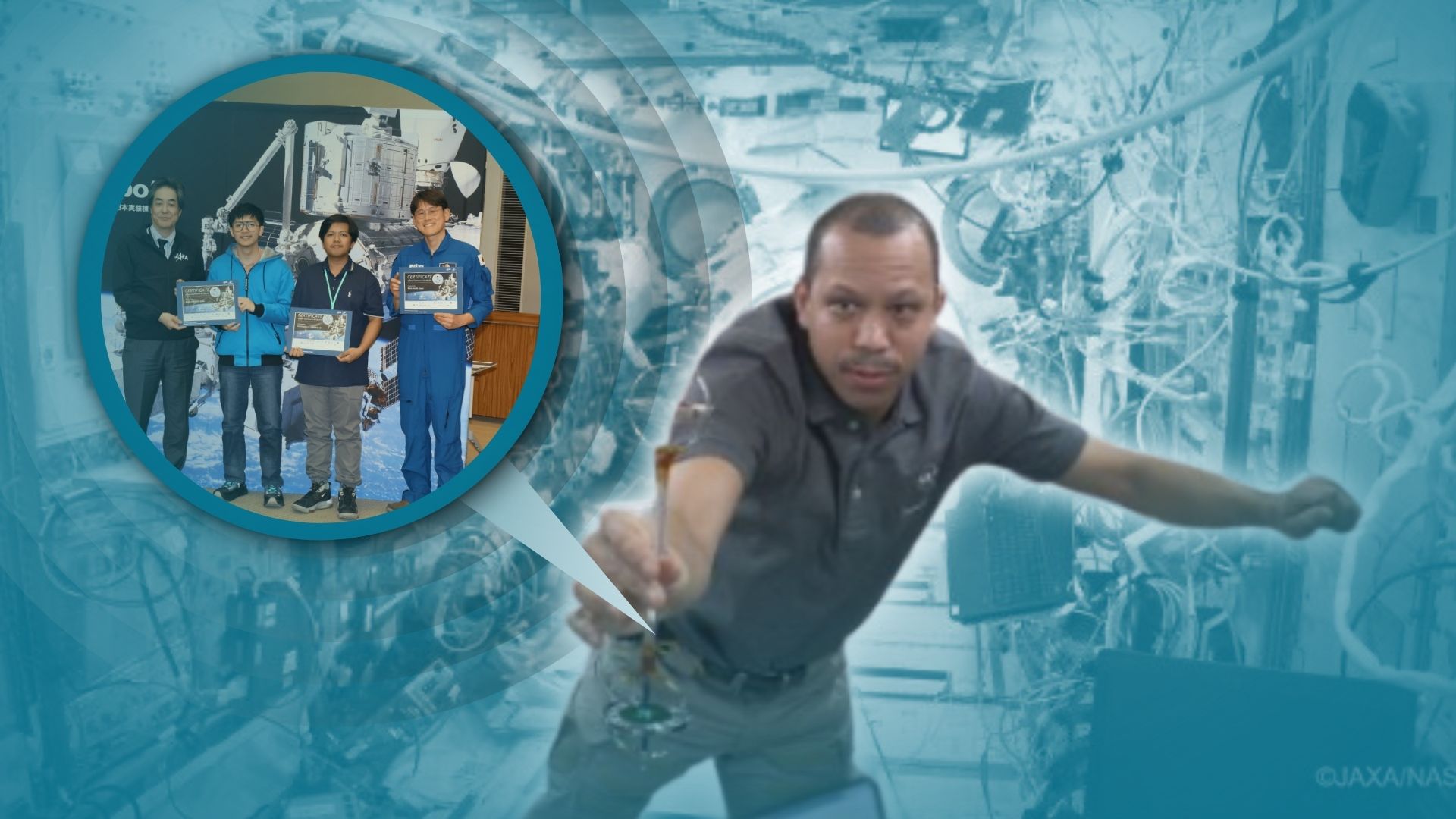
Double Gyroscope, developed by Christopher Tumamac, Ryan Andrew Doña, and Rose Ann Cezar, is an instrument made of two gyroscopes—A fast-spinning wheel-like device used in airplanes, ships, or spacecraft to maintain balance and determine direction—attached on both ends of an acrylic stick.
“The (RTU) students hypothesized that when the gyroscopes spin in opposite directions, their motion may cancel each other out, causing the system to appear stable or nearly motionless. However, small differences in spinning could slowly change the direction the device points to over time,” PhilSA stated.
Performed by NASA astronaut Christopher Williams in the Kibo Module of the ISS, the RTU students’ device works by spinning the two gyroscopes either in both or opposite directions to observe how their motion affects its stability and movement in an environment where gravity is nonexistent. However, their experiment goes far beyond just observing its movement in space, as the result of their project may help scientists to better understand how satellites or spacecraft maintain their stability and direction in space, which can possibly help improve future space technology and missions.
Moreover, Double Gyroscope was selected as one of the Philippines’ three official entries among 89 submissions nationwide during the local call organized by the Philippine Space Agency (PhilSA).
The entries were later submitted to the Japan Aerospace Exploration Agency (JAXA), the host of ATZG, which selected the finalists from across the Asia-Pacific region.
Along with the country’s entry, 10 other student-developed experiments from Thailand, Japan, Taiwan, Singapore, Australia, Bangladesh, Malaysia, and the United Arab Emirates were successfully conducted aboard the ISS.
For years, the Philippines has consistently produced Filipino students who have represented the country in the field of science and technology. With PhilSA helping to curate the stepping stones of these students, Filipinos were not just able to bring pride to the country through talent but also through intelligence. Continuously inspiring young yet bright minds to contribute towards the success of the world.
“We are very thankful for this opportunity given to us by PhilSA, and I hope in the next batches of ATZG, more Filipino students will apply so they can also experience proposing an experiment in zero-gravity, see their experiment carried out, and learn a lot,” the RTU students expressed.
The space may be thousands of kilometers above the planet, and some dreamers may stay on Earth, feet tucked and still grounded. But for these students, dreamers are the ones who remain on the ground, while their minds build something that reaches beyond what the cloud bounds.